EDITOR'S NOTE:
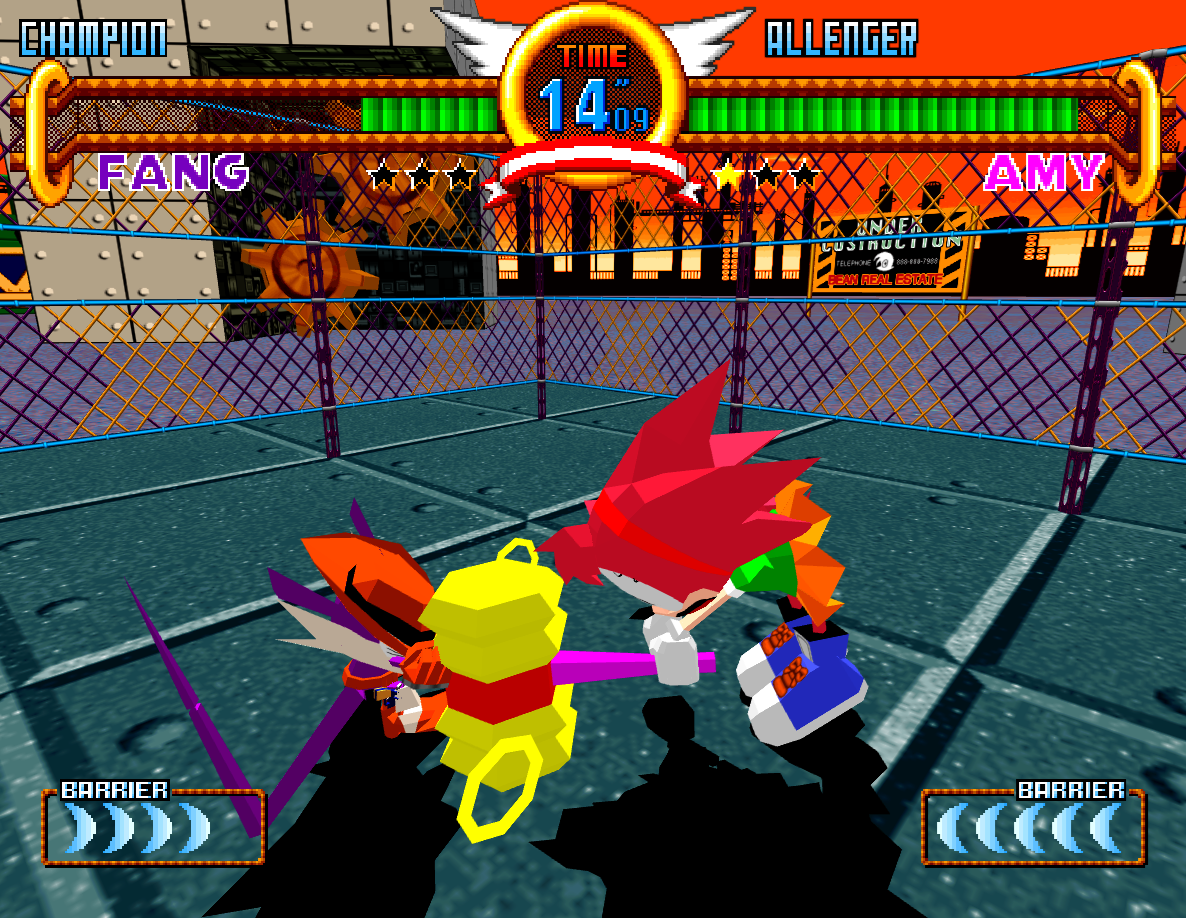
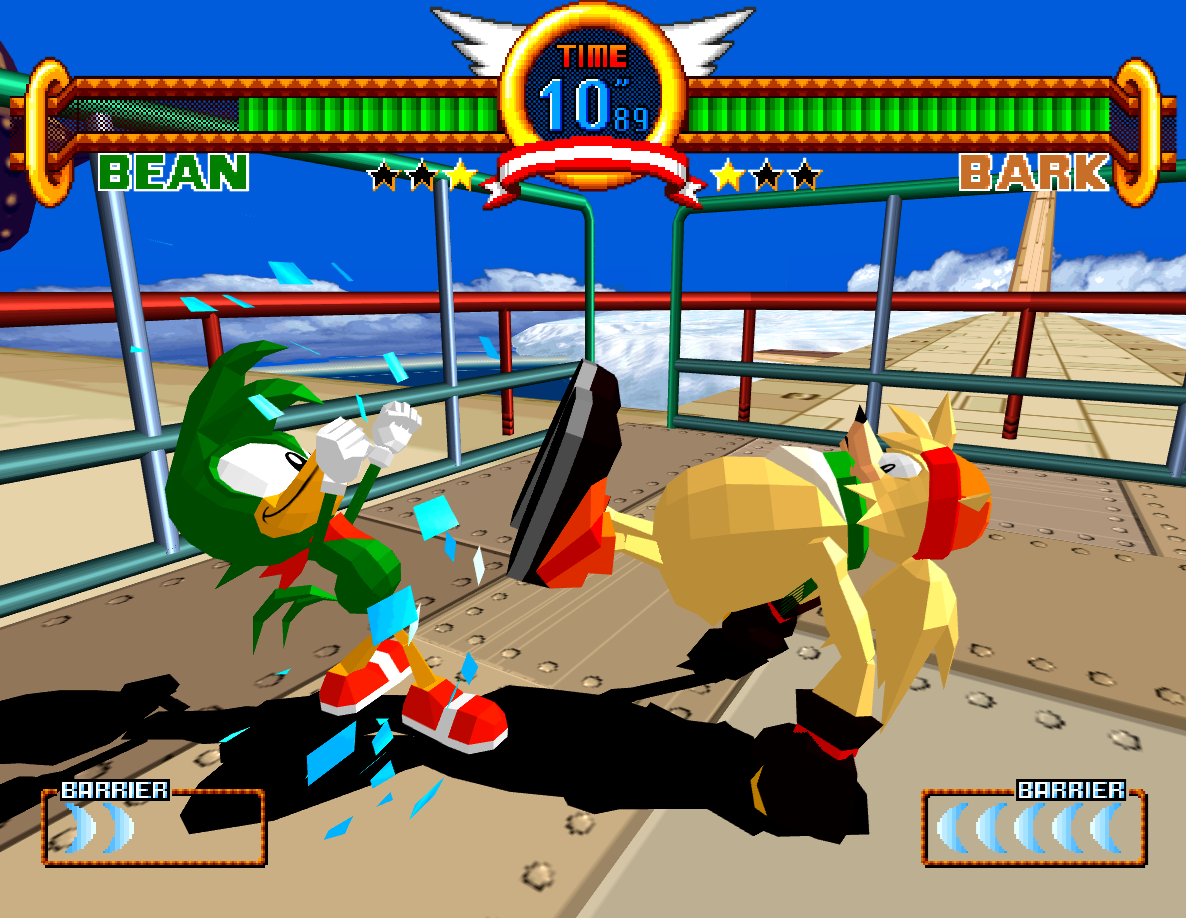
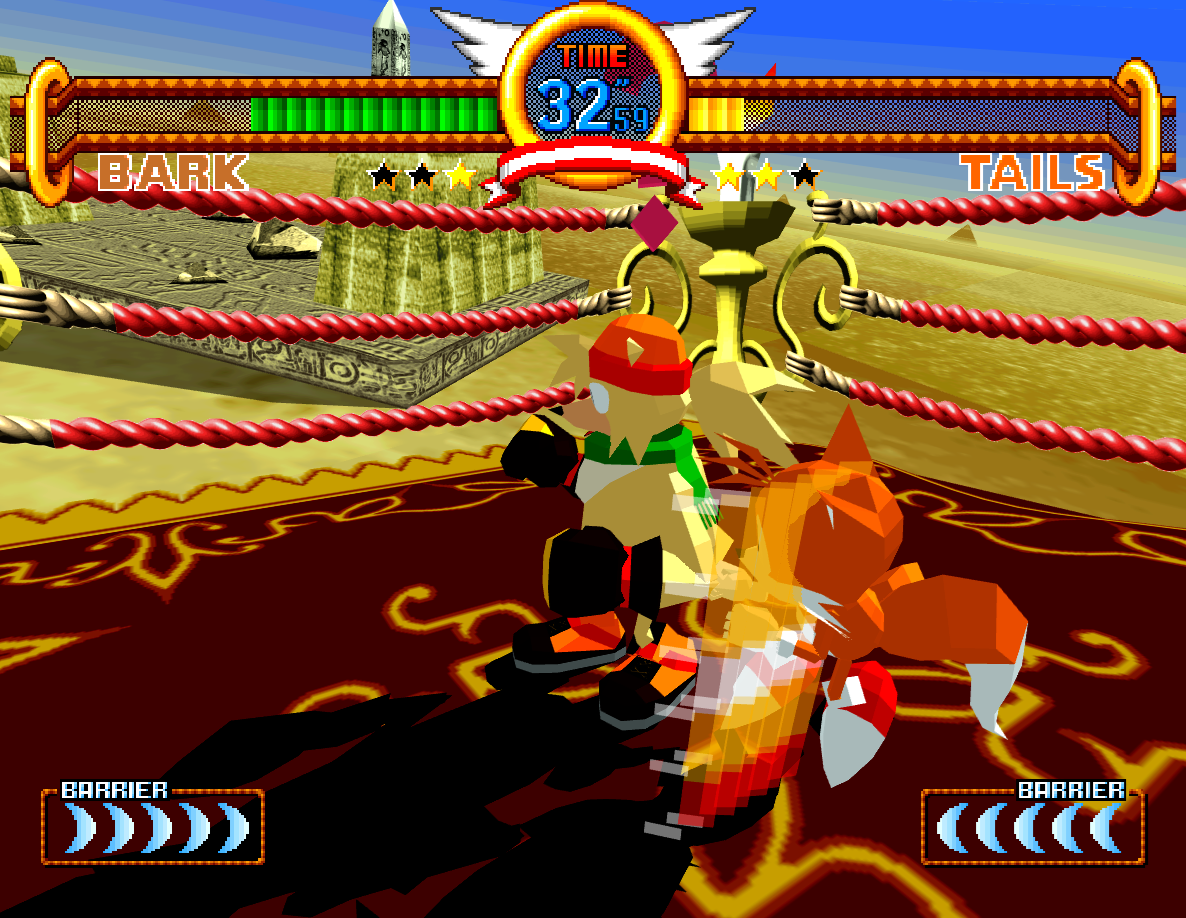
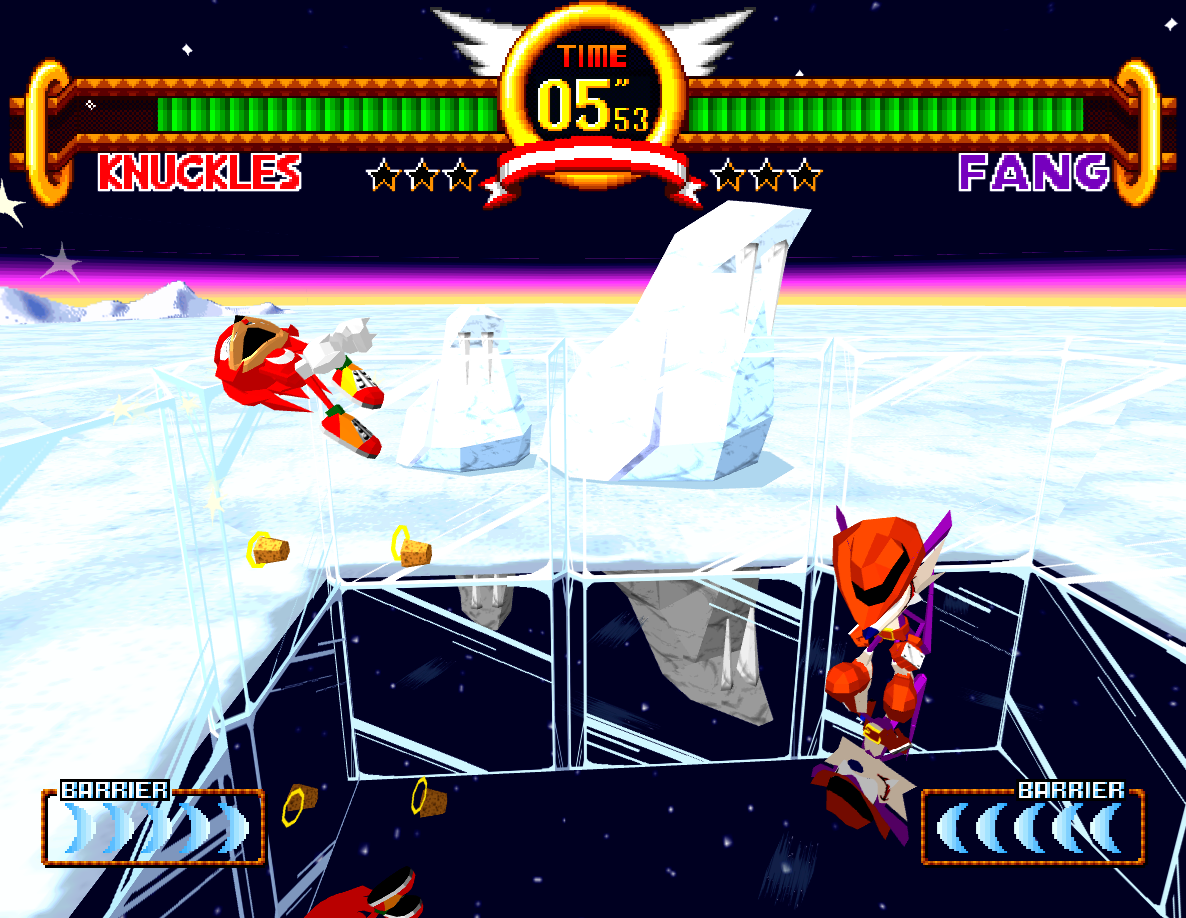
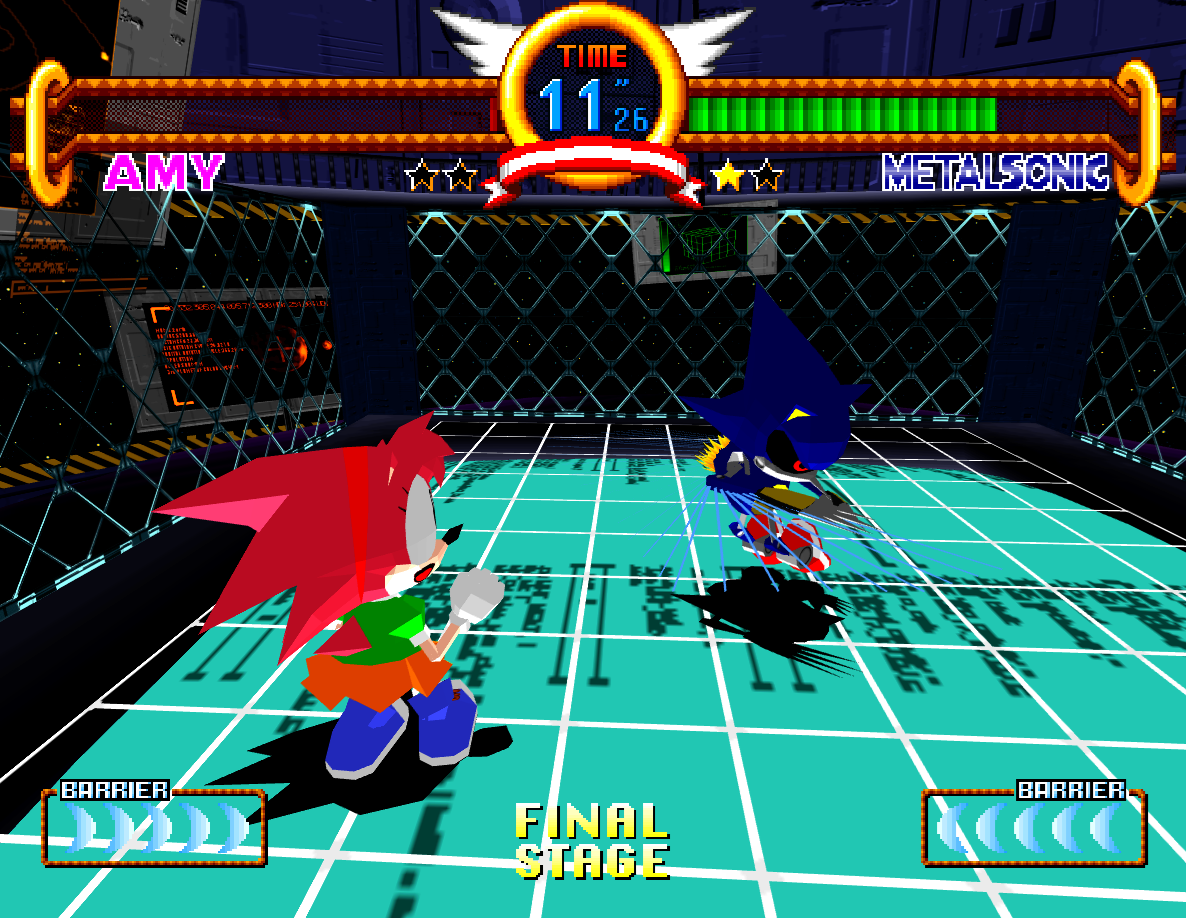
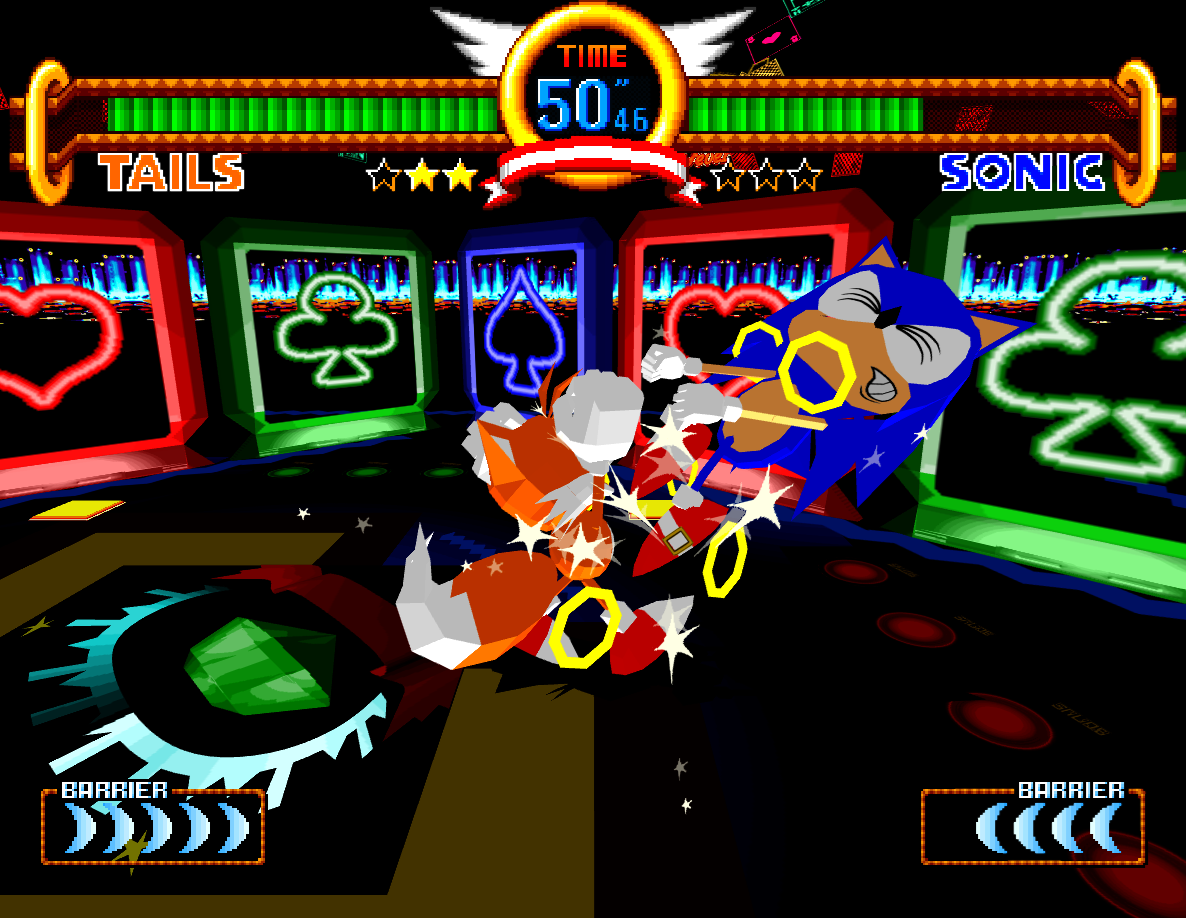
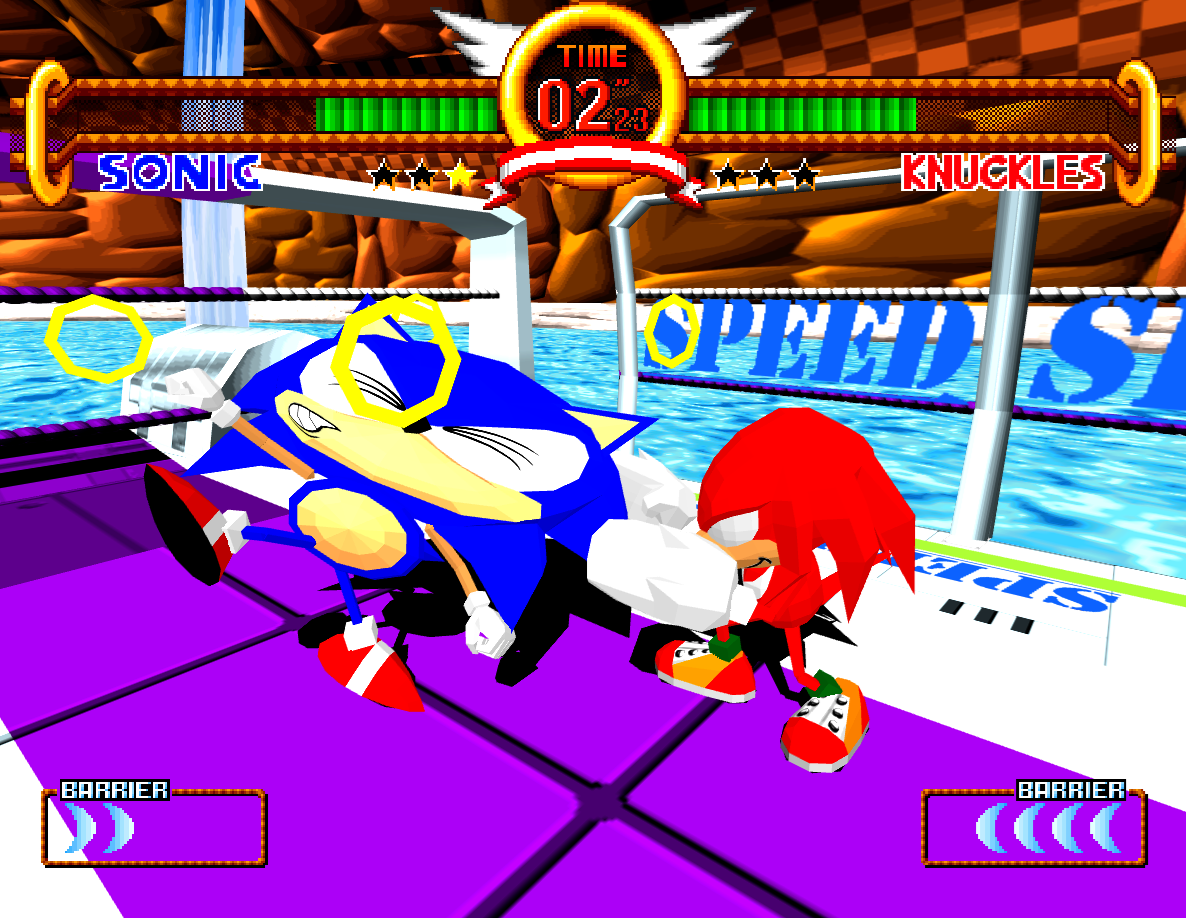
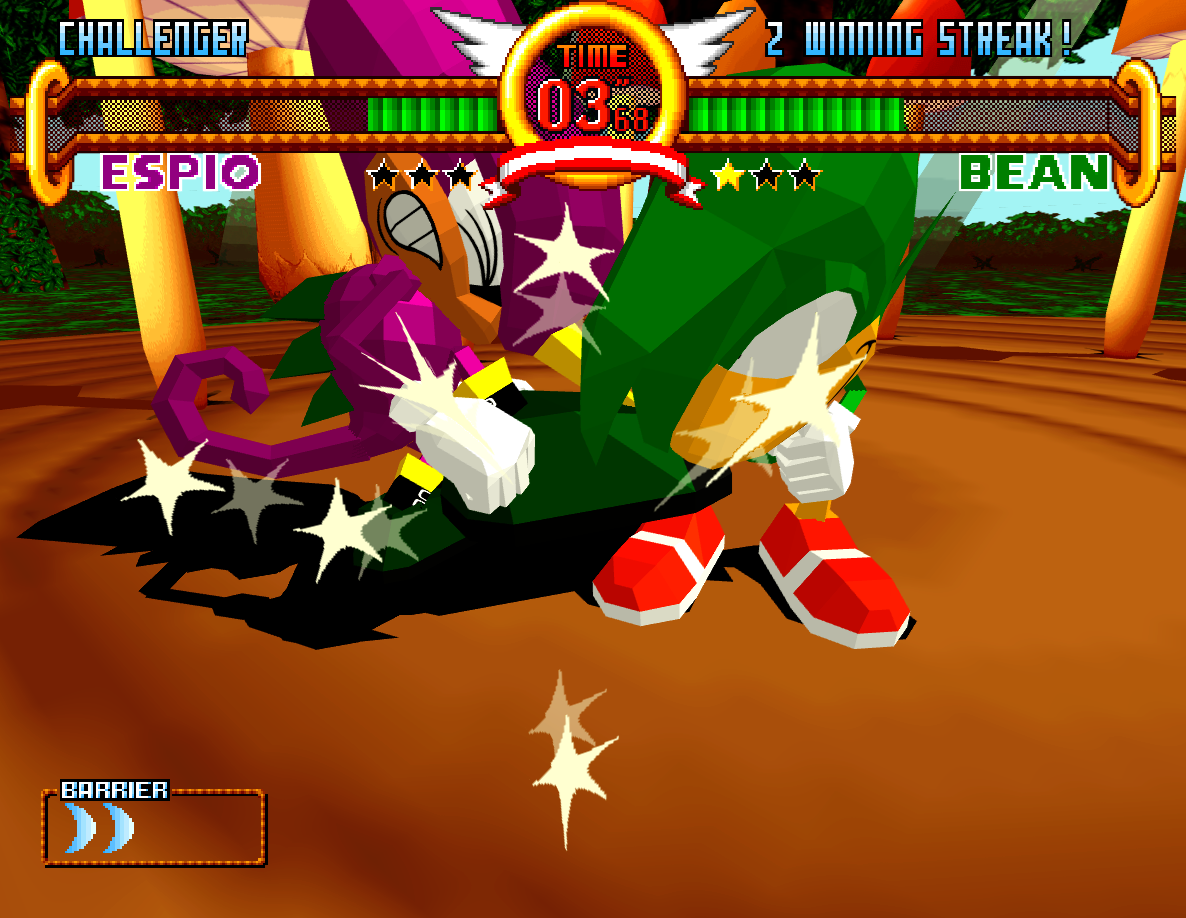
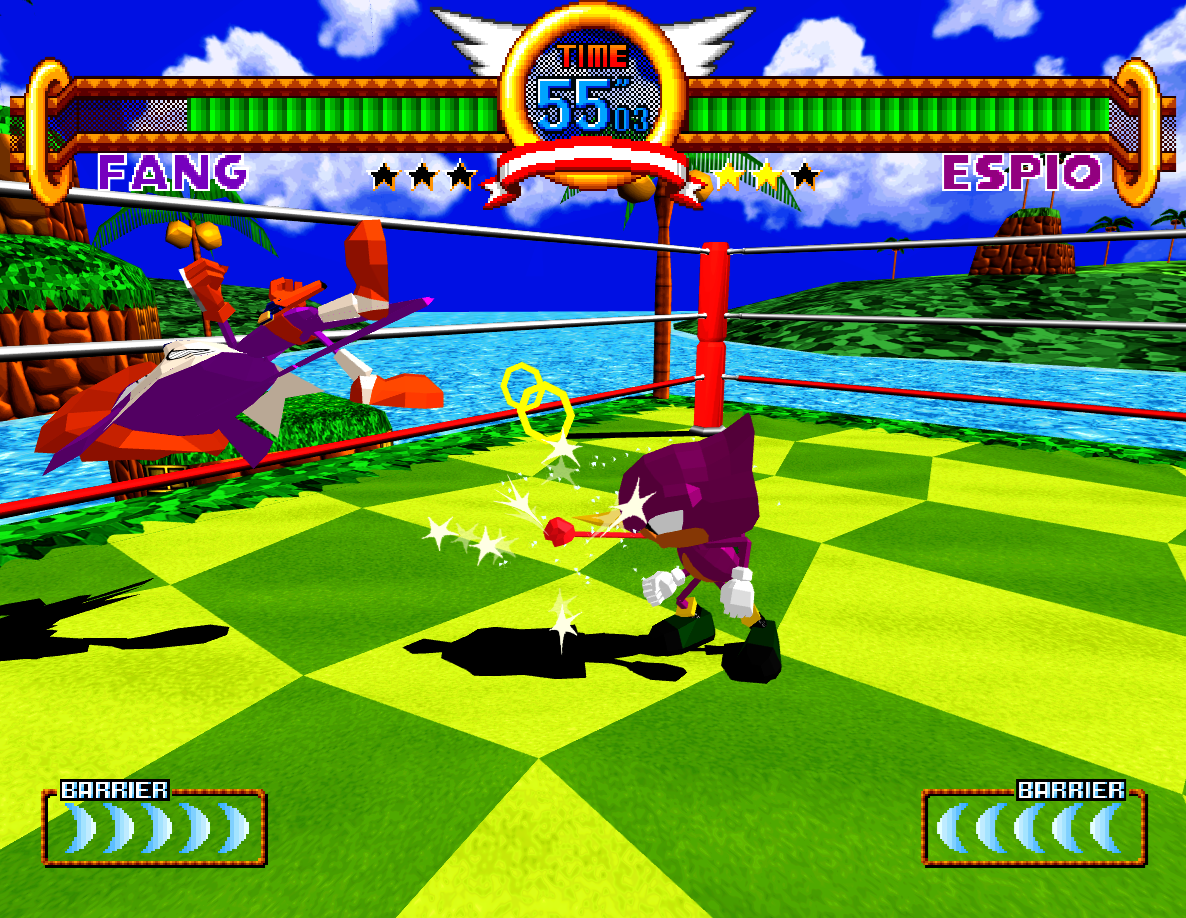
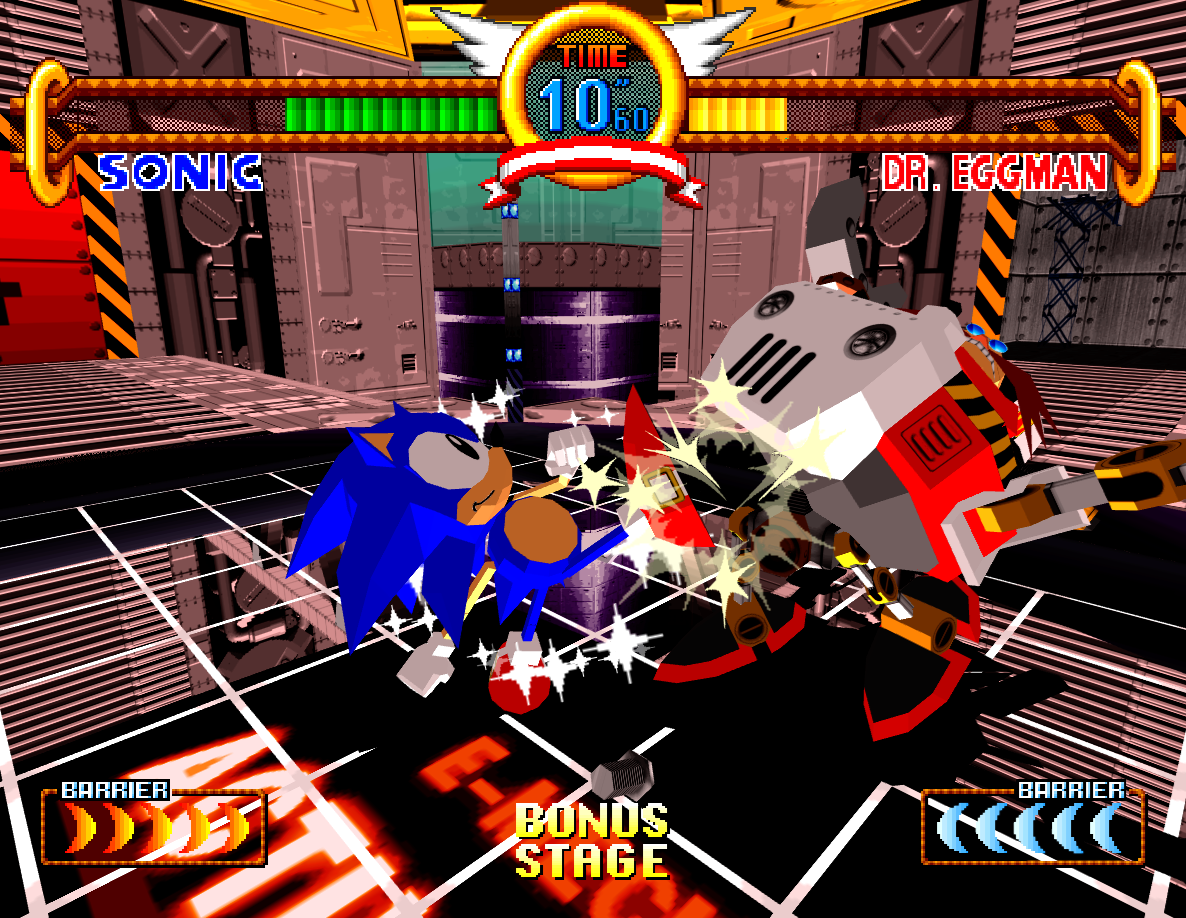
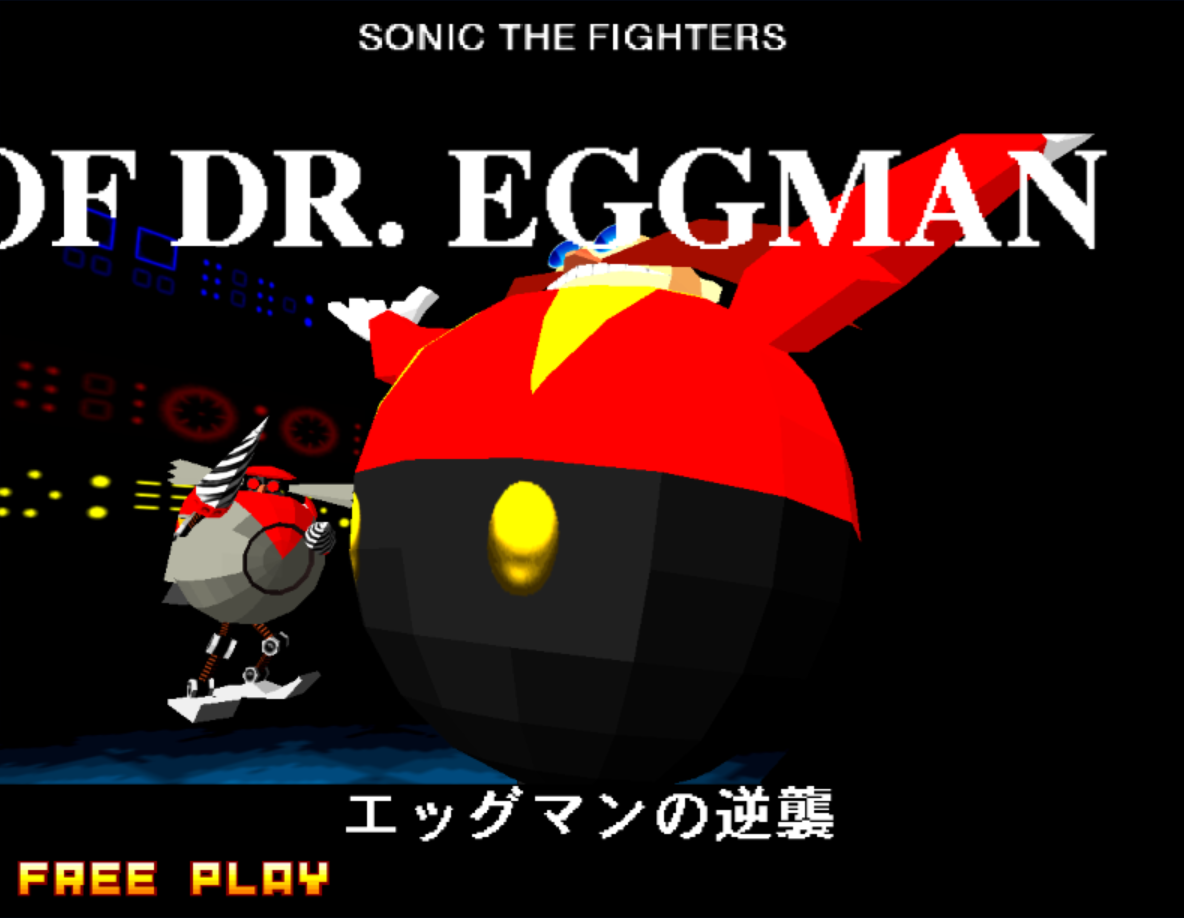
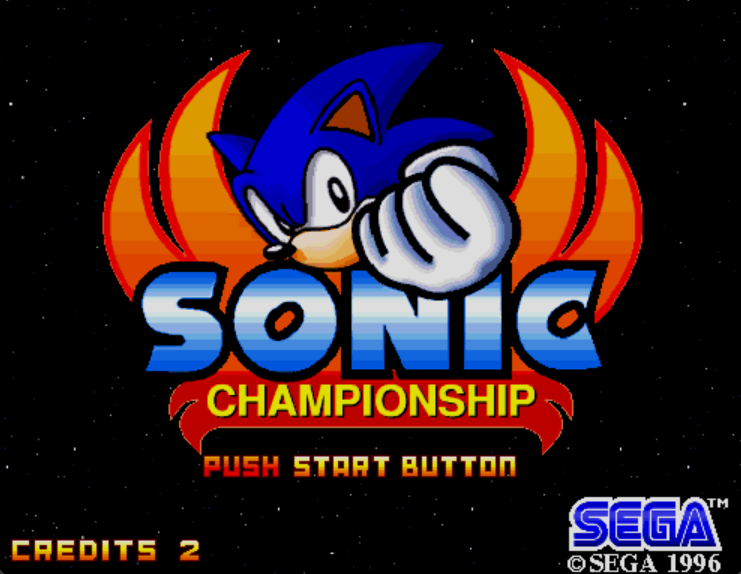
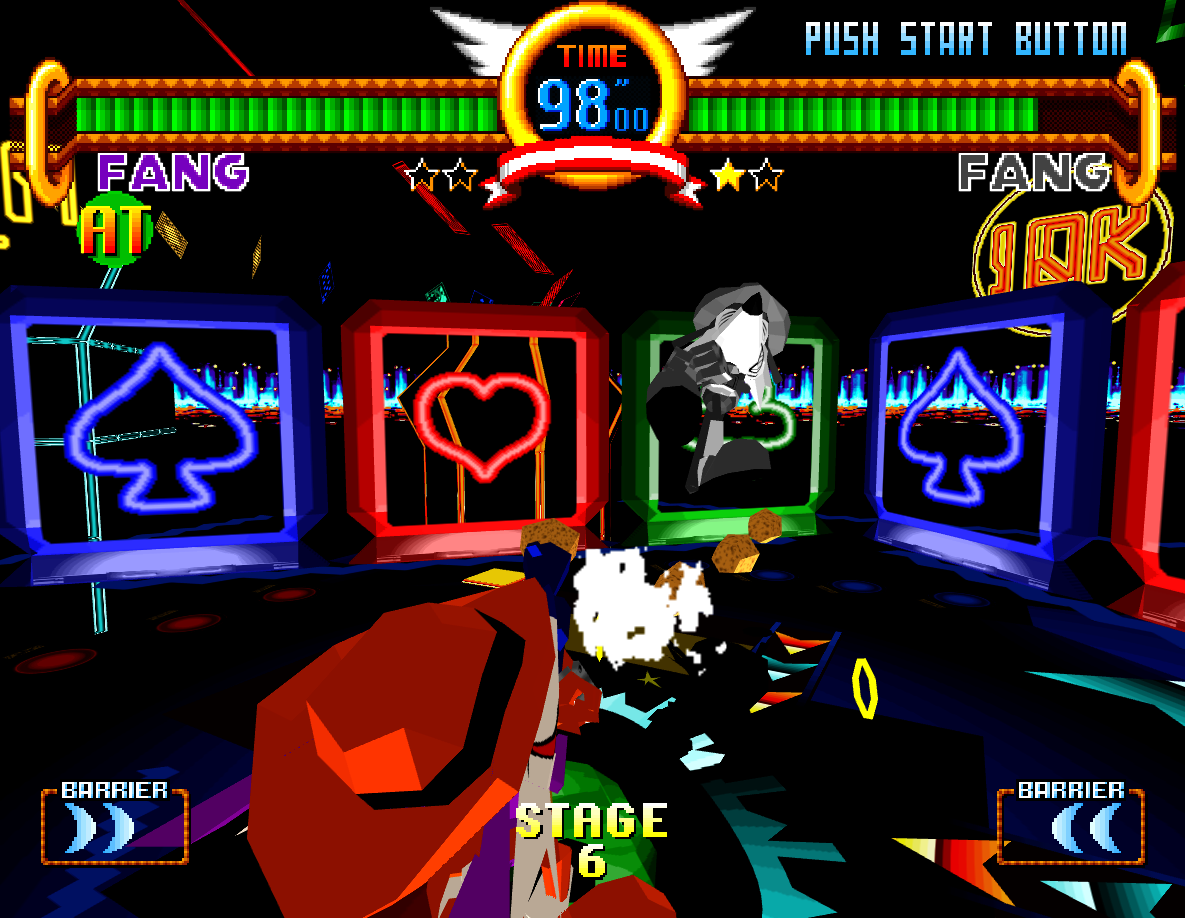
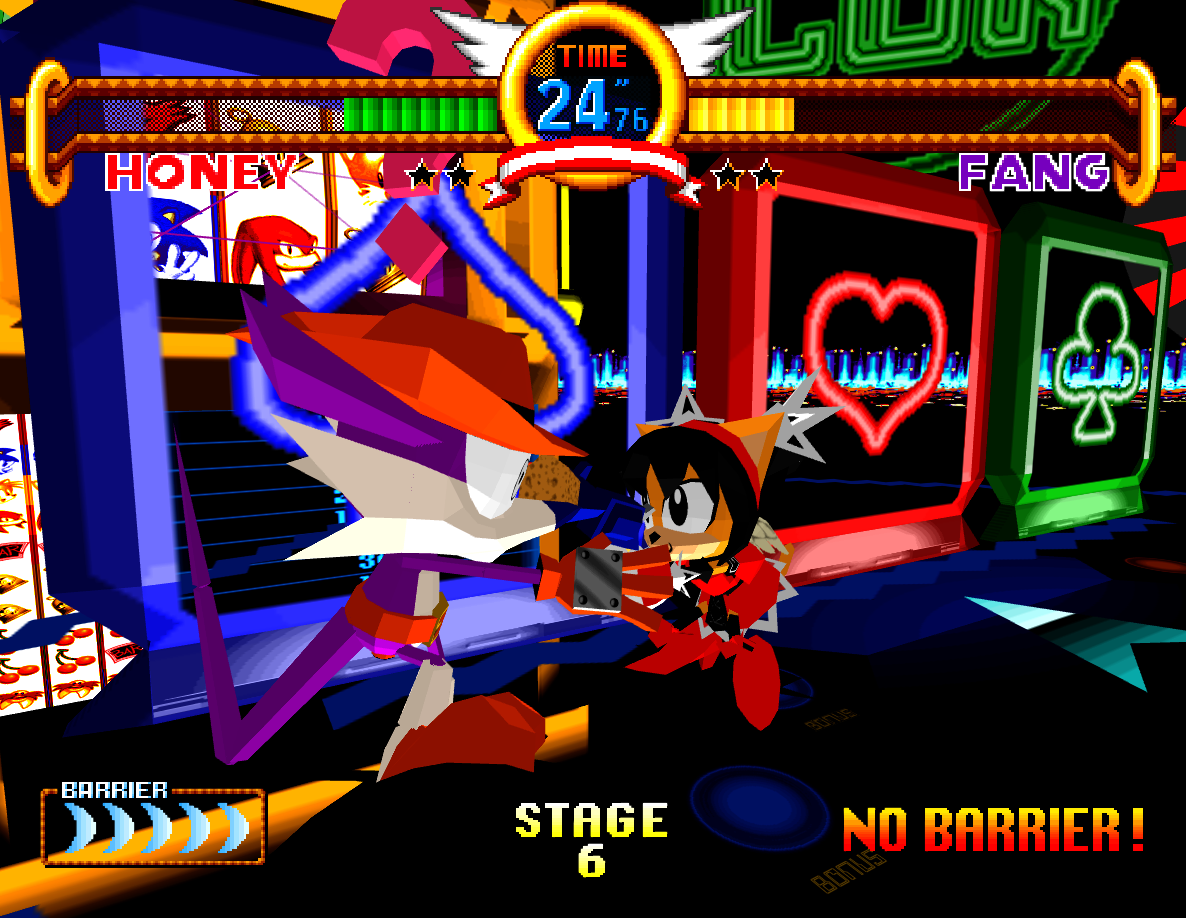
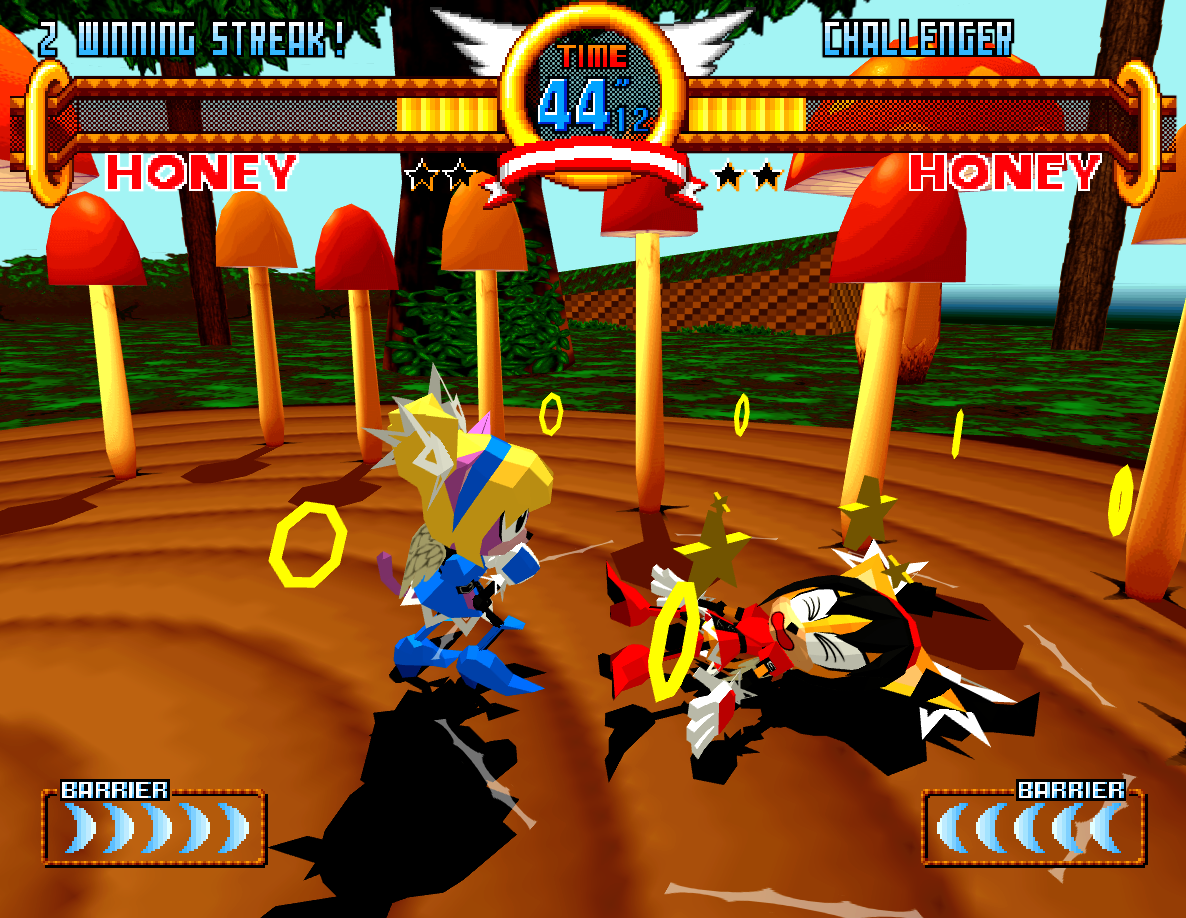
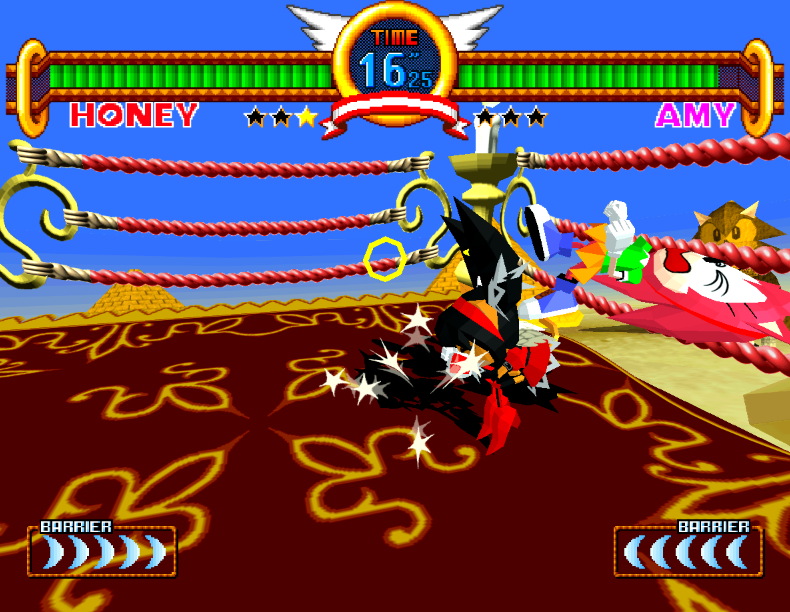
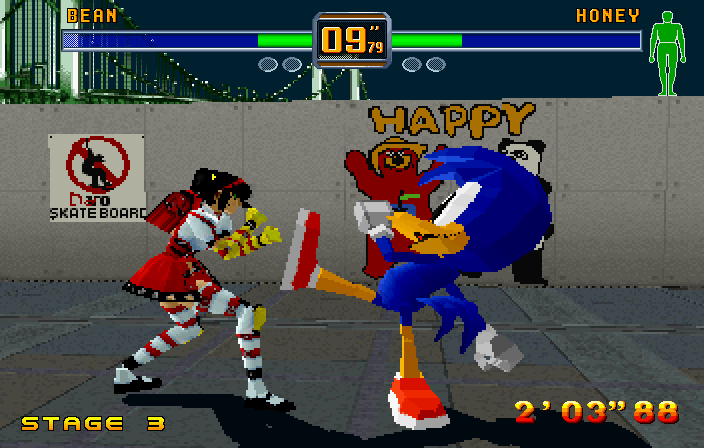
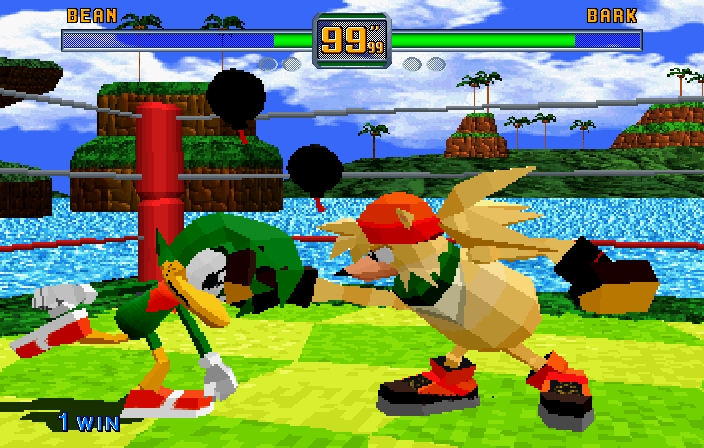
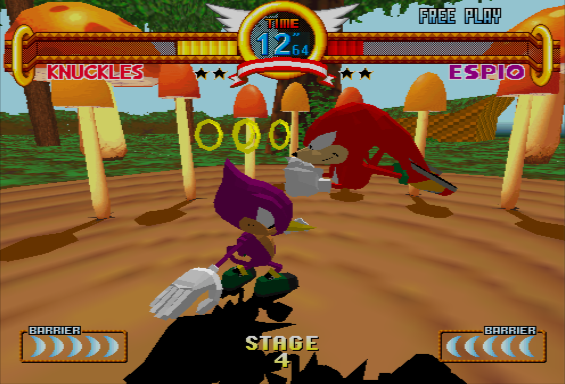
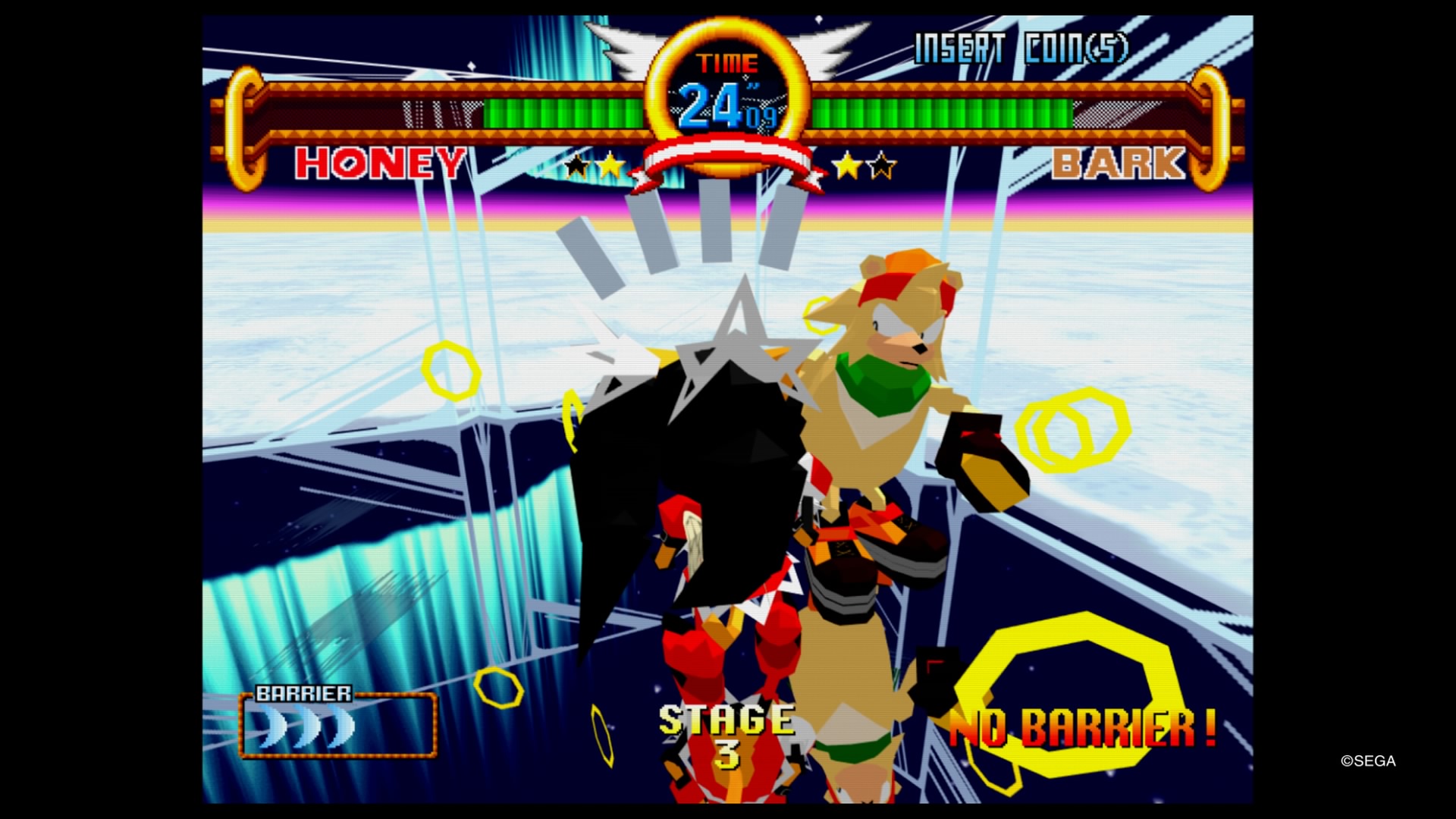
Just like with Fighting Vipers, Model 2 emulation on PC isn't quite there yet for our twisted purposes, so our screenshots here are a bit of a compromise, taking screenshots from the 2012 Xbox 360 version (using the Xbox One's very handy 'screenshot' button, can you imagine, just pressing a button to make screenshot appear? Technology is wonderful) using the 'original' screen size while snipping the borders off and ever-so-slightly adjusting the aspect ratio (by like ten pixels), bringing it to a 4:3-compliant size (362 x 272 to be specific, 272 has become a magic number for Gaming Hell to keep screenshot just the right height) for something as close as we can get to the arcade experience. Yes, this is the kind of thing we agonize over because this place is full of nerds.
Finally, special thanks to Ultra Powerful Pal of Gaming Hell HokutoNoShock for the multiple online sessions we've played of this game together, even labbing a few things out, ta!

It's time for a rumble on South Island, as Sonic and his furry pals knock seven bells (or rather, rings) out of each other!

How did such a battle come to be, though?

Our story begins in a completely different article- the Fighting Vipers one- but we'll jazz it up a bit.


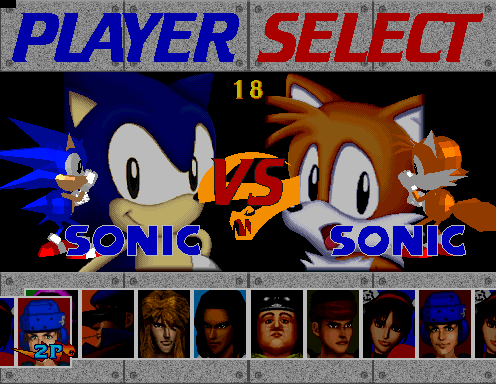
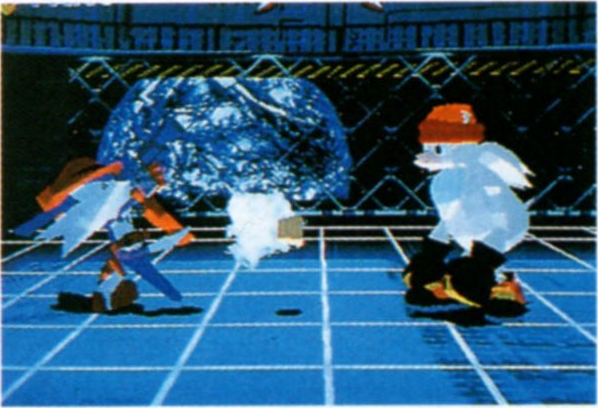
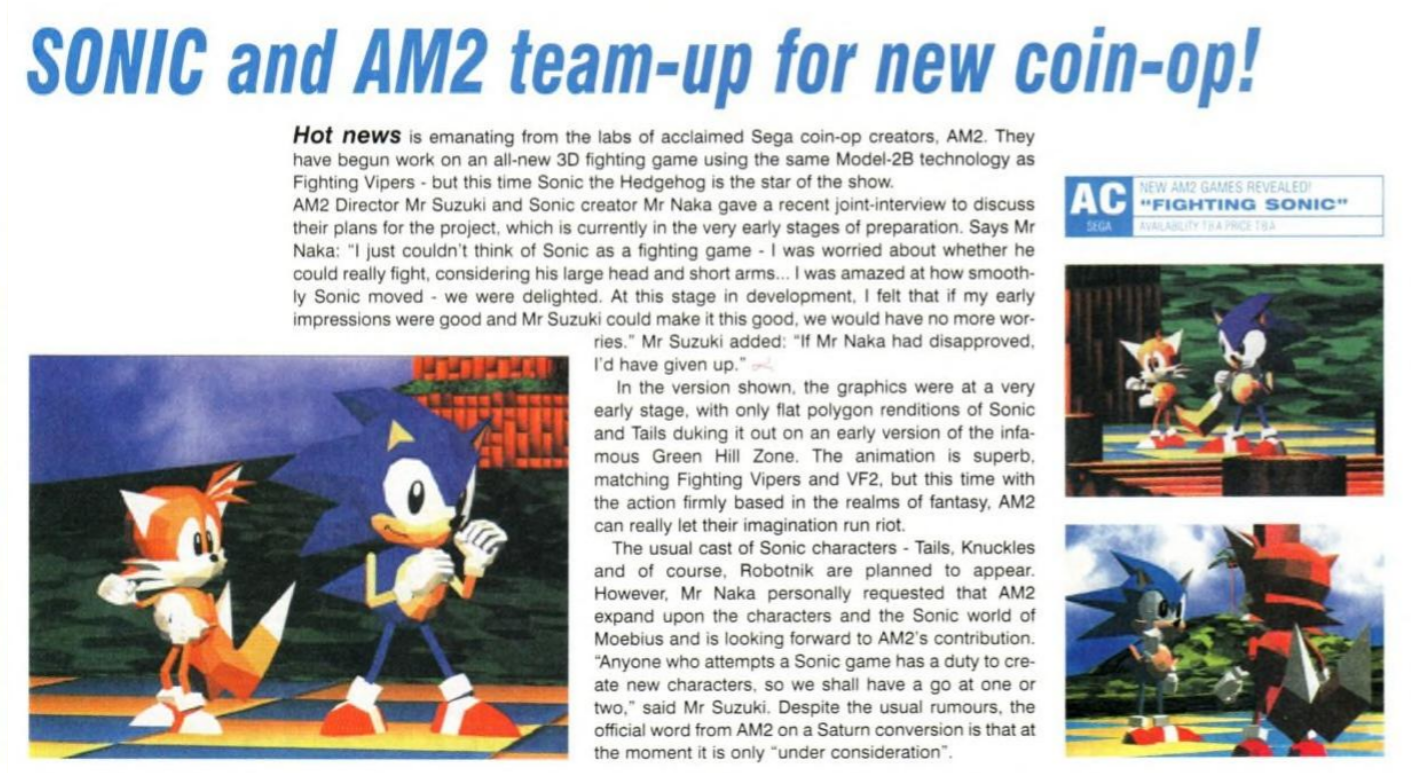
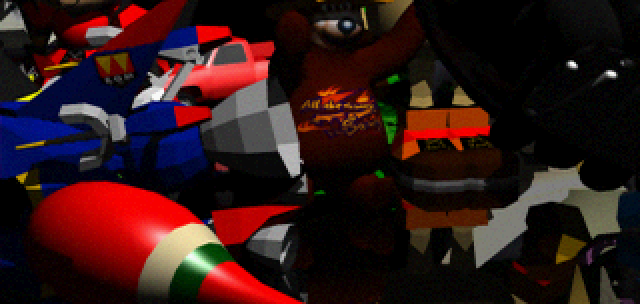
If you're familiar with the screenshot above, you'll know it's from The Cutting Room Floor page for the arcade Fighting Vipers, or maybe you saw it (as identified by SeventhForce) in UK magazine Computer & Video Games #174 or you know where it's really from (as identified by BiggestSonicFan), the Japanese magazine Saturn Magazine 1996 #09 covering Fighting Vipers secrets. Well, what is it? It's the character select screen from the arcade Fighting Vipers, but with Sonic and Tails there, ready to duke it out. As explained on The Cutting Room Floor, these two are hiding in the code of the game, documented on the on the long-defunct Sonic-CulT / X-CulT site, and their discovery can be traced back to 2006 again by BiggestSonicFan on their forums... But what are they doing there? As explained in a 1UP.com interview with Hiroshi Kataoka, Sonic and Tails were added into Fighting Vipers during the game's development as a joke, possibly by Honey's character designer Masahiro Sugiyama although it's only mentioned as 'probably' being him rather than being definitively identified (although his Twitter bio does credit him with creating Honey the Cat, more on her later). Whoever was responsible was messing around with character models one day and put the pair in as a little goof (just filling up one character slot- Tails is the 2P palette) which was seen by Yu Suzuki, who then talked about it with Hiroshi Kataoka, who then presented the idea of a Sonic fighting game to Sonic Team head Yuji Naka, who loved the idea so much he approved it, eventually leading to the creation of Sonic the Fighters.


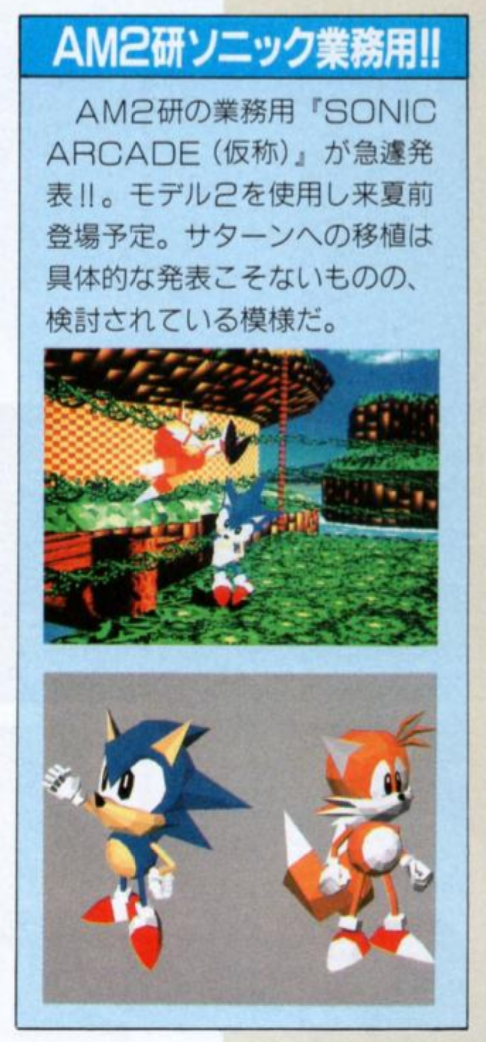
The game was initially revealed (with the tentative title "Sega Sonic no Taisen CG Game") in promotional stills that mostly showed Sonic and Tails standing around or fighting in an early version of the South Island arena with many differences (a different floor pattern, chains and palm trees instead of the ropes and turnbuckle of the final game, etc.) that started appearing in magazines in early 1996 (the first print mention I could find was in Saturn Fan 1995 - 13 from December 8th, 1995, that's the scan on the left where it's called SONIC ARCADE) with Gamest 165 - Appendix 0001 - 96 AOU Show-Which is the Best Game!? offering the best look at some early shots (thanks for the tip, ohfivepro!). There's more early screenshots on the Development page on Sonic Retro too, some of which we'll come back to later, and some which come from the game's demonstration at that year's AOU Show held from February 21st to February 22nd. There's not a whole lot of information about the game's development out there (although Maki Morrow's liner notes for the soundtrack are interesting), but multiple pieces of magazine coverage early on in the development process mention that staff members weren't really sure that Sonic could properly work as a fighting game with his stubby limbs and big head, but once they started working on the animations and models, it started to come together, with Yu Suzuki specifically saying, "If Mr. Naka had disapproved, I'd have given up" before mentioning Mr. Naka's odd habit of saying he'll never be caught for insider trading and I'm glad they persevered as the visual presentation is especially great here, but I'll come back to that later.

In any case, the game was released in May 1996 according to Sega themselves- that's about six months after Fighting Vipers, only a month after Virtua Fighter Kids and a scant four months before Virtua Fighter 3, and so this would be Sega AM2's fifth 3D fighting game since 1993 (or sixth, depending on whether you count Virtua Fighter Remix or not). They'd certainly been busy then, but this was quite a departure from their previous fighting game works beyond Virtua Fighter Kids. I'd be right to wonder how it could work, honestly! How do you make stubby little woodland creatures fight one another and make it fun? Let's find out together, shall we?


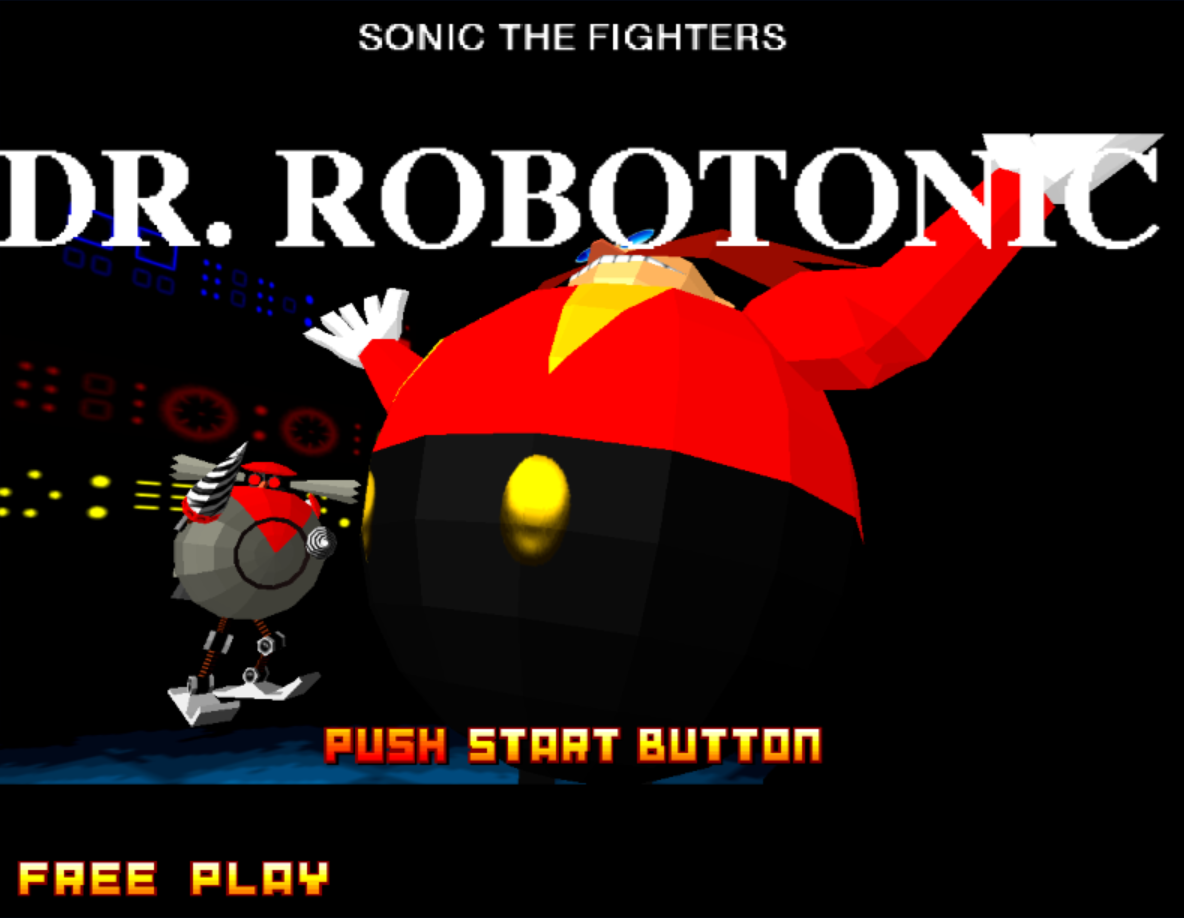
The plot, as shown in the intro and corroborated by the Sonic the Hedgehog Encyclo-speed-ia (ISBN: 978-1506719276), has Sonic and his friends facing a new threat from the nefarious Dr. Eggman (or, as he's known in the Western version's intro, Dr. Robotonic, oops) as his latest space station, the Death Egg II, is operational and threatens the world as it looms above it in the reaches of space. Tails, mechanical genius that he is, has the solution- the Lunar Fox, a spacecraft that can reach Eggman's new base of operations and put an end to his ambitions. Slight problem- it's a single-seater and requires the eight Chaos Emeralds (don't think about it too hard, Sonic nerds, you'll give yourself a headache) to power it. Seven of Sonic's pals and rivals, as well as the Blue Blur himself, happen to have one of those Chaos Emeralds each, so the only fair way to do this is to hold a little fighting tournament to see who's worthy to take the fight to Eggman. Who will save the world? The answer lies in the heart of battle!


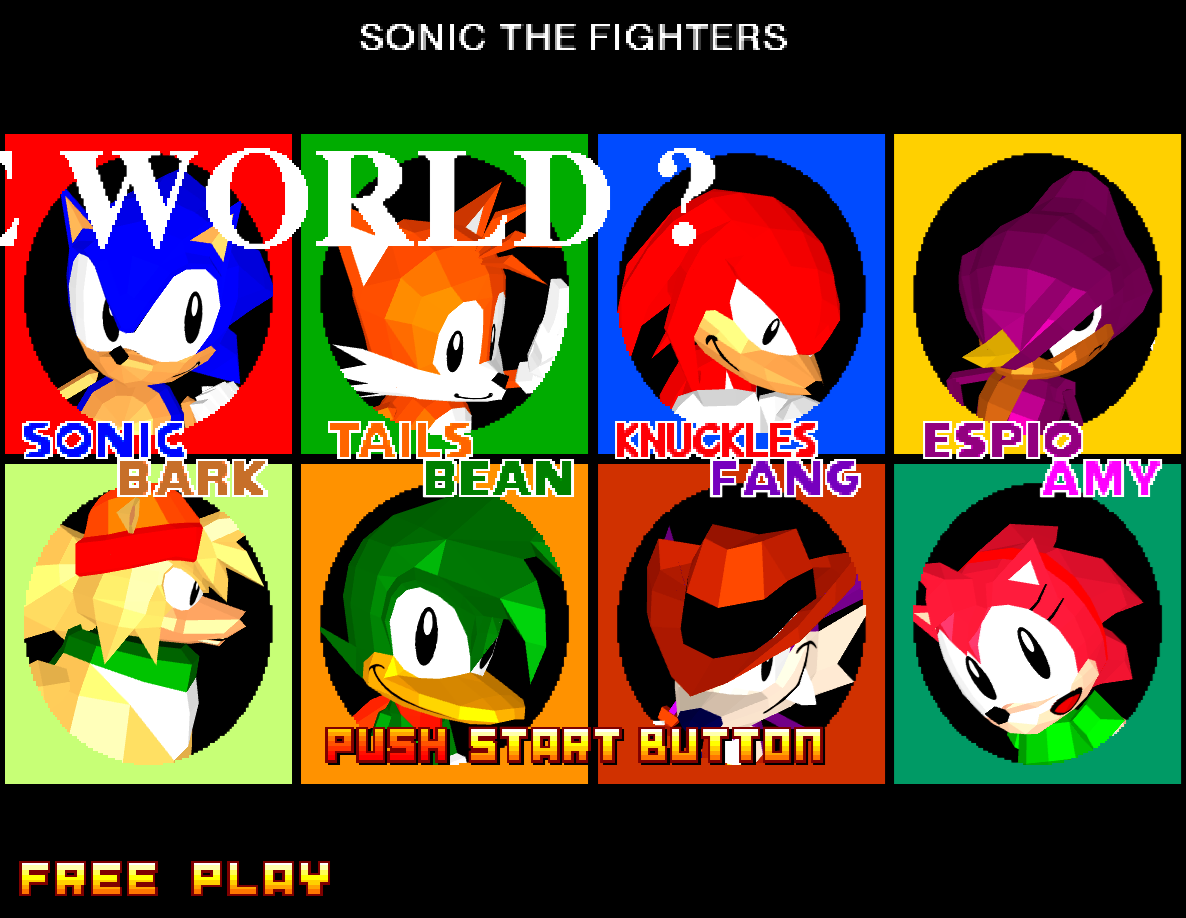
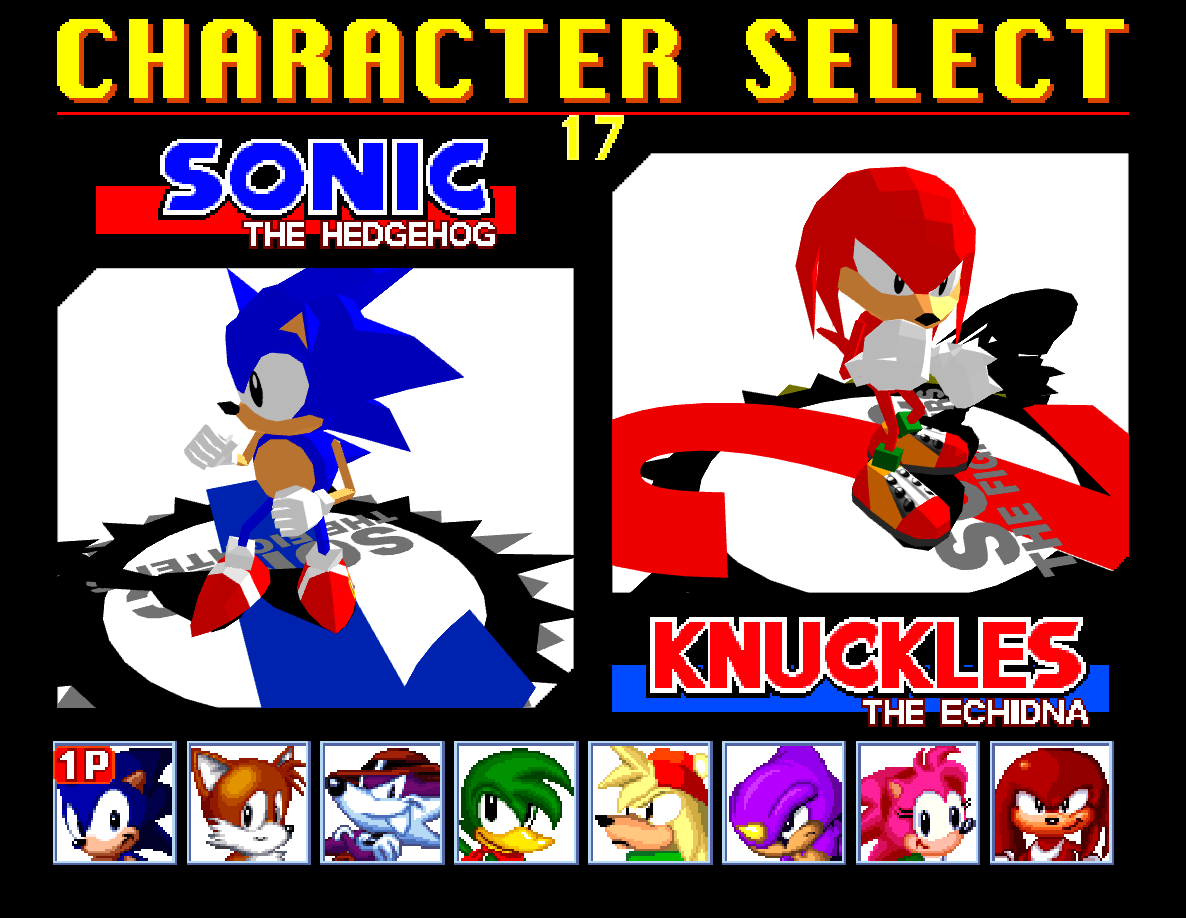
Let's take a look at our cast, then. You'll recognise a lot of these characters, but there's some new challengers here too!

Character artwork taken from the Sonic Retro page on Sonic the Fighters.

SONIC

From: Sonic the Hedgehog (1991)
Full Name: Sonic the Hedgehog
Speciality: Spin Attack
Home Stage: Giant Wing

A gallant hedgehog with a free spirit
who's always running, spinning and stopping
the ambitions of the nefarious Dr. Eggman.

TAILS

From: Sonic the Hedgehog 2 (1992)
Full Name: Miles "Tails" Prower
Speciality: Propeller Dash
Home Stage: Canyon Cruise

A young two-tailed fox who idolizes Sonic,
he's a smart kid who created the Lunar Fox
and can use his tails to fly.

KNUCKLES

From: Sonic the Hedgehog 3 (1994)
Full Name: Knuckles the Echidna
Speciality: Knuckle Glider
Home Stage: South Island

The last of the Echidna tribe who lived
on the Floating Island, his name's not just
for show, he's rougher than the rest of 'em.

AMY

From: Sonic the Hedgehog CD (1993)
Full Name: Amy "Rosy the Rascal" Rose
Speciality: Magical Hammer
Home Stage: Flying Carpet

An energetic girl with a big crush on Sonic,
she's brought along her Piko Piko Hammer
to squish and flatten the competition.

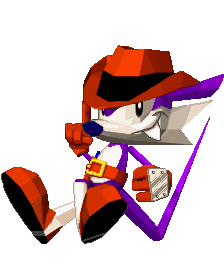
FANG

From: Sonic Triple Trouble (1994)
Full Name: Fang the Sniper
Speciality: Popgun
Home Stage: Casino Night

A lousy bounty hunter who once tried to sell
the Chaos Emeralds on the black market,
he's armed with a long-range popgun.

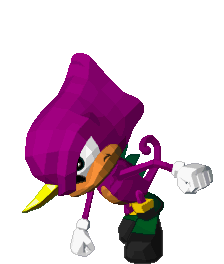
ESPIO

From: Knuckles' Chaotix (1995)
Full Name: Espio the Chameleon
Speciality: Tongue Attack
Home Stage: Mushroom Hill

Part of the Chaotix Crew who once helped
Knuckles in the Neutrogic High Zone incident,
he fights alone this time around.

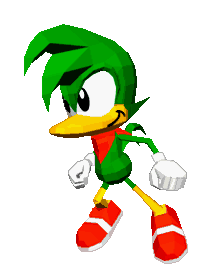
BEAN

From: Sonic the Fighters (1996)
Full Name: Bean the Dynamite
Speciality: Bomb Attack
Home Stage: Dynamite Plant

With a familial connection to Bin from
Dynamite Düx, he sure takes after
him with his penchant for explosives.

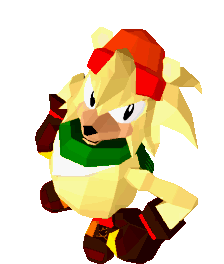
BARK
THE POLERBEAR
From: Sonic the Fighters (1996)
Full Name: Bark the Polarbear
Speciality: Throw
Home Stage: Aurora Icefield

Just a big ol' polarbear with a wicked-sick
beanie and scarf, he's ready to take
everyone else for a ride with his throws.


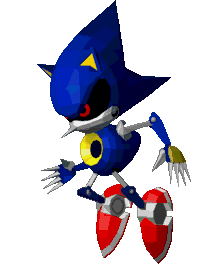
METAL SONIC

From: Sonic the Hedgehog CD (1993)
Full Name: Metal Sonic
Speciality: Metal Laser
Home Stage: Death Egg's Eye

The mid-boss.
Created by Dr. Eggman to beat Sonic
at his own game, Metal Sonic is the
scientist's last line of defence here.

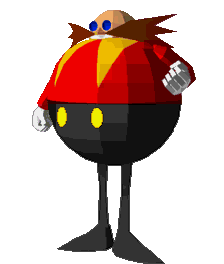
DR. EGGMAN
DR. ROBOTONIC
From: Sonic the Hedgehog (1991)
Full Name: Dr. Ivo "Eggman" Robotnik
Speciality: Drill Claw
Home Stage: Death Egg's Hangar

The final boss.
An evil genius of a scientist with a
300+ IQ, the Death Egg II serves as
his latest attempt to conquer the world.


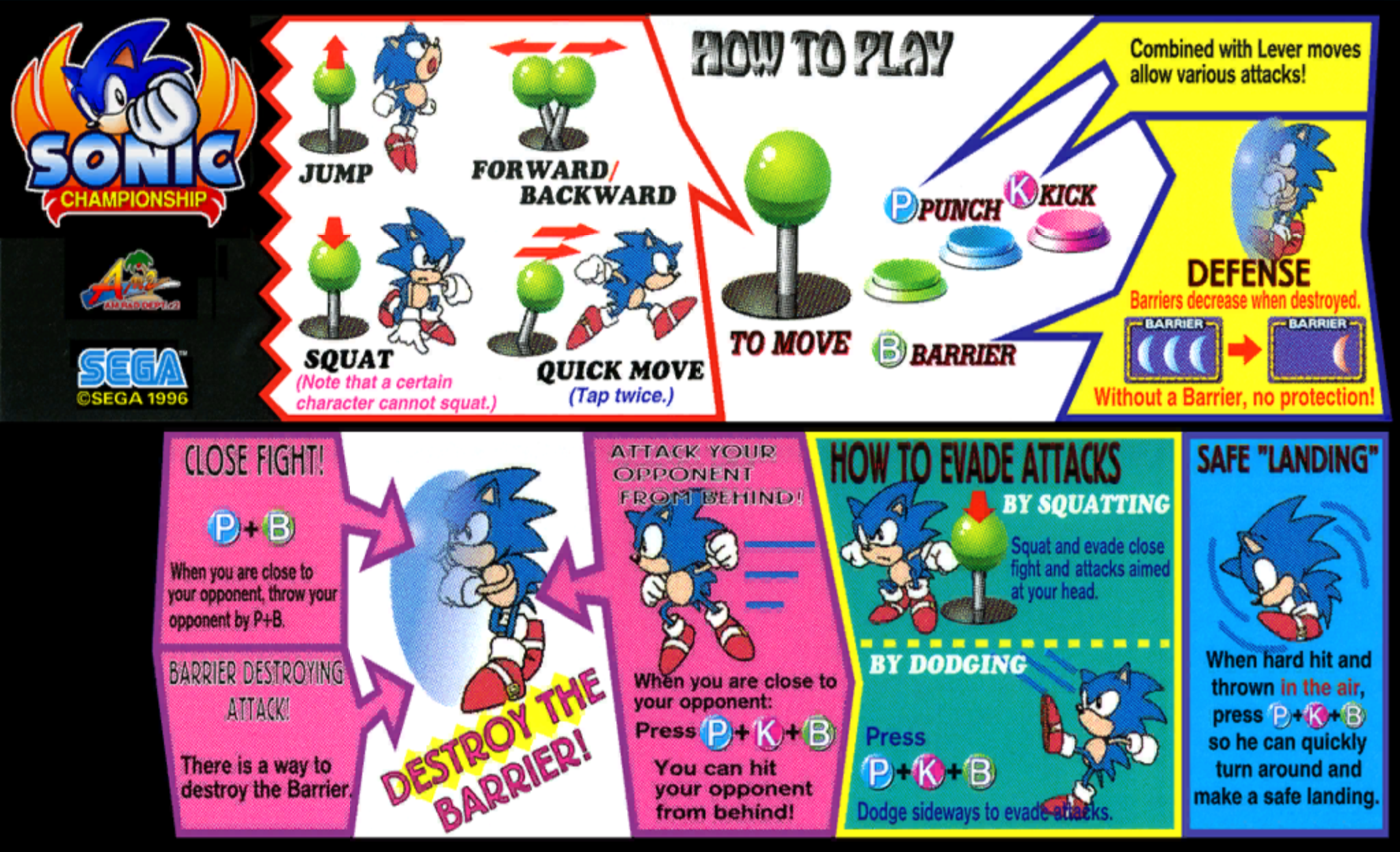
Sonic the Fighters is a Sega AM2 fighting game through and through, so it's got the same basic control scheme as Virtua Fighter and Fighting Vipers, with three buttons and a joystick. In this case, the traditional Guard / Defense is replaced with Barrier, but we'll get to that in just a minute. In terms of attacks we still have Punch and Kick buttons and the focus on a selection of strings of button and directional inputs, button combinations (P + B for a grab, K + B for a powerful kick, etc.) and some special move inputs (more than Virtua Fighter and Fighting Vipers for sure) to do moves, so that's pretty easy to grasp. Similar to Fighting Vipers, there's a lot of shared moves among the cast with almost everyone having step kicks, the foot crush grab and a special weapon grab against characters who've armed themselves (Bark, however, lacks all these, he's a big body, he's built different, poor guy can't even crouch) but it makes up for this by giving leaning more into what we'd call special moves- three members of the cast (Amy, Fang and Bean) have full-on projectiles, several have Psycho Crusher-style leaping moves that go across the screen, Bark has a few moves that let him act while guarding, and so on. There's also several kinds of moves missing, mostly special throws from behind, next to a wall or to a crouching foe, throw escapes and wake-up attacks (you've still got wake-up movement so you can roll forward, backwards and in and out of the screen once you're knocked on your ass, and you can hold Barrier to guard as soon as you're up) so I guess a few less-common moves were excised to keep things more straightforward. Well, except for throw escapes, they'd be nice, but oh well. This makes it a bit simpler than Virtua Fighter of course, but it's a nice balance between making the game easy to pick up and making the characters stick out from one another. (Things are even simpler if you pick Automatic Mode which wusstunes' Sonic the Fighters is Broken video explains far better than I could, but this does things like make you automatically throw frame-one with just one button and alter moves, even giving some characters moves they don't normally have, so it's busted in a variety of fun ways, but we've focused on the Manual playstyle for our look at the game.)

Given its origins, several of the mechanics originally unique to Fighting Vipers make a return here, chief among them the walls surrounding the arena (so no Ring Out for you) and the Air Recovery technique (P + K + B after being launched to recover mid-air and perform actions on your way down) but they've been changed up a little, as have the physics in general. The walls now let you kick back against them for a lunging attack (a bit awkward as you have to be square against the wall, and Bark can't do it) as well as climb them to attack as you could before, but you can't destroy them at the end of a match, alas (if you're good, you can knock your opponent over them, sometimes into the abyss!). Air Recovery gets some upgrades here too as you can now hold directions to massively alter your trajectory (hold Up to jump extra-high, hold Forward to stay more neutral, or hold Back to zip backwards to get some space). Using them to get out of a jam is really useful, although you don't want to use Air Recovery too much if you're pressed against the wall, or you'll get bullied! As for the physics, they've still got that unrealistic feel to them like FV so characters get launched high in the air (if anything, they go even higher and fly further when walloped against walls) but with heavier-feeling jumps that drop you faster to the ground, so it's certainly distinct from VF and FV, and feels more fitting for the cartoon-like aesthetic, enhanced by the stretching and skewing effects (more on those later).


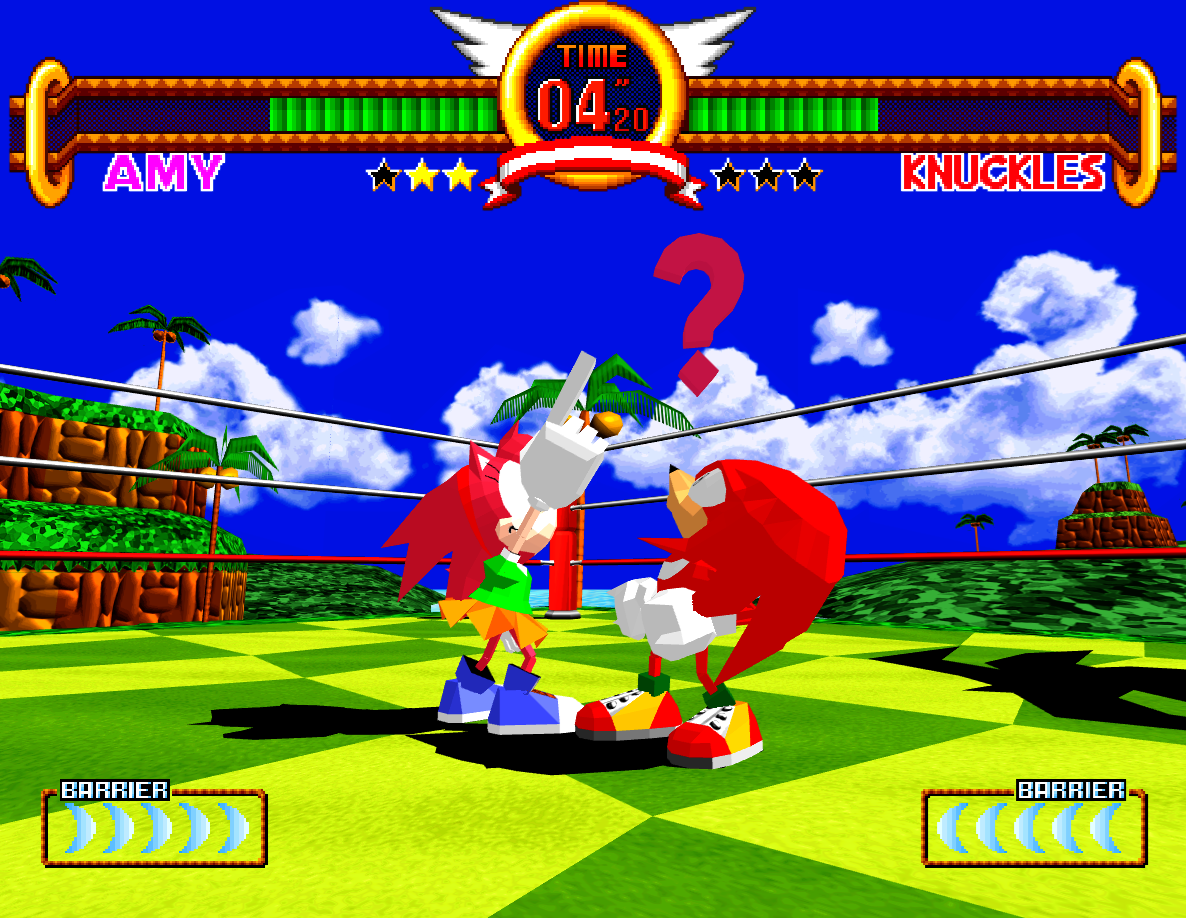
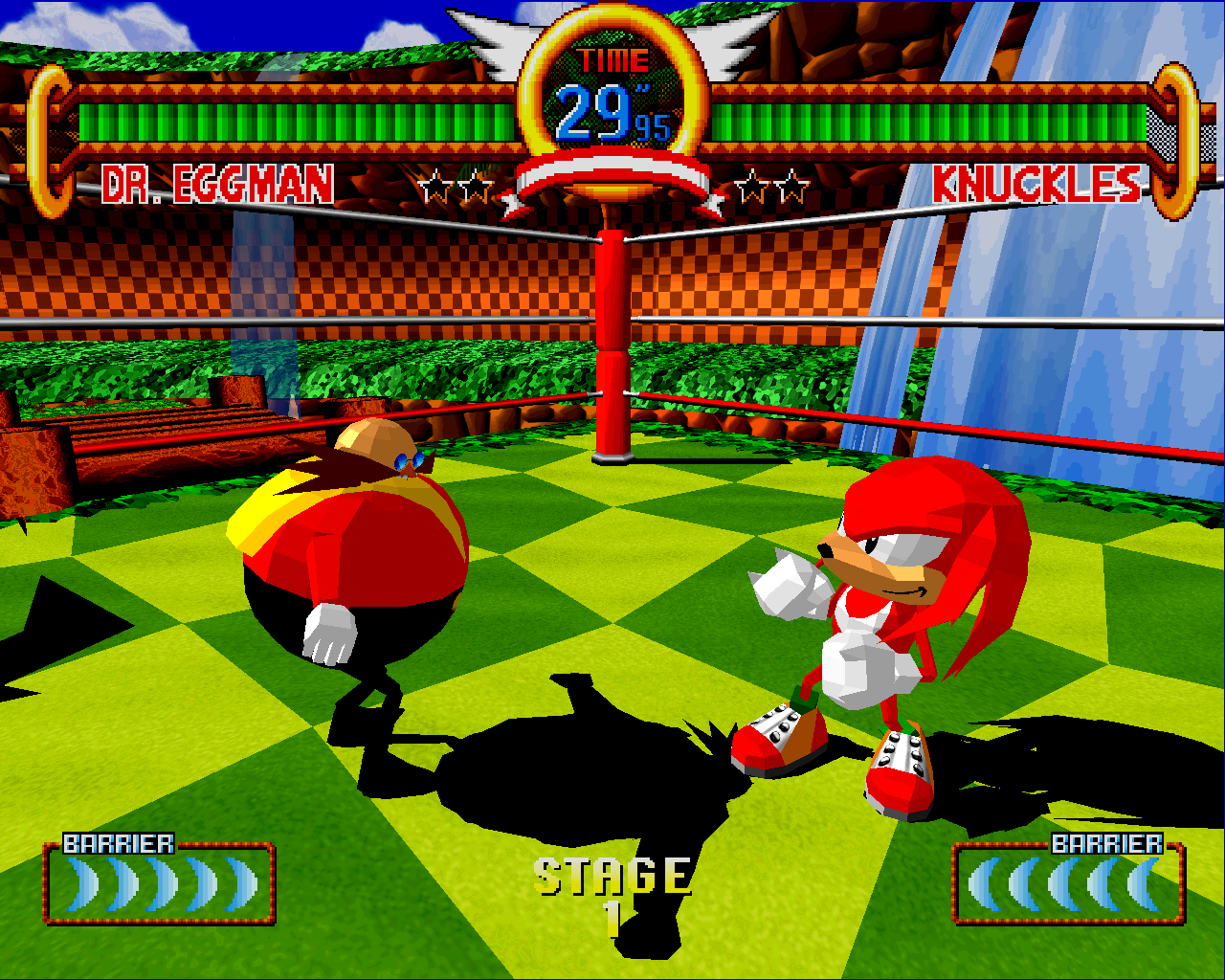
Let's get back to that Barrier button and defense in general, 'cause this is where things take a big swerve. Guarding is thrown out in favour of Barriers, where each character has a stock of (by default) five Barriers for the entire match (not just the round). Hold the button, block incoming attacks and take no damage, pretty simple, right? However, like Fighting Vipers' power attacks which would slightly stagger blocking foes and break armour when weakened, many attacks here (including throws) will break the Barrier and take a stock away from the one guarding. You can still block plenty of stuff without losing a Barrier, but if you just hold the Barrier button, you'll eventually lose them (and some attacks, like Spin Dashes, can just rip through your stockpile). Limited guarding? Surely that means you're out of options when they're all gone? Nope, this is where we get the most vital addition, the sidestep. This is performed with P + K + B to move into the background slightly (or Forward + P + K + B to move into the foreground which goes a little further) and offers some precious invulnerability frames if done when an enemy's about to attack you. From there, you can either do another dodge (much riskier) or do a limited number of attacks out of it, with several characters having a punch-kick combo which has a lot of uses and some having unique moves like Sonic's Spin Dash. Get close enough and you can even give 'em the sliparound and end up behind them, complete with a giant ? appearing over their head! This is clearly a mechanic AM2 were still working out the kinks with as while the options out of a sidestep are limited, they're extremely effective and maybe a bit too strong in cases (Sonic's unique Spin Dash out of it is pretty nuts) but it's something you definitely need to get to grips with if you want to get anywhere with this game. The sidestep is important because a lot of people see the limited Barrier stock and assume that defending yourself becomes impossible after you lose them all, but that's not true. It's maybe not as easy to immediately grasp as it would be in later fighting games (which often just use the control stick rather than relying on multi-button combinations) but taking the time to learn the sidestep, how it works and how you can incorporate it into your playstyle, will massively improve both your performance and your enjoyment of the game.

The thing is, guarding isn't the only thing you can do with Barriers, you can also intentionally use one up with Back + P + K (usable in the air too), and with a little thrust animation, you're in Hyper Mode. For a pretty brief moment, you trade in raw damage for the ability to cancel any move into anything else you like as well as unique or modified moves like Amy's Heads Up! dropping an unblockable 16t weight, Bean and Espio being able to teleport and Bark having a moving lariat. It's basically a micro version of the Custom Combo system from Street Fighter Alpha 2 but you get a lot less time to use it before it wears out and the damage nerf is pretty significant, but being able to string anything into anything can be useful for getting your opponent off you or to bully them in the corner, plus the extra moves you get are pretty powerful. There's something a little deeper here too- as explained by wusstunes' essential Sonic the Fighters video, you're able to use the hip-thrust attack that starts Hyper Mode either when it's cooling down or when you've got no barriers, and it's actually quite useful as it's very fast and effective as an anti-air. For some characters, burning through your Barrier stock is actually an advantage, giving you a very useful tool in exchange for having to rely on sidestepping and sliparounds instead of more traditional defense, although that's not a huge problem seeing how good they are! These extra mechanics definitely make Sonic the Fighters stand out from other 3D fighting games of the time, as while sidestepping and 3D movement was slowly starting to appear into other games (even in the home, Battle Arena Toshinden was making strides in this area), the fact you have more options than you'd expect out of sidestepping and the choice the player has to make on when to use their Barrier and when to save those for Hyper Mode is really interesting. It helps that the sidestepping is especially satisfying to pull off when you get all those invincibility frames!


There's one more thing we have to spend a bit of time talking about though, as it's something that's gone on to define the game somewhat- this game has a baked-in comeback mechanic. It's not X-Factor, it's not Pandora, it's... Well, my notes here call it ketchup. That can't be right, hang on. Oh, wait, it's catch-up. By default ,when one player has a life lead over the other, the player who's lagging behind gets a damage boost, and it's not an insignificant boost either, the damage can be dramatically different. On the one hand, I can see why this is a particularly disliked mechanic. If you're playing alone especially, this will infuriate you as it'll give the CPU an advantage at points, and it's something you'll notice when fighting against friends as players with a tiny bit of life left can pull back with less of a struggle than you'd think. However... I don't mind it too much, honestly. Sure, it's not a great fit if you're playing alone, but in versus matches it keeps things close and exciting even if it's a bit close to rubber-banding, and because the game is pretty fast and loose with things anyway, I think it feels appropriate. I'm not speaking for the competitive scene of course, and I can completely understand why people would want to toggle it off (it's forced on in Ranked in the HD versions, hence fan hacks that disable it) but when I'm playing the game, I'm obviously doing my best to win but having a more easy-going feel to it works well with the silly presentation and generally more laid-back vibe. It's tempting to say it's also fitting for a game aimed at children, although I don't want to lean into that idea too much partly because I couldn't find anything specific from interviews confirming that, and partly because people often use this as an excuse to write the game off, and clearly the game's got a bit more going for it than that as I've hopefully demonstrated. Its very existence might be enough to put people off, but I do urge you to give it a try yourself, it's a little instrusive but not game-ruiningly so, for me anyway.

So... What kind of game does all this make Sonic the Fighters? You know me, I like to spend a lotta time going over the mechanics in my own little way- not so in-depth that I'm breaking out info on frame data or port priority, not so surface level that I miss out key systems and don't understand the game at all (surprisingly common with this game)- so what do we get in the end? To me, StF fills a similar niche to Pocket Fighter, in that it's a 'mess-around' game that's surprisingly comfy and easy to get back to if you haven't played it in a while. Characters have a lot of shared moves so it's easy to pick up any character but they have enough unique moves to give themselves their own identity so you can pick out a favourite, the pace is fairly breakneck (it's a Sonic game after all), you've got plenty of mechanics to play with like the sidestepping and Hyper Mode that there's something to sink your teeth into without being too overwhelming, and the sidestepping alone, while not a 100% perfect implementation of the mechanic, is a big step in the right direction and is super-fun to play around with. There's some weirdness about it for sure- sidestepping can be a little overpowered, some things like attacks that break multiple Barriers at once seem a little cruel, plus I really miss throw escapes- and it's not the sort of fighting game I'd like to play for a multi-hour session compared to contemporaries like, say, Soul Edge. However, like I said, it fills that nice niche of something simple to get to grips with after not playing it for a while, ideal for a quick one-hour set, a role it's filled in quite a few times in my casual fight nights. If you want to get more in-depth with it, there's quite a bit there too! The one thing I imagine that prevents a lot of people getting into it is that, well, there isn't any particular version that does a great job telling you how to play outside of just giving the movelists. The instruction card in Sonic Gems Collection helps, but not having a Training Mode in any of the ports is especially unfortunate.


This is usually the part where I talk about the presentation, and oh, I'm gonna have to gush a little this time, because this game's got the cleanest polygons of 1996, it is impeccable. I'd say that's remarkable given this was Sonic's first proper appearance in 3D, but then again, this is Sega AM2 at the helm, if anyone of this era was gonna nail the 3D depiction of something on cutting-edge hardware, it was gonna be them. This isn't the first time Sonic was depicted in 3D ever, mind you- the earliest I can think of is this Sonic CD advert from 1993, and then there was Sonic Ride by Sega AM3 from 1994 as well- but it's the first time he and his friends were playable in real 3D, and they look great. A smidge of the ol' blockiness to them perhaps, but the vibrant colours, exaggerated features and the way their eyes always follow where their opponents are give them a lot of life and charm, quite an achievement at this point in time. There's also a lot of Tom & Jerry-esque stretching and skewing of the little animals, with them getting squashed by Amy's hammer, splatted and walloped against walls, and even stretching sky-high when being launched! This willingness to play with the characters' forms is used in gameplay too, as many attacks enlarge or exagerrate limbs to try and mitigate the problem of the characters being too stubby to reach each other (although throws are still pretty short-range, and the heads can sometimes get in the way as seen in Sonic the Fighters is Broken, oopsie), so it really looks like a living cartoon in a way. The backgrounds help too, as they're not super-busy but there's a lot of details like Flying Carpet's Sonic Sphinx always tracking your movements, Canyon Cruise being a whole mini-waterway and the extremely cool reflective floor of Aurora Icefield that are just Sega AM2 showing off, but damn were they at the forefront of 3D arcade visuals at this point in time!

The sound is solid too with lots of comical slaps and wallops punctuating the action, even some classic Sonic sounds like the bumper noises in Casino Night- some might get a little tired of the 'rings lost' sound with each hit, but I don't mind (and that's another cute visual touch, especially since Dr. Eggman's mech replaces it with nuts and bolts). Interestingly, while Takenobu Mitsuyoshi is part of the sound team here, he says in the liner notes for the soundtrack that he had more of a directorial role, and most of the composition work was done by Maki Morrow, a less well-known Sega composer which is a shame, because her work here is excellent, a Eurobeat-inspired soundtrack with some tremendous tunes backing the fights. Looking at the official sound track credits, she was the sole creator of my favourite song in the whole game, Death Egg's Eye ~ Never Let It Go as well as Giant Wing ~ Fire Stone, an oddly-dramatic theme for Sonic's stage, but it makes more sense in the game, as he's the last character you fight before the bosses, so a bit of gravitas is appropriate, no? Definitely one of my favourite arcade fighting game soundtracks of the time, a lot of them are mainstays when I've got some jams on in the background.


Time to wrap things up, then. Considering this is a silly little game where Sonic and his mates have a big ol' punch-up, it's pretty important as you can see AM2 experimenting more boldly with sidestepping and 3D movement that'd form an integral part of their later works- they tried out a fourth Evade button in Virtua Fighter 3 before settling on tapping Up or Down in Virtua Fighter 4 and settling on that for future instalments in the series, but it all started in this game. Outside of that though, this is a really fun, colourful fighting game that isn't just Fighting Vipers with a new coat of paint, it adds its own mechanics and visual identity to create a cute little fighter that's got a few things under the hood going for it, a fun set of characters to mess around with, and it's one that you should really give an honest try with, whether you're interested in this era of 3D fighting games or you just want to see some cartoon-style violence courtesy of AM2. I'll be real with you, a big part of the reason I wanted to write this one at all is to encourage more people to try it, as it's so easily dismissed as 'just a kid's fighting game' or 'just a Sonic spin-off' and it's definitely more than that. If you're reading this then maybe preaching the choir a bit, but this really came into focus for me with GuileWinQuote's StF video that starts with mentioning how the game got a lot of bad reviews- mostly after its inclusion in Sonic Gems Collection as I remember it- usually from the perspective of people who don't play fighting games regularly or, perhaps more commonly, Sonic fans with no familiarity with the genre. I can see how this kind of thing can happen, Sonic games and fighting games are two very different genres! There's lots of people who enjoy both (hello, that's me) and people who like one but not the other, but I can only hope that what I've presented here, and what many others have shown the game has hiding under the hood, might get some people to reconsider their stance and give the game a fair shot. That's what it's all about over here, at least I like to think so.

For not just being for the Blue Blur faithful, Sonic the Fighters is awarded...

In a sentence, Sonic the Fighters is...
A nice and solid rumble in the Jungle Zone.


And now, it's that time, folks!
EXTENDED PLAY!


Before anything else, let's share some links to experts in the field of Sonic the Fighters so you can learn how to play the game yourself.


wusstunes is the channel to go to for Sonic the Fighters info, including a history of the game's competitive scene, essential viewing!


GuileWinQuote, one of my favourite fighting game channels, also did a good overview of the game that I recommend.


First, some esoteric arcade version info- regional differences, two little secrets and a secret character... Sort-of.


Regional differences! The English arcade version is called Sonic Championship and changes Dr. Eggman to Dr. Robotnik...

Except in the intro, where he's famously called Dr. Robotonic.

The rest of the in-game text, except for the warning before the final boss, is in English with Japanese subtitles only in the Japanese version.

Fang the Sniper kept his name the same though, surprisingly.

The Sonic Championship name was never used again, and every region would use Sonic the Fighters from this point forwards.


Next, secrets!

Pressing Start during a single-player game shifts the camera to behind your character, turning it into a third-person action game! Only kidding.

Your controls remain the same of course, so when facing right (or into the screen now), Right moves forward, Left moves backwards. It's a fun perspective.

Also, playing a Sonic vs. Knuckles match in two-player mode plays a different song to the stage theme- Sonic Vs. Knuckles ~ North Wind. They're rivals, so they get their own theme!


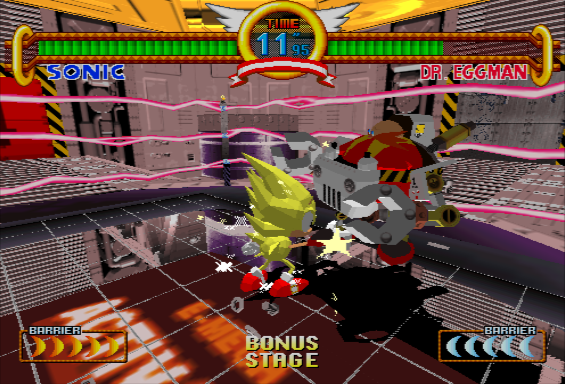
Next, Sonic's super form is playable in the game, but only for the most skilled!

(These screenshots are from the Gamecube version included in Sonic Gems Collection because I'm not good enough to get it in the Xbox 360 version, sorry!)

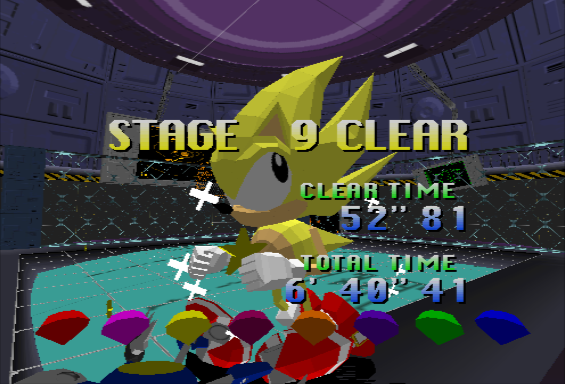
Super Sonic is technically a playable character, but you won't get to use him for very long. As explained on arcade-history, to play as Super Sonic you need to reach Metal Sonic on Stage 9 without continuing or ever losing a single round, then win the first round and activate Hyper Mode with Back + P + G at any point in the second round. If done correctly, the power of the eight Chaos Emeralds will turn Sonic into his super-powered form, rendering him invincible (you can get hit but you'll take no damage) and this carries over into the Dr. Eggman fight so you'll have a better chance at getting the proper ending! There's no other way to play as him outside of these two stages unless you do a little hacking, though.


Next, some promotional material for the arcade game.

These aren't scans, but instead screenshots, painstakingly pieced-together, from both the English and Japanese versions of Sonic Gems Collection.

Click on them to rebigulate them!

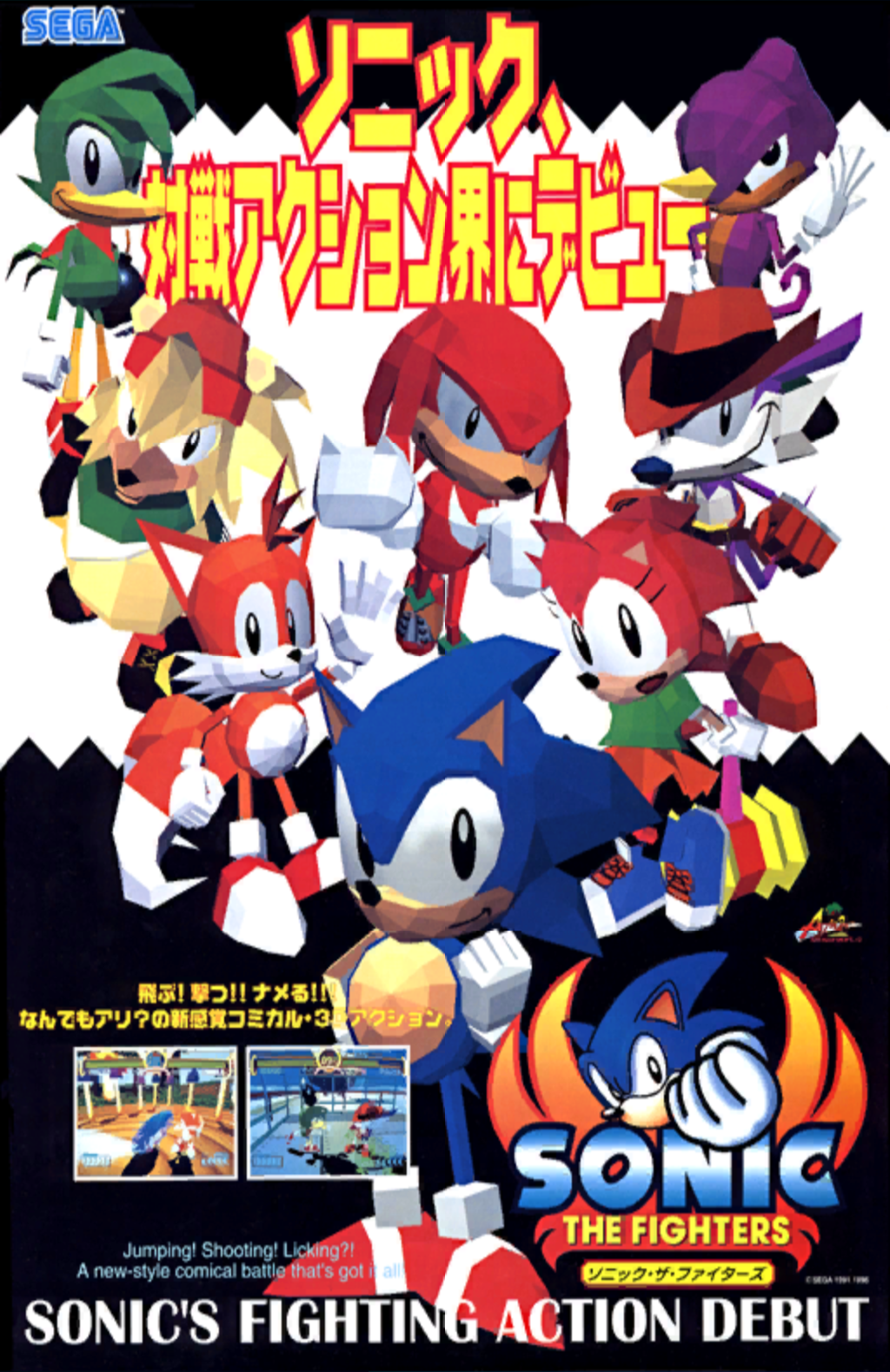
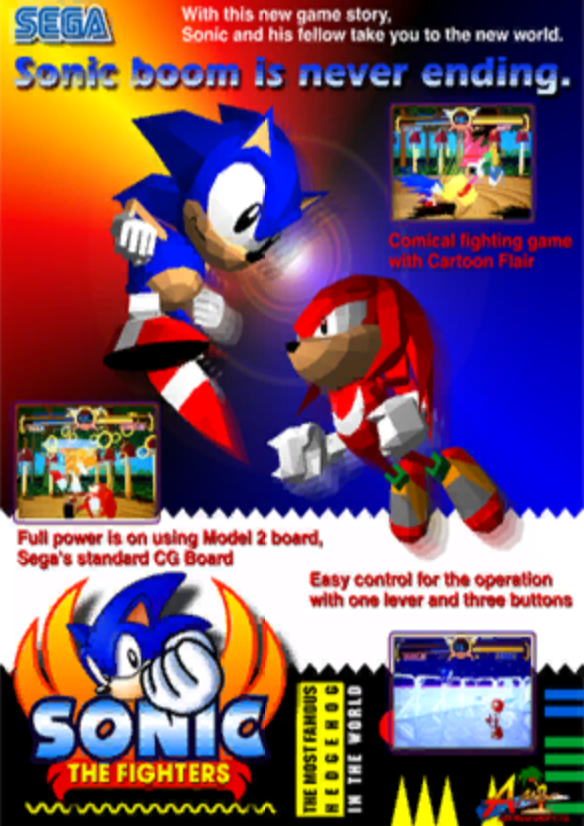
Let's start with two flyers, a double-sided one (seen in the Japanese Gems Collection) and a single-page one (seen in the English Gems Collection):


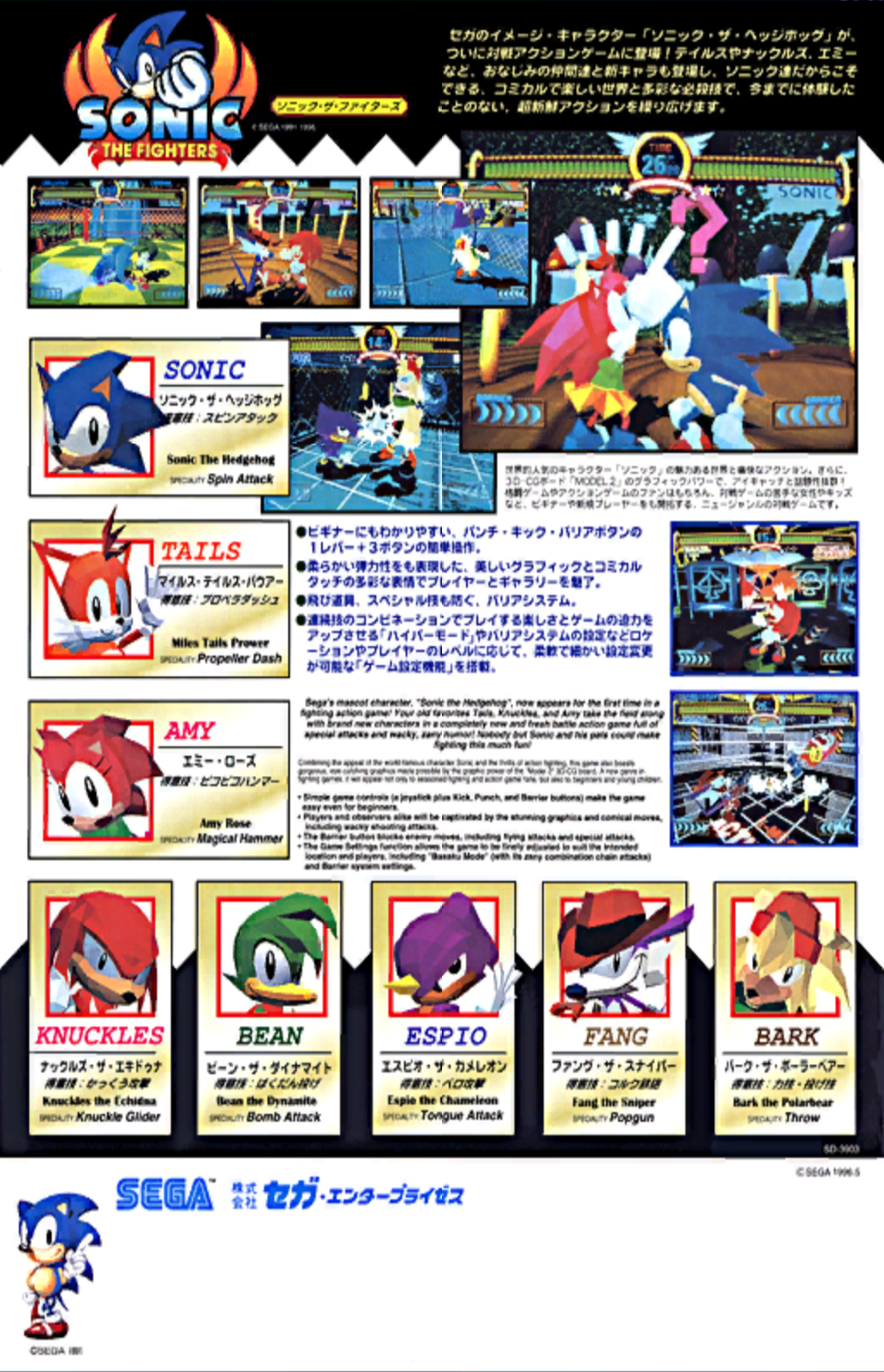
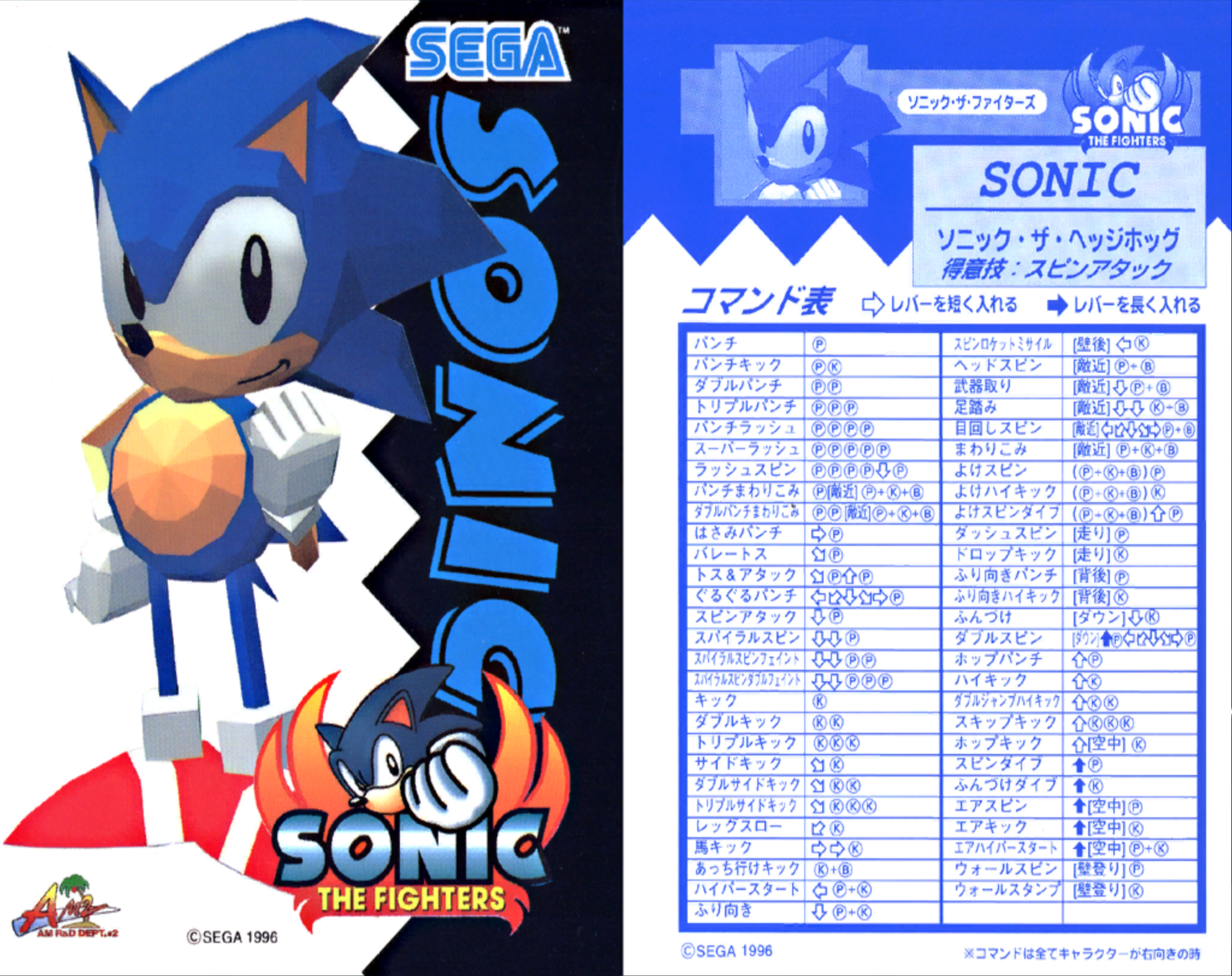
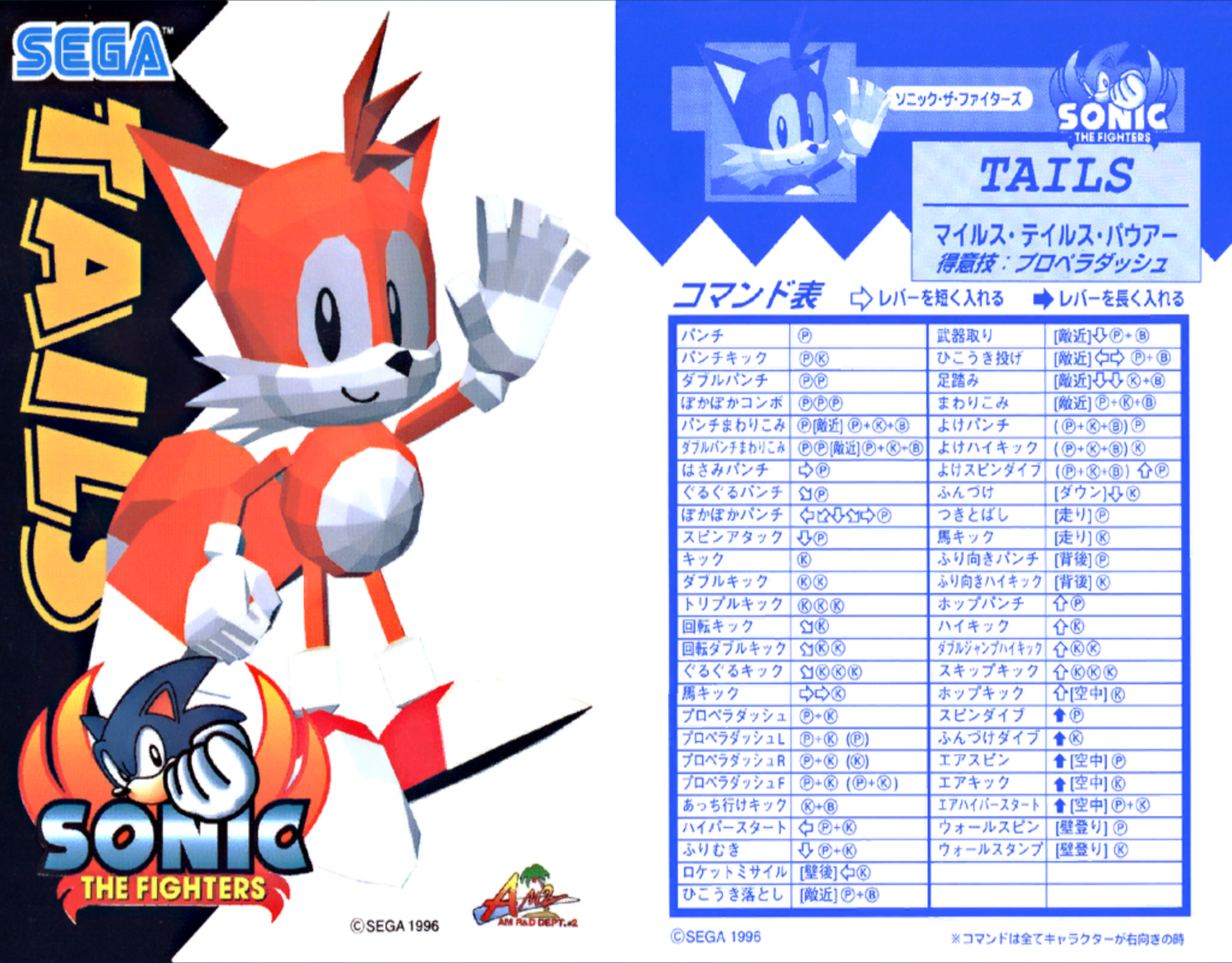
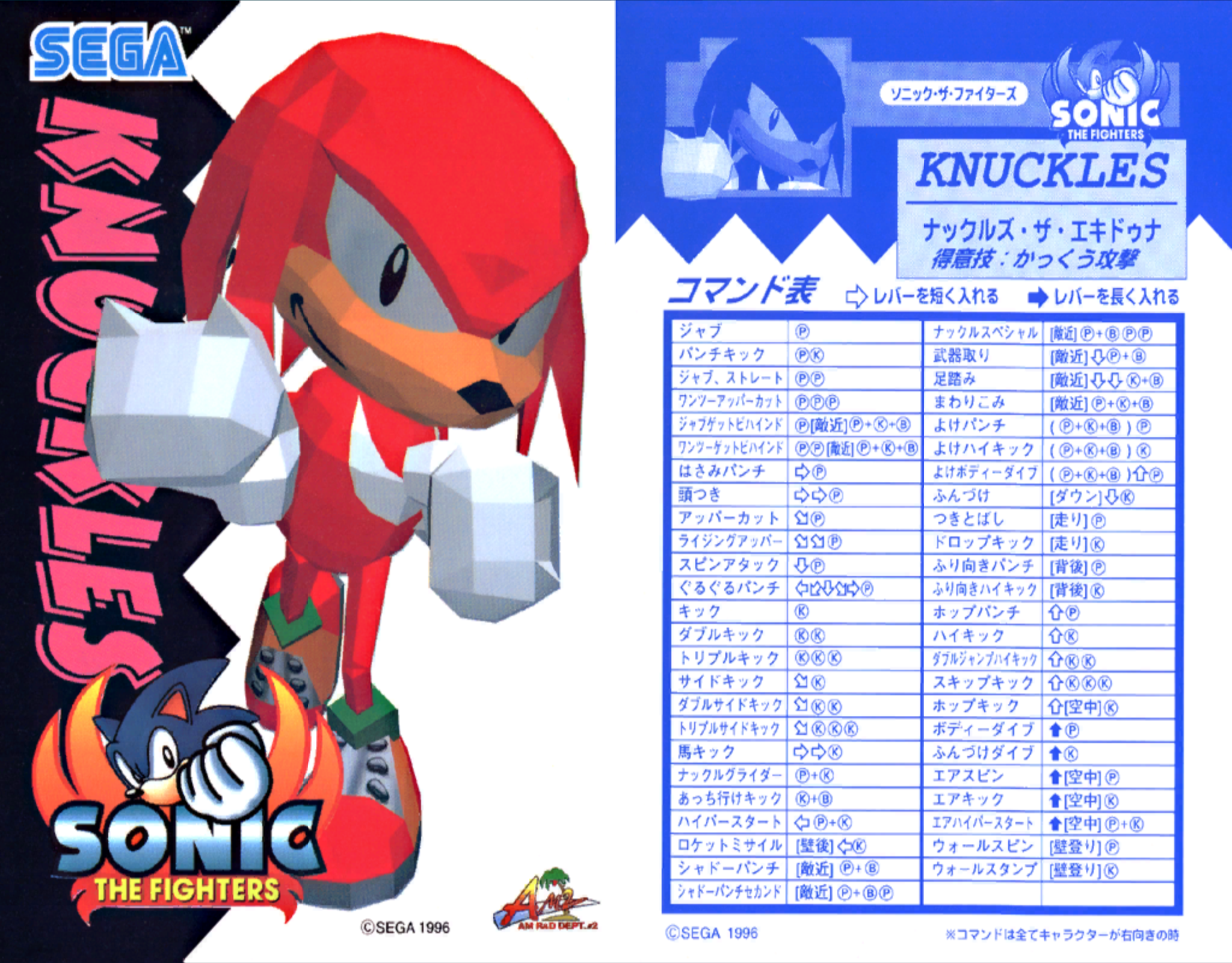
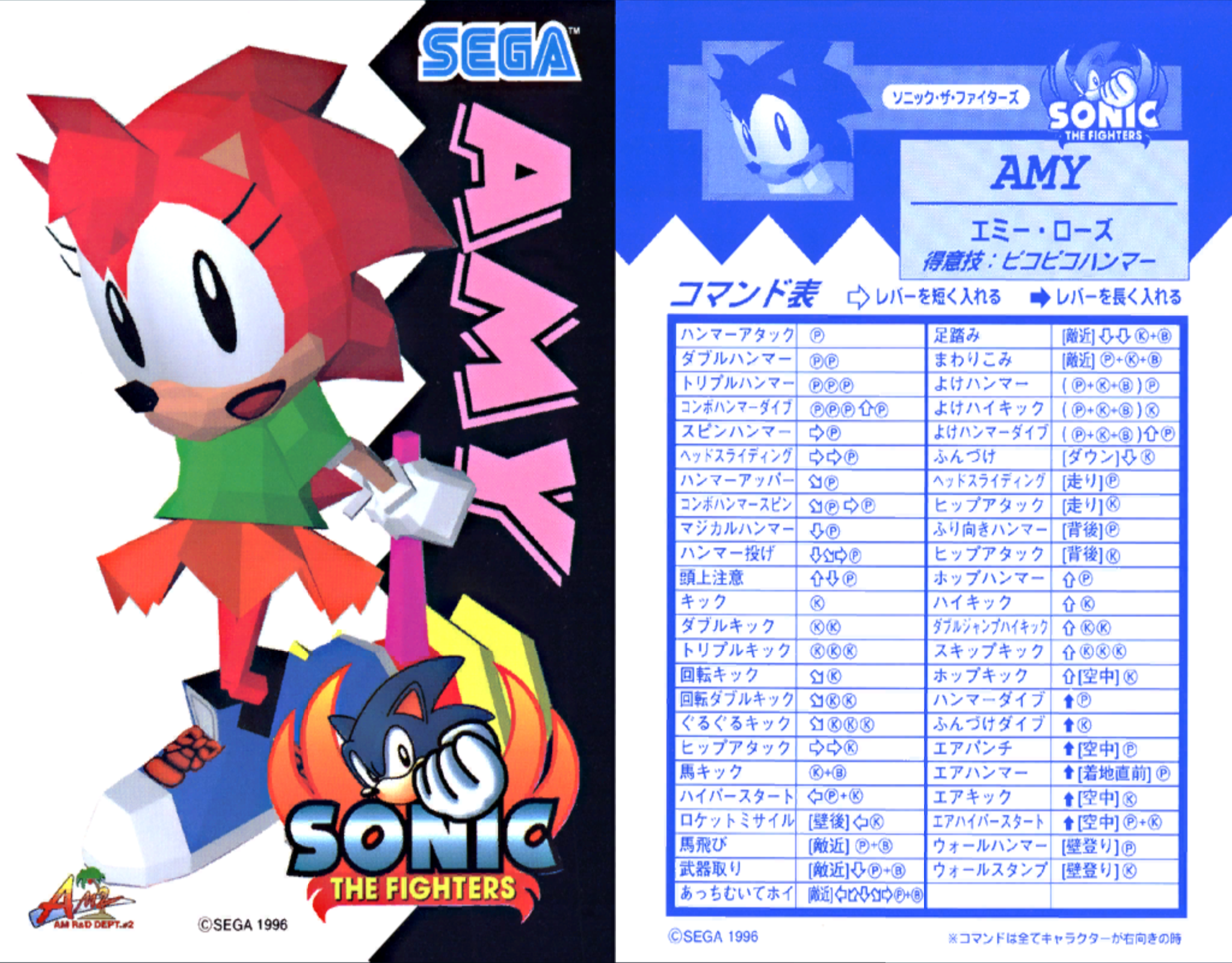
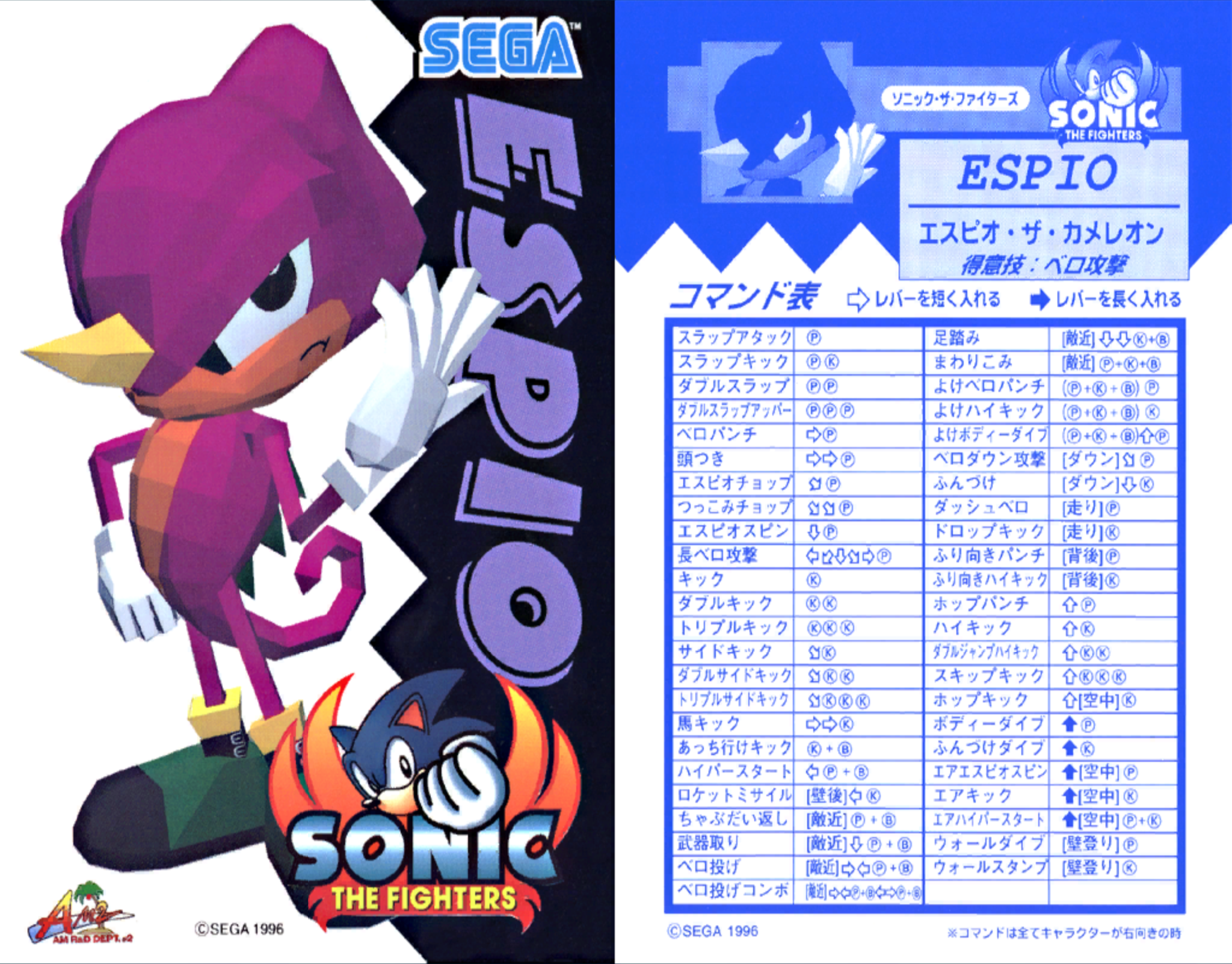
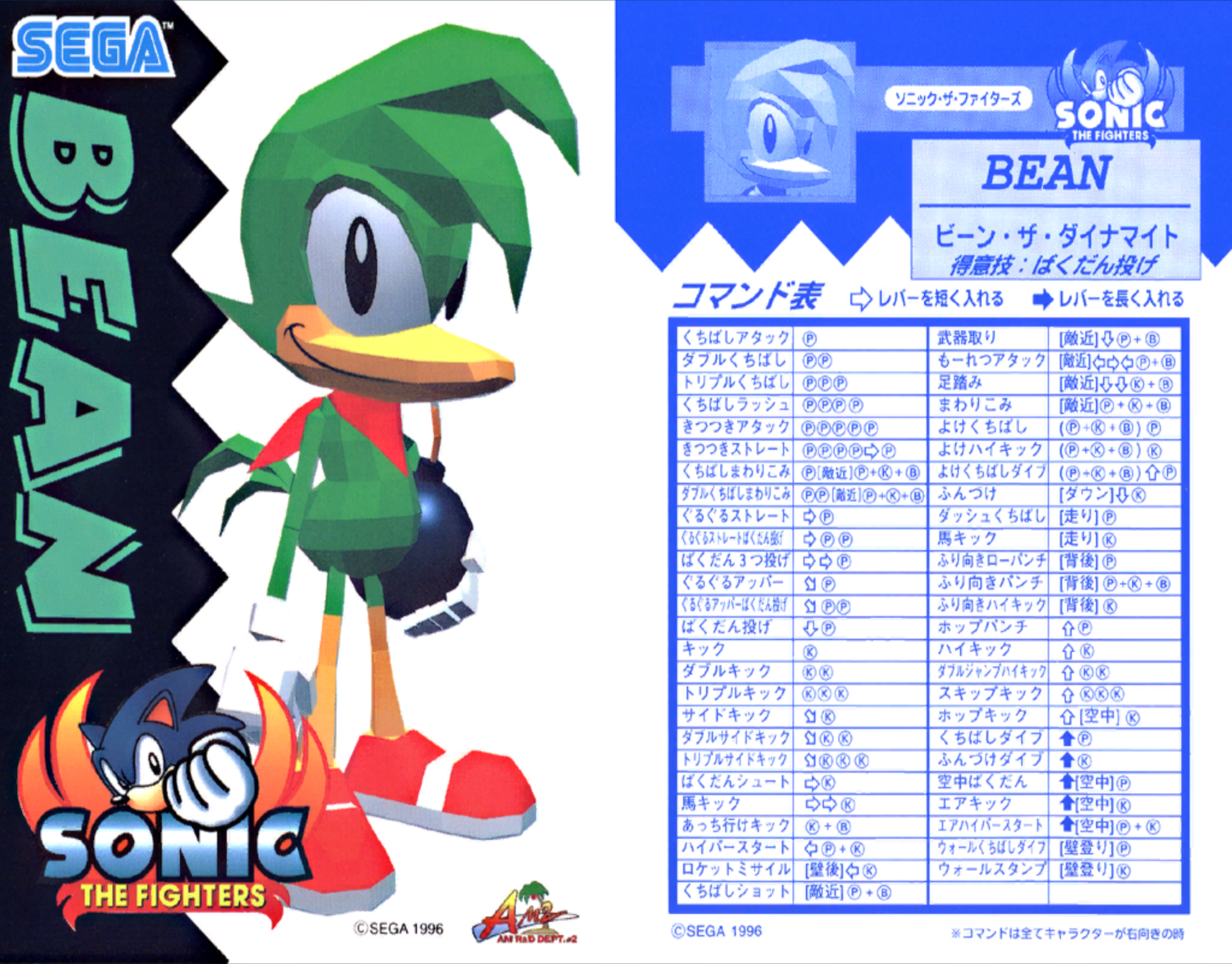
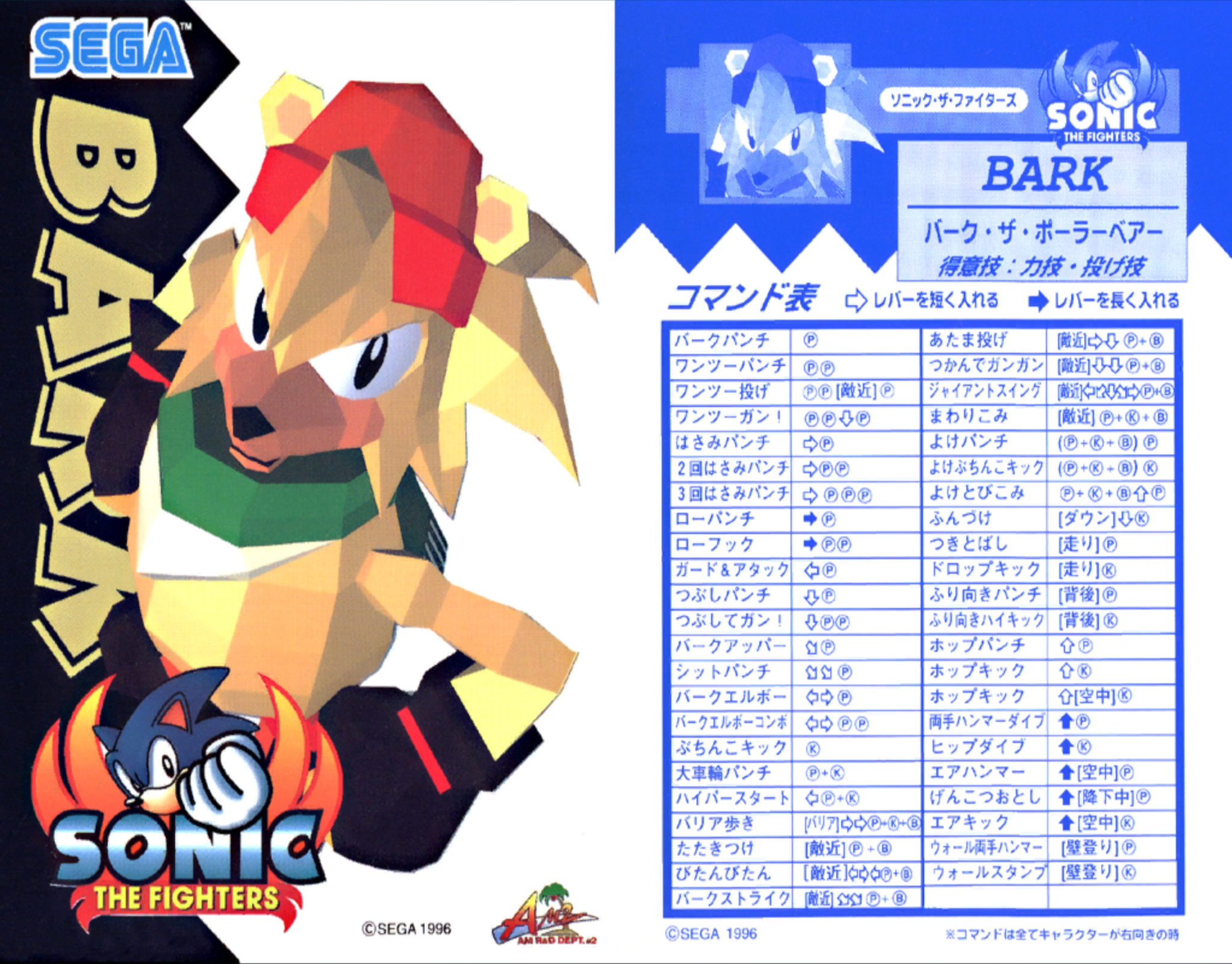
Next, detailed movelists seen in the Japanese Gems Collection:


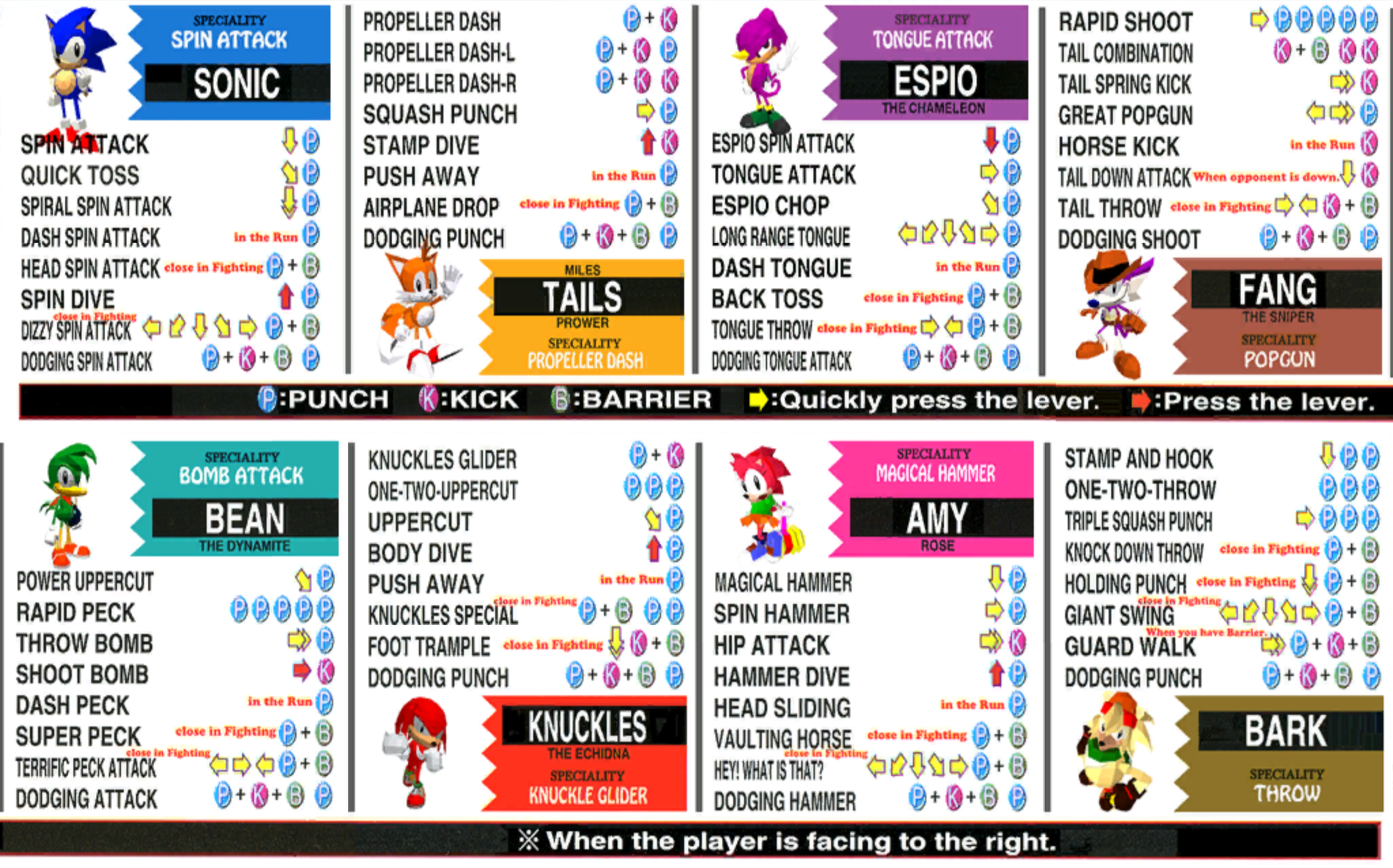
Finally, smaller movelists and control panel instructions seen in the English Gems Collection:


Moving on, let's talk unused and pre-release stuff in the arcade version!


First, pre-release screenshots, and the Development page on Sonic Retro has a pretty extensive library of these but unfortunately no sources are given, so I can't say what magazines these came from. Still, two I'd like to highlight are ones taken at the AOU Show '96 that, among several others, show off a very different and unfinished design for Bark the Polarbear with completely white fur instead of the yellow fur with a white patch on his chest that he has in the final game. It makes sense, he is a polarbear after all, but his hair and the placement of his beanie is a bit different too. Some small parts of this earlier design are hiding in the game data though, but not enough to reconstruct this look. The second shot here also shows another different, P1 was meant to have a blue lifebar instead of the yellow lifebar from the final game. You can see that early lifebar colour in this brief clip which also shows a different KO text display.

Moving on to unused stuff... This next section is based on research documented on The Cutting Room Floor and lots of it done by BiggestSonicFan.

For the sake of brevity (and to get you to visit the original page) I won't be going over everything, just picking some that are interesting to me.


First, a handful of unused models. There's more hiding in there, including 3D versions of the little animal friends Flicky and Pocky, various unused speech bubbles and assets for a scrapped pinball-themed stage, but the ones that particularly interest me are the heartstruck heads for every playable cast member and a cameo from Sega's 1982 arcade game star, Pengo! The heads have the characters with their mouths agape and with hearts in their eyes, suggested by TCRF to be for a kiss-based throw Honey the Cat was meant to have (who? Ah, wait) but one of them is used- there's a small chance Amy's "Heads Up!" move will spawn the heartstruck Bean head. As for Pengo, TCRF speculates it was for a cameo in the Aurora Icefield stage, which would've been cute, but it would've been odd to just have him wandering out there alone... There's also some extensive debug tools you can access via a code entered using the Service button, explained over at sudden-desu in two parts (and they're in Virtua Fighter 2 and Fighting Vipers as well!).

Next, some unused music. Alongside an unused variant of the Character Select theme and an unused jingle, there's two major themes the game never uses. One might be due to an error- Death Egg's Hangar, where you fight Dr. Eggman in the single-player mode, has its own song (titled Death Egg's Hangar ~ Hurry Up on the soundtrack) but instead uses Sonic vs. Knuckles ~ North Wind, leaving its actual theme unused (there's also an unused duplicate of Death Egg's Hangar, pictured above, that does use the correct music, which may have been intended for two-player mode but ultimately it can never come up, although Death Egg's Eye can). The other song is completely unused, as Sunset Town is a song presumably meant for a scrapped stage, we'll get to what I think it might have been intended for in a minute.


Of course, there's a bunch of unused fighters as well, similar to Fighting Vipers, but it's a little different here. Rather than including members of AM2 as little jokes, the 'unused' characters here are mostly ones seen in the game's attract mode sequence. It's a little similar to what you can do in Soul Blade on PS1 by forcing characters seen in the endings to be playable, but interestingly most of them have proper character name plates as if they were meant to be real characters. These include RoboEgg (a small robot that appears of the Dr. Eggman scene in the intro), Rocket Metal (a rocket-shaped variant of Metal Sonic that appears in the outer space scene of the intro), and multiple versions of Dr. Eggman including two outside of his mechs (one small, one big, just like Mahler and B.M. in Fighting Vipers), one in the UFO used to create mirror matches and an unused, heavily-incomplete variant of his mech with tank treads.


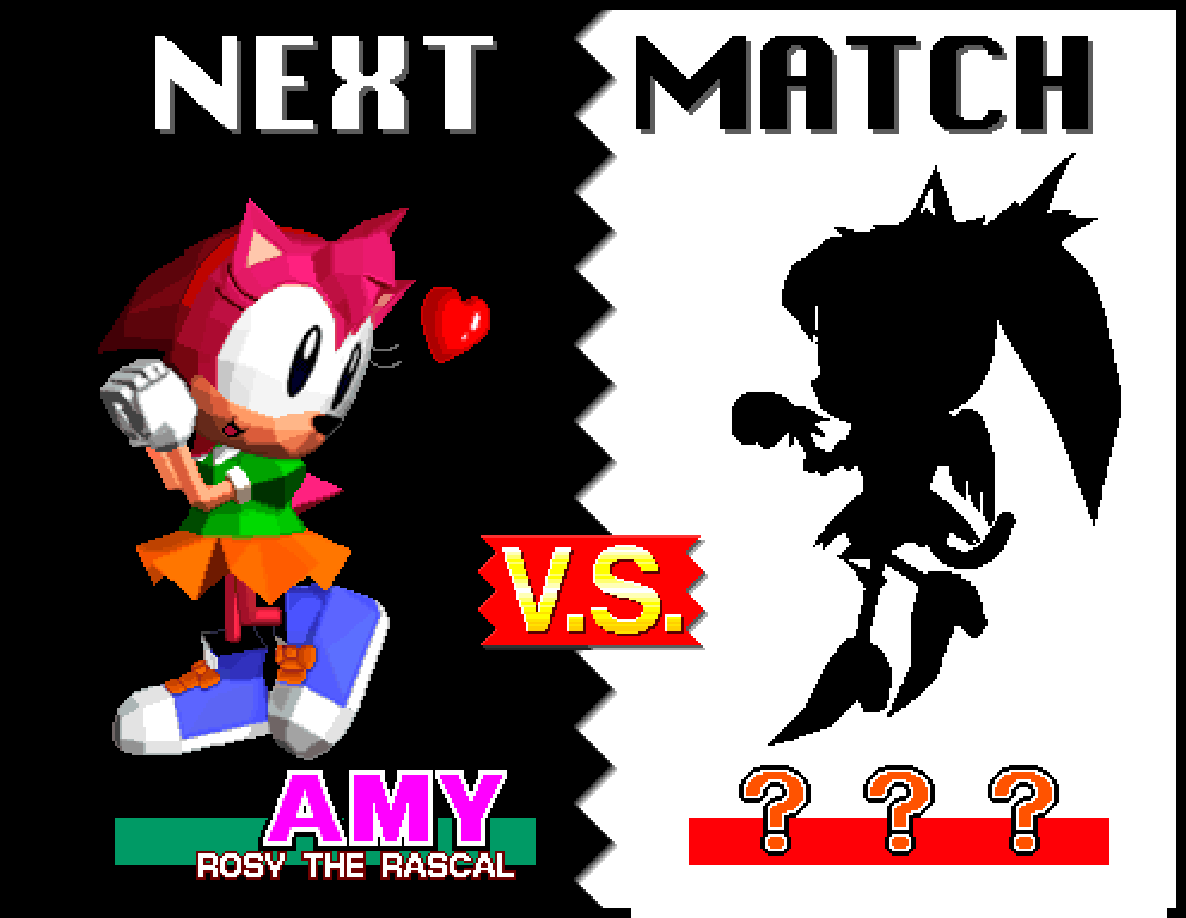
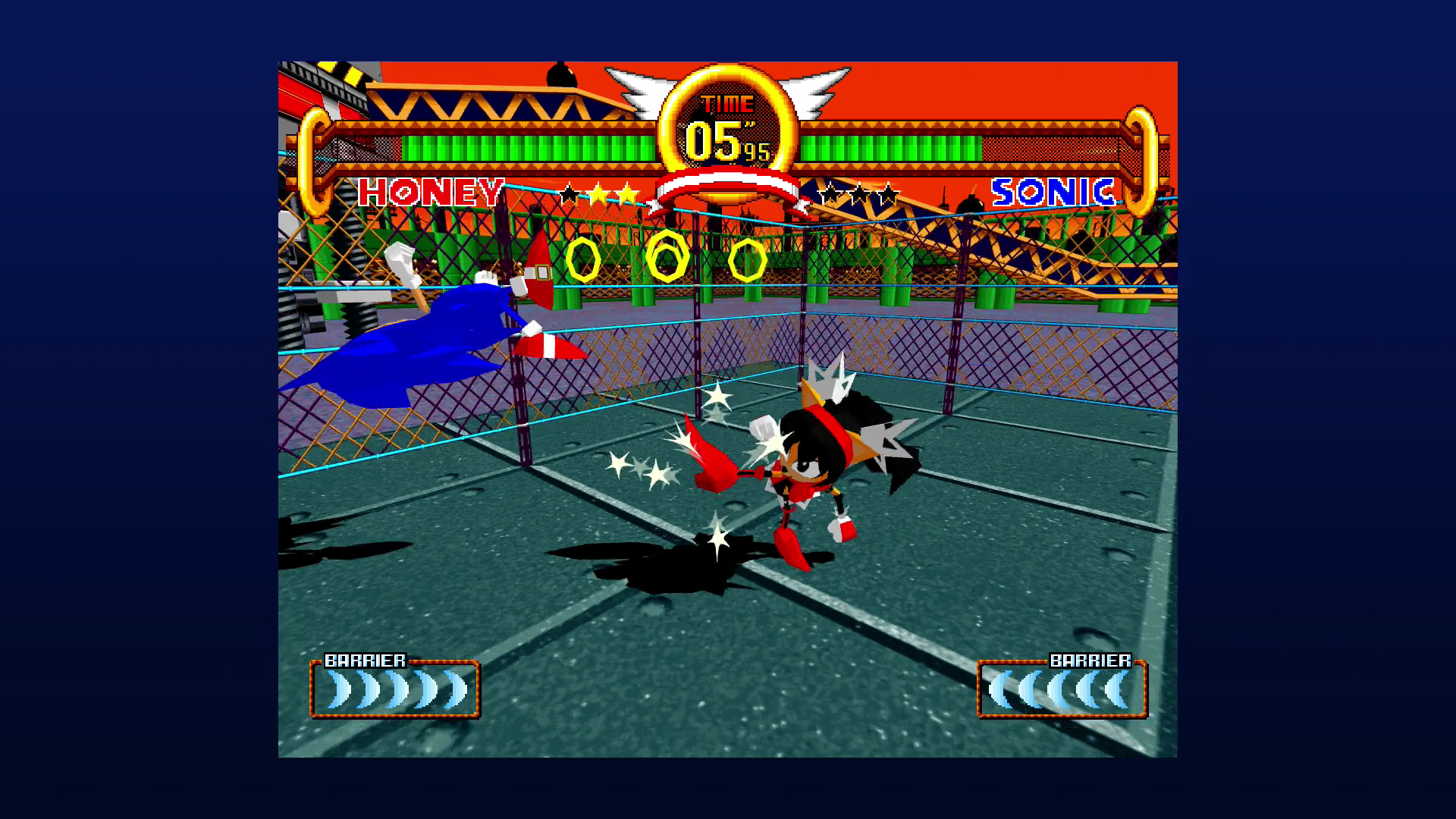
The big one is, of course, Honey the Cat. Shortly after the release of Sonic Gems Collection on Playstation 2 and Gamecube in 2005, BiggestSonicFan found remnants of a completely unused character that had its model removed from the Gems Collection version and, upon exploring the arcade version and documenting the findings on Sonic CulT / X-CulT, found what remained of Honey the Cat, a scrapped character based on Honey from Fighting Vipers but as a Sonic-style cat! In particular, Honey was mostly complete (many of her moves are taken from Knuckles but she has her traditional Bootie Bop from FV) but has some visual oddities- her eye-tracking is broken, her lower body turns into Amy's body when squished and while she has a silhouetted pre-match image, she'll use an otherwise-unused one for Dr. Eggman instead. She's also unique amongst the StF cast as, while everyone else has a black-and-white clone, she has her FV 2P colours (blue clothes, blonde hair and pink fur) in mirror matches! That 2P outfit version was snuck into the FMV intro of the Saturn port of Fighting Vipers as a joke, even! This leads me to pure speculation, but I wouldn't be surprised if Sunset Town was meant to be used for Honey the Cat's stage- the Old Armstone Town arena used by Bahn and Sanman in Fighting Vipers would be a good fit for such a theme, even if it wasn't Honey's arena in that game (she had the Bay Side stage instead). Just a thought!


Honey's rediscovery many years after the game's release lead to an influx of interest and fanart of her, eventually being half-canonized into Sonic lore when the 2012 Playstation 3 and Xbox 360 port of Sonic the Fighters included a fixed-up version as a secret character (sadly, you can't play as her in Ranked matches) as well as appearances in both the Archie and IDW Sonic comics. This Japanese Sega blog also has a few extra details on her reimplementation into this version- specifically, the team were surprised not only to find her data in the arcade code, but also that Western fans had even drawn fanart of this otherwise unused character, and that they brought Daichi Katagiri back to help fix her up to put her back in the game, so she finally got her moment in the spotlight. Isn't that lovely?


Normally we'd do home ports first, but, well, we have to address the planet-sized elephant in the room first.

Where was the Sega Saturn version?


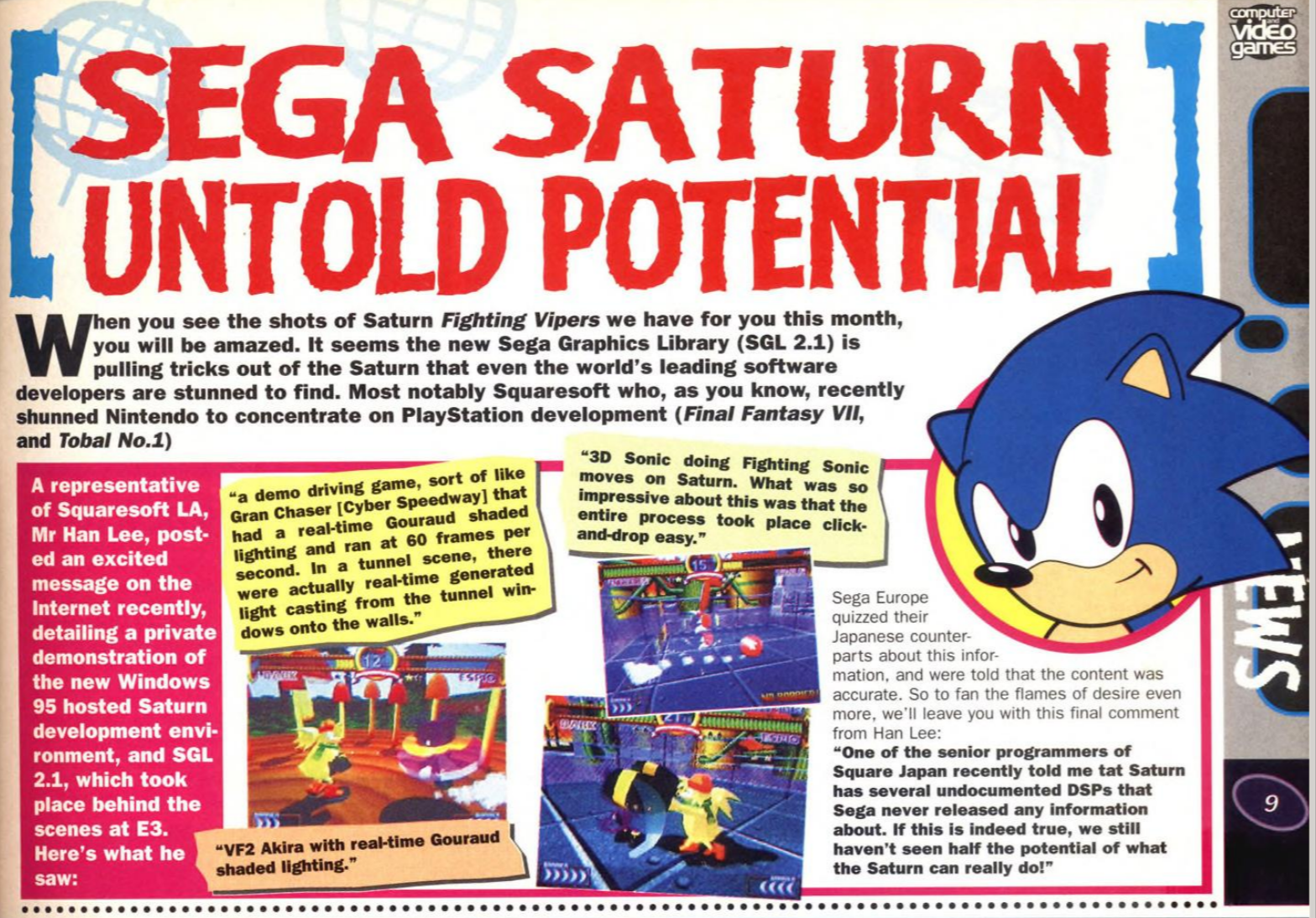
This is one of those things that was constantly rumoured at the time but, as far as I'm aware, was never shown in any capacity. It's also a strong demonstration of how a confusingly-phrased article from a video game magazine of the time can be warped into something it's absolutely not, my favourite kind of thing when I'm researching decades-old video games. Did I say 'favourite'? I meant 'least favourite, the worst thing, only villains do this'. Computer & Video Games Issue #177 from August 1996 has a section on a behind-closed-doors demonstration at E3 of the Sega Graphics Library 2.1, witnessed by a Mr. Han Lee of Squaresoft LA (confirmed by ragequitter87 to be a real person who would later go on to create Manic Game Girl for the PS1, thanks!) showcasing things like Akira from Virtua Fighter with full Gouraud shading and, quote, "3D Sonic doing Fighting Sonic moves on Saturn. What was so impressive about this was that the entire process took place click-and-drop easy" which is a little confusing but, after chatting about it with other, much smarter people (thanks, ohfivepro and DeconTheed!) this was probably just a graphics demonstration, showing Sonic doing moves possibly from Sonic the Fighters, but certainly no confirmation of a port being in development. At the time of writing this article, Wikipedia cites this article in the section on the planned Saturn port and frames it as "a Saturn version of Sonic the Fighters was shown" which, you know, isn't what was said and there's no evidence of such a version existing. Thanks, Wikipedia.

So what is there? Not a whole lot. When Sonic the Fighters was first being revealed, a few magazines claimed a Saturn port was in development, with Sega Saturn Magazine Issue #4 from February 1996 claiming (in a news piece that starts with 'Put away those suicide notes... Sonic is back!' which, yep, that's a UK magazine for sure, keep it classy) that a Saturn port would release 'a few months after [the arcade game release]' which seems very optimistic, plus confusing matters is discussion of a separate Saturn Sonic project which one could easily mix up with Sonic the Fighters. However, UK magazine MAXIMUM (always all-caps, gotta do that), specifically MAXIMUM Issue #3 from January 1996 covered that story and was more direct in its explanation, saying that a Saturn conversion was only "under consideration" according to AM2. That matches up with what was said in the 1995 issue of Saturn Fan from that far-flung time of 'at the start of this page'. The only other really solid evidence that it was at least being seriously considered is Sega Saturn Perfect Catalogue from 1997 that lists the game as a tentative '1998' release. That's about it. The Saturn is also mentioned in this interview with Yojiro Ogawa, producer of Sonic Gems Collection, who explains "Console hardware has evolved since the time of the Sega Saturn, making it much easier to recreate what was quite difficult to reproduce at the time of Sega Saturn", which makes sense as his Sega Retro page mentions he joined the company in 1995 and worked on Panzer Dragoon Saga for the system. Still, not confirmation that it ever existed, but interesting to note.

This is a long and roundabout way of saying that, in my opinion with the evidence we have, if there was any work done on a Saturn port of Sonic the Fighters it was probably very preliminary, and more likely there was little beyond looking into the possibility of it done at all. What I'm saying is, I wouldn't hold my breath for a development build to ever surface. Looking forward to this paragraph blowing up in my stupid, punchable face in like ten years. Or maybe five minutes after I upload this thing, knowing my luck.

... But while we're here, let's talk about the Sonic the Fighters stuff that did end up on the Saturn.


First, the Fighting Vipers port has a few nods to the game. There's some visual cameos in its FMV intro (among the trinkets in a toybox that Sanman pulls his helmet out of, you can see the Lunar Fox, the transformed Metal Sonic from the intro, Bark and even Honey the Cat in her 2P outfit!) and a poster for the game that appears in one of Tokio's Portrait CGs. More interestingly, the Hyper Mode that you can switch to in most modes is essentially an adaptation of some mechanics from Sonic the Fighters into Fighting Vipers, specifically the sidestep and Hyper Mode activation (here it removes your armour and gives you Hyper Mode for the rest of the round, but you can't use it for the rest of the match after that) which is a fascinating way of giving Saturn owners a sense of what Sonic the Fighters is like in a small way, even if they might not realise it.


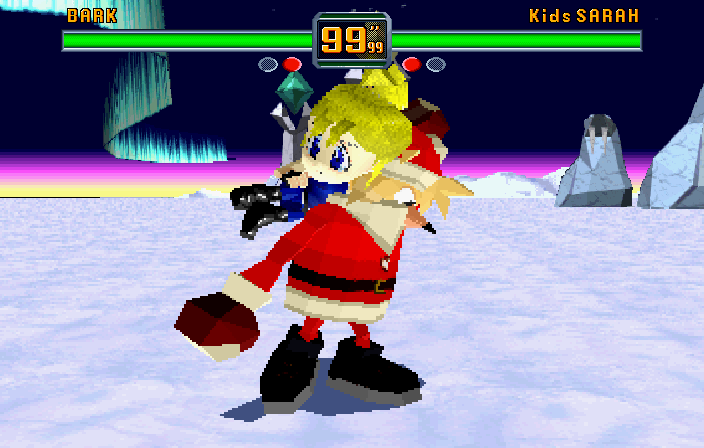
You're probably not thinking of that though. You're thinking of 1997's Fighters Megamix, the crossover fighting game with an all-Sega AM2 cast, and Sonic the Fighters does indeed get represented with its two original stars. Bean and Bark are unlocked by beating Course £ - Muscle in the 1P Mode (you need to beat Courses A-D first to get the second set of Courses, though) where you fight Bark its boss, and you'll also fight both Bean and Bark in Course I - Secret. As well as both characters, you also get two stages based on Sonic the Fighters, with Bean getting South Island as a walled stage (originally Knuckles' stage, but we'll let it slide) and Bark getting Aurora Icefield as an open stage (sadly missing the reflective floor, and the music is from Flying Carpet instead, oops). As a bonus, they get proper second costumes rather than black-and-white clones, with Bean getting a Bin outfit and Bark getting a Santa getup. They mostly have their moves in-tact (they both have their Hyper Mode-exclusive moves as standard, although you'd have to activate Hyper Mode, a secret option, to use Bark's Hyper Lariat to its full potential) but, to put it politely, their implementation is jank as all hell. Their attacks do very little damage to the rest of the cast, their movement is strange and glitchy at points, they don't have all the facial expressions they're supposed to (they never open their mouths and they no longer have the eye-tracking, making them look like people in mascot outfits) and they can only use throws on themselves and the Virtua Fighter Kids characters, no-one else. In other fighting games, this'd be worthy of ridicule and admonishment, but it's Fighters Megamix, so it's all in the spirit of the thing, it's fine. I don't think this really serves as a 'what if' of how Sonic the Fighters would necessarily look on the Saturn, given it was apparently developed on a very tight schedule according to (Yutaka Ito in a series of tweets that reveal a long-hidden stage that had a crash bug) but it does make you wonder, doesn't it? Anyway, for full movelists for both characters, Fighters Mega Books (also on Sega Retro) has you covered (complete with funny English single-page comics for each character).


Now we get to talk about home ports! There's, like, two of them, and four if you count inclusions in the Yakuza series.


With no Saturn or Dreamcast ports, Sonic the Fighters would have to wait until 2005's Sonic Gems Collection on the PS2 and Gamecube for its first home version.


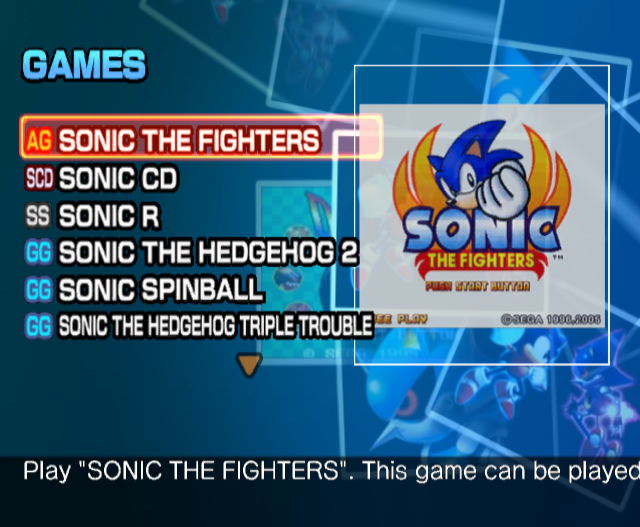
This was actually teased, kind-of, in the Walk of Fame trailer for Sonic the Hedgehog's induction from March 2005 which was several months before Gems Collection was announced- at 0:11, you can briefly see the Sonic the Fighters title screen with the mode selection text that would later be used for this port. Anyway, Sonic the Fighters absolutely fits the collection's remit of rare and unusual Sonic games without much in the way of ports or rereleases at that point in time, and so it's one of the three headliner acts in the set. This is a pretty direct port with the only additions being a dedicated Versus Mode and an Options menu with the soundtrack (including unused songs like Sunset Town) available to listen to. It's quite similar to the Sega Ages 2500 ports of Virtua Fighter 2 and Fighting Vipers that would've released in Japan in 2004 and 2005 respectively. Unfortunately, this is not a particularly optimal way to play the game- the visuals are weirdly washed-out with significantly muted colours and odd lighting and, so I am told, there's several frames of input lag (I can't really tell, I'm bad at detecting it). Additionally, the PAL version adds insult to injury by being in 50hz only, making it 17% slower than intended. Cool. On the plus side, this release did lead the charge in rediscovering Honey the Cat as explained earlier, and it also comes with scans of the arcade instruction sheets (although they're different between the Western and Japanese versions- the US and European versions only get a single sheet with small movelists, while the Japanese version gets full movelists for everyone) and unlockable art related to the game as well as a brand new remix of the Aurora Icefield theme, Fairy of A.I.F. with lyrics by none other than Takenobu Mitsuyoshi. While this would be the only home port for some time, eventually we'd get a much better one.


Speaking of... Sonic the Fighters would get its most feature-rich port as a digital release in 2012 on both Xbox 360 and Playstation 3.


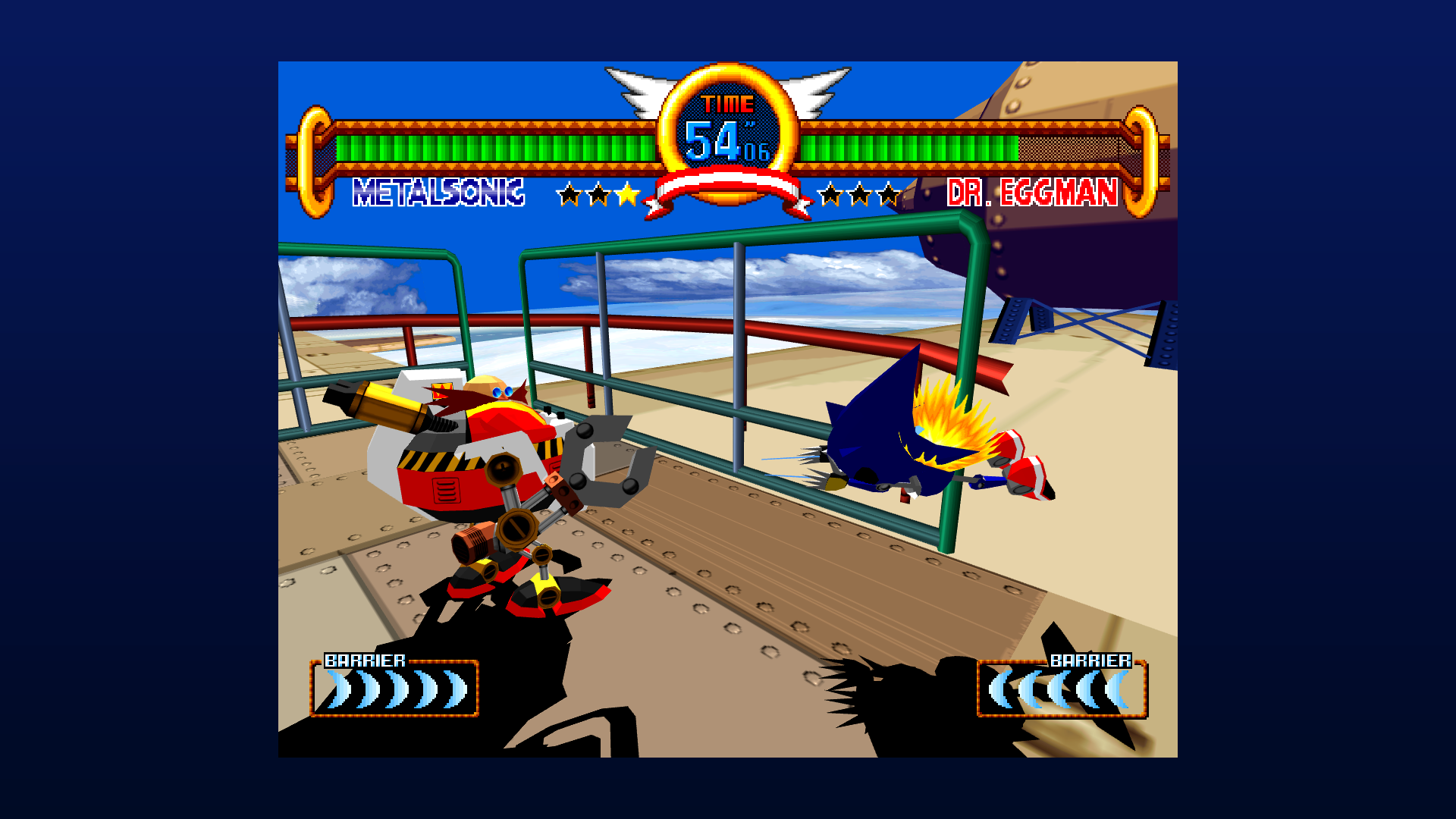
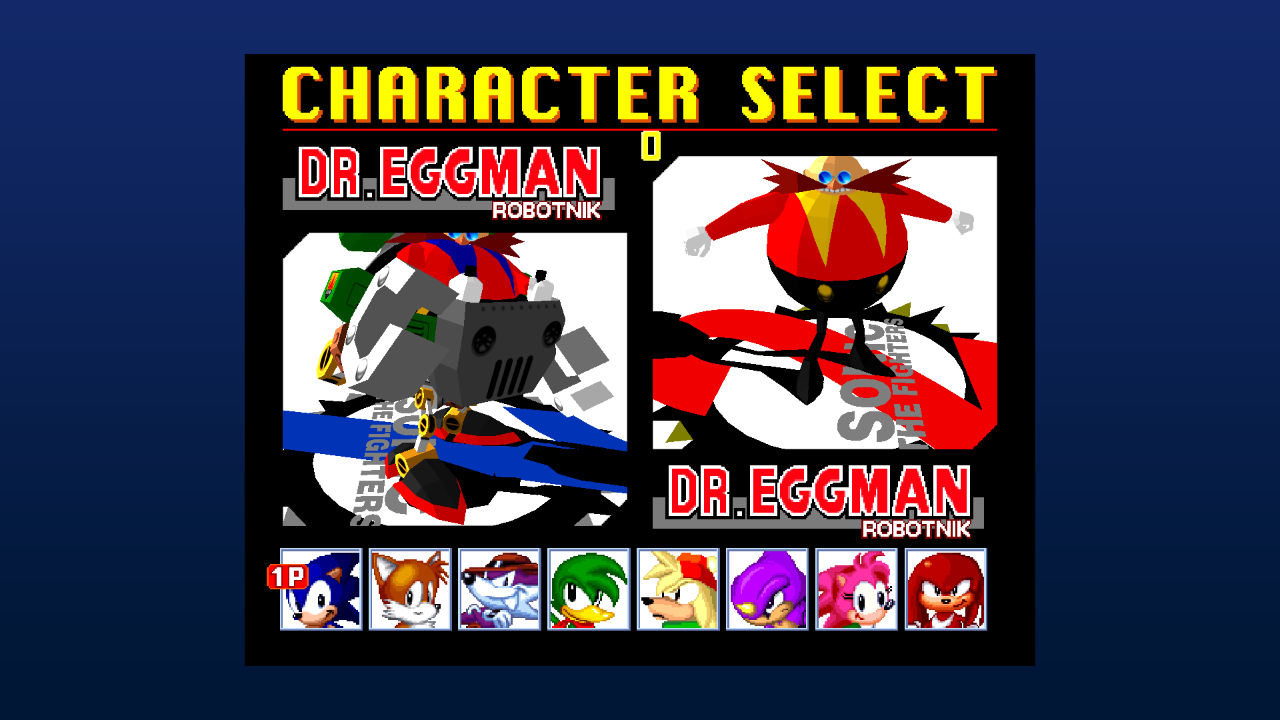
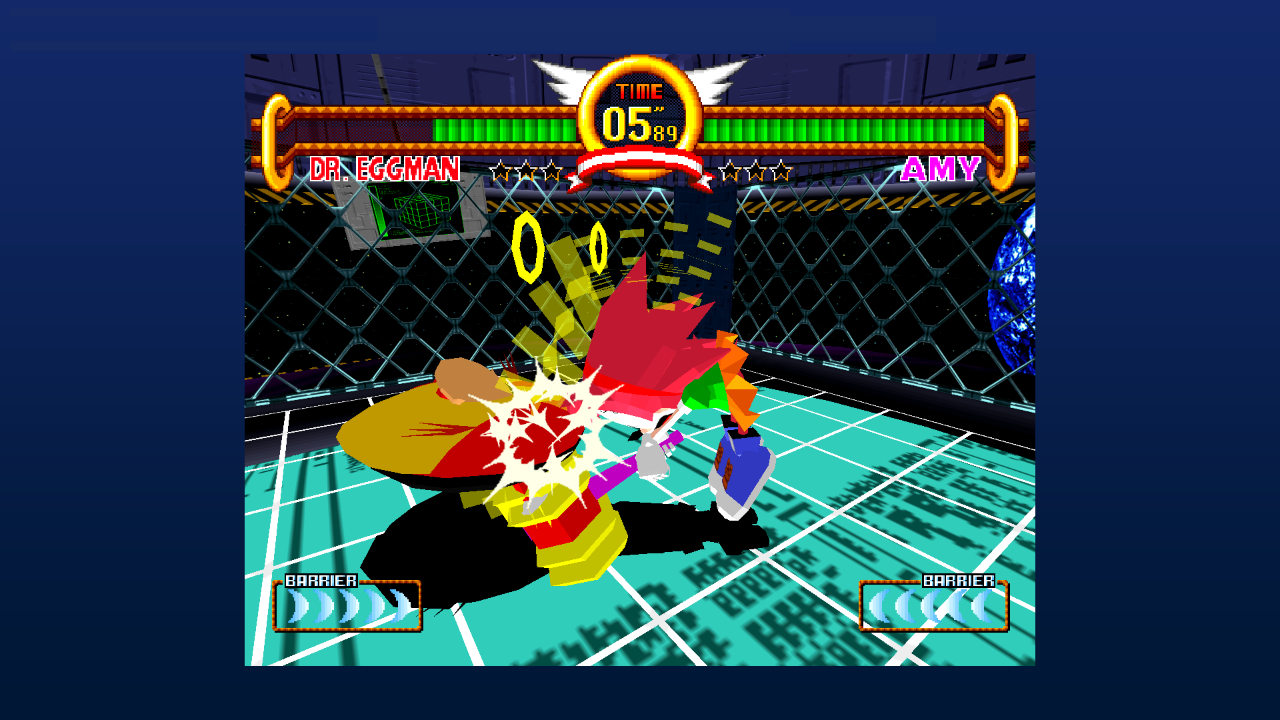
Part of a five-game line-up of Model 2 ports (Virtua Fighter 2 and Fighting Vipers would be released worldwide, but Virtual On: Cyber Troopers and Virtua Striker would remain Japan-exclusive), this version of Sonic the Fighters is a significantly better port than the Sonic Gems Collection version as it looks closer to the arcade game, lacks the input lag (as far as I'm aware) and adds both online play and three otherwise unplayable characters yours to control. Starting with the secret characters, you can play as Metal Sonic (hold Start on Sonic) and Dr. Eggman (hold Start on Bean) in two player matches, and you can play as the unused Honey the Cat for the first time (hold Start on Amy) in both single and versus play, with her animations cleaned up and eye problem fixed. These characters don't have Automatic Mode though, As for the netcode, it's decent enough, certainly not a disaster like Street Fighter II': Hyper Fighting on Xbox Live Arcade but not best-in-class like the Code Mystics Neo Geo ports, it does the job. Similar to the Fighting Vipers rerelease, this has regional differences depending on which marketplace you buy it from, although it's an odd mishmash- US and EU get the USA / Export version with English in the attract mode but it still uses the Sonic the Fighters name, while Japan gets the Japan version. Honey the Cat was also never renamed Candy, so she keeps her original name in all versions, which is nice. Sadly, the Xbox 360 version was delisted on December 8th, 2024 because... I genuinely have no idea. The Playstation 3 version should still be available everywhere except Europe because that was delisted too because Sega really has it out for us, I guess.


Before we wrap this section up though, it would be remiss of me not to mention that this rerelease, particularly the Playstation 3 version, has been the main source of the game's current life as a tournament fighting game. The PS3 version in particular is the source game required for Sonic the Fighters Community Edition, a community-created hack with many, many hands in its creation that essentially serves as a balance patch for the game, adding Honey, Metal Sonic, Dr. Eggman and, for the first time, mechless Dr. Eggman (amusingly referred to as Leggman) as standard characters by moving the cursor off the Character Select screen and rebalancing the boss characters to make them less overpowered and more viable for fair tournament play. It also completely removes catch-up / ketchup (you could remove this normally as an option but this would not apply to online matches) which needless to say changes the game dramatically, so if you're curious about playing Sonic the Fighters seriously and can't look past the catch-up mechanic when fighting online, definitely look into setting this up, there's a few steps involved but it's not too rough to get running in RCPS3 with a little digging. You might also want to look into Sonic the Fighters Tournament Edition which removes the port priority bug that means Player 1 wins most hit-trades (explored in-depth in the wusstunes video Sonic the Fighters is Broken) as well as removing catch-up.


Finally for now, we go to that place where all Sega arcade ports live these days, I guess- the Yakuza / Like a Dragon series.

Specifically, the spin-off 2021's Lost Judgment and 2023's Like a Dragon Gaiden: The Man Who Erased His Name.

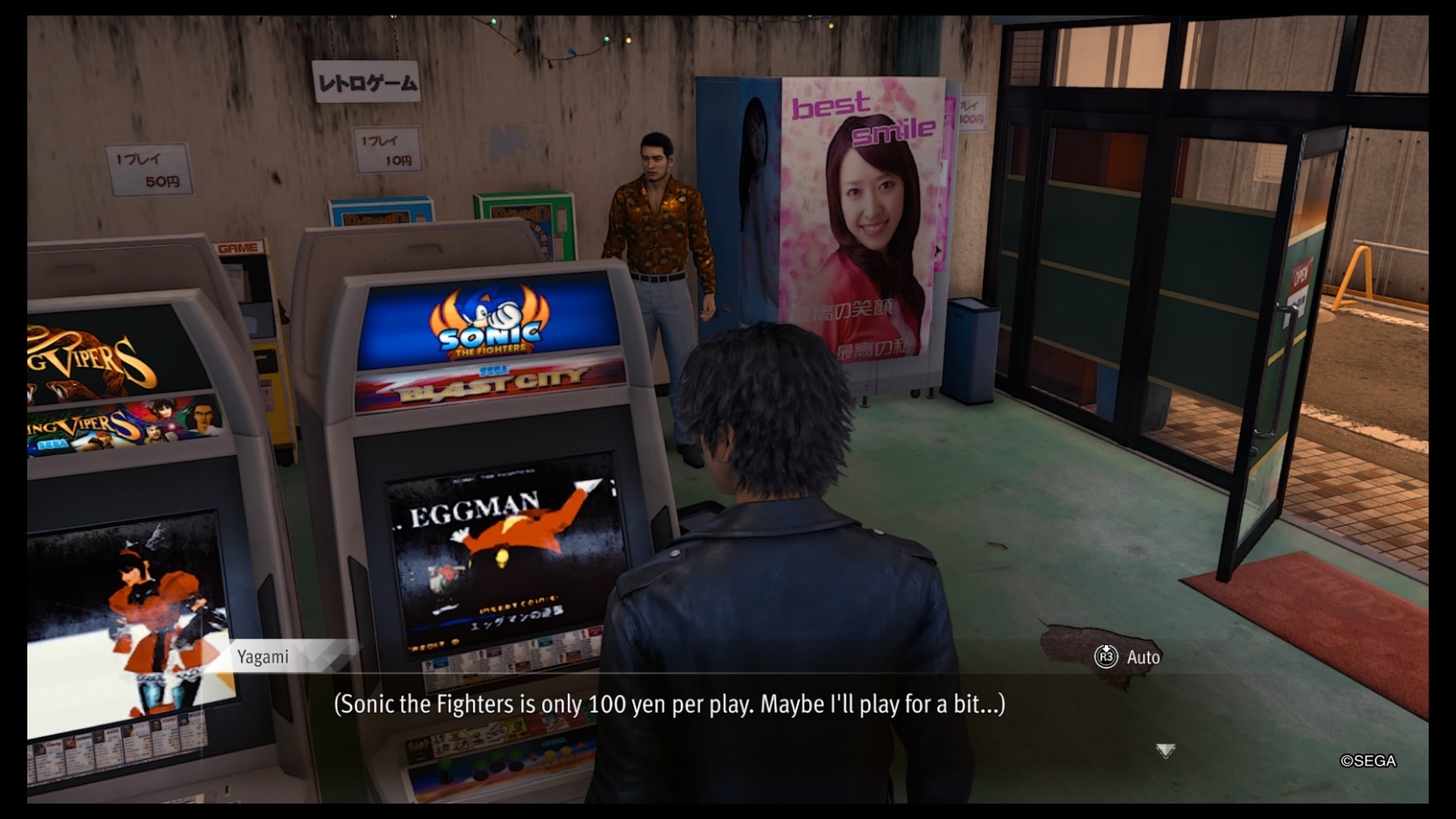
Not a whole lot to be said here, but in Lost Judgment you'll find a set of Sonic the Fighters cabs in the Club SEGA location on Nakamichi Street and at the Sasaki Arcade on Tsurukame Alley in Ijincho's Commercial District, whereas in Like a Dragon Gaiden: The Man Who Erased His Name, you'll find the game in the Sasaki Arcade in Ijincho and Club SEGA in Sotenbori, 100 Yen per play. You can also play it from the title screen as a versus minigame with a second player if you want! Unlike the Fighting Vipers port in Judgment, this stll has the secret characters of the HD port available, unlocked the same way (but Metal Sonic and Dr. Eggman are still two player versus only). All it's really missing, of course, is online play, but this technically means you have an official way of playing Sonic the Fighters on PC. Sort-of.


To end on a silly note...

I don't have anywhere else to put this, so here's Bean the Dynamite in Virtua Striker 2 (ver 2000.1) for your amusement and delight.


According to the comments, you need to force a member change (via throw-in, goal kick or free kick) with less than 30 seconds remaining against FC Sega, and Bean will enter the field!

... Oh, and the machine you're playing on needs to have FC Sega beaten at least 50 times. I think, anyway.

You can't even play as Bean, he's just part of your team, apparently.


If I've helped people understand this game a little better, or lead them to resources that do a much better job than me, then my work here is done.

COME ON, MR. SONIC