EDITOR'S NOTE:
Ooh, we had a fancy little setup this time, kind-of! This review was conducted via the Taito Egret II Mini for actually playing the game and MAME for grabbing screenshots, and most of the secrets are explained in the Taito Station Magazine that came with Arcade Memories Vol. 2 expansion card the game was included on. However, it would be rude of us not to mention and link to Bisboch's LA PARTITINA 01 - Return of the Invaders video which inspired the writer doofus to look more into the game to begin with. They were part of the team that made the famous Bubble Bobble hack Lost Cave so take a look at that if you would. No other real notes on this one except hope you're ready to read about like a million other Space Invaders game, I think my writer dorkus has gone all-in on the series and is only going to write more about them. This is a threat.
In 1985, seven years after the Space Invaders first enveloped the sky like a cloud, they returned!
In Return of the Invaders. Obviously.
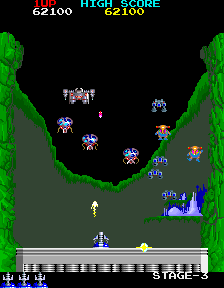
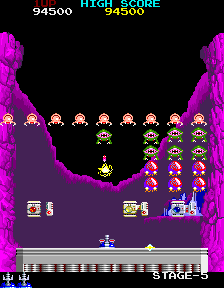
So, this article only exists because of a different one, really. I was ready to get guts-deep on Majestic Twelve: The Space Invaders Part IV when it occurred to me that, well, there's an arcade lineage here, so wouldn't it make more sense to cover the first attempt to modernise Space Invaders and see where the series goes from there? Half a decade before Majestic Twelve's shot at bringing the Invaders into the '90s, Taito released Return of the Invaders to do something similar for the '80s... However, Taito didn't develop this one, as an Easter egg and hidden in-game text shows, this was the work of a company called Comix, with three employees identified here. Hikaru Kasahara has no other credits, but Nobuo Kodera and Akira Nakakuma were previously at Coreland and worked on their classic ice-block-em-up Pengo distributed by Sega. John Andersen adds a bit more info here by explaining Akira Nakakuma would later start Soft Machine in 1989 but it's unclear if Comix was the same company just under a different name or a unique entity. Some places also credit UPL to this game, but as well as these credits making that doubtful, a website called UPL GRAVEDIGGER (which might be the best source I've ever had to use) which at least presents itself as being written by someone who worked at UPL mentions that a "Mr. F" was known to work on it but casts doubt on whether UPL had any kind of involvement otherwise. The only other info we've got on the development here is from the Taito Station magazine included with the Taito Egret II Mini's Arcade Memories Vol. 2 expansion card which mentions that the game's development took over a year which is quite long for a game like this at that point in time. Kind of a weird history for a Space Invaders sequel, huh? Not the first time a game in the series would have an extended and difficult development cycle, but that's a story for another time.
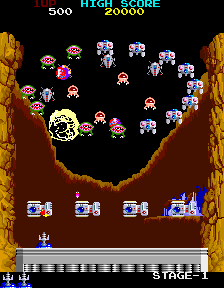
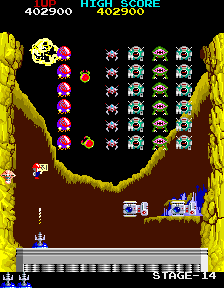
Anyway, let's start talking about the game. Return of the Invaders sees you piloting the Xerovy cannon, protected by Xero-Guard barricades as you fight off wave after wave of invaders from space across twenty increasingly-difficult rounds before the game loops. An upgrade to the original core cannon, the Xeorvy can fire two shots at once instead of one, but you still have to make every shot count to destroy the entire fleet before they reach the ground, because if they do, the invaders win and it's an instant Game Over, regardless of how many lives you've got left. So far, so Space Invaders, but as this is the very first official sequel outside of the 1970s (sorry, Midway's cocktail cabinet Space Invaders II), there's quite a few new ideas here to mix things up. Let's start with the changes I like, and first and foremost, there's five new types of formations the invaders assemble themselves into at the start of each round- first, a striking spiral formation with three rings spinning in alternating directions; a standard-but-smaller nine by five grid; invaders loosely arranged into the shape of a giant invader; a seven by six grid with invaders that head directly down the screen rather than doing the ol' side-shuffle; and another nine by five formation but with larger gaps between the invaders so they hit the edges of the screen faster. That's a decent amount of variety considering it's sticking solely to the Space Invaders style and not having multiple kinds of boards like Gorf or Phoenix, and they generally work pretty well, although maybe mixing things up just a bit more would've been nice as some of the stages are a bit similar to one another. Additionally, the spiral formation can be trickier than you'd expect as invaders only need to brush the bottom for it to count as an invasion and instantly end your game- this is closer to the original game's rules, as later sequels just take a life away instead, reminding you that you are in the harsh, untamed field of the 1980s. At the very least, Taito liked the spiral formation enough to include it in Majestic Twelve five years later! The way the invaders attack you is much the same but has the benefit of using colours (red and blue) to denote which shots you can intercept and which you can't, with the UFOs also firing yellow shots that try and home in on you, although only very slightly so it's not too scary.
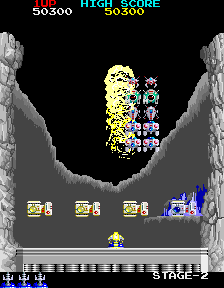
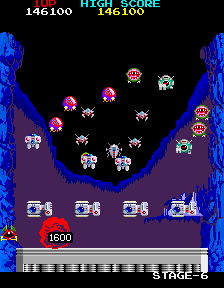
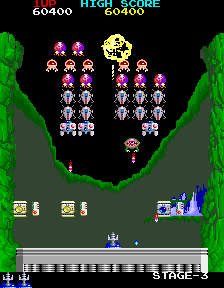
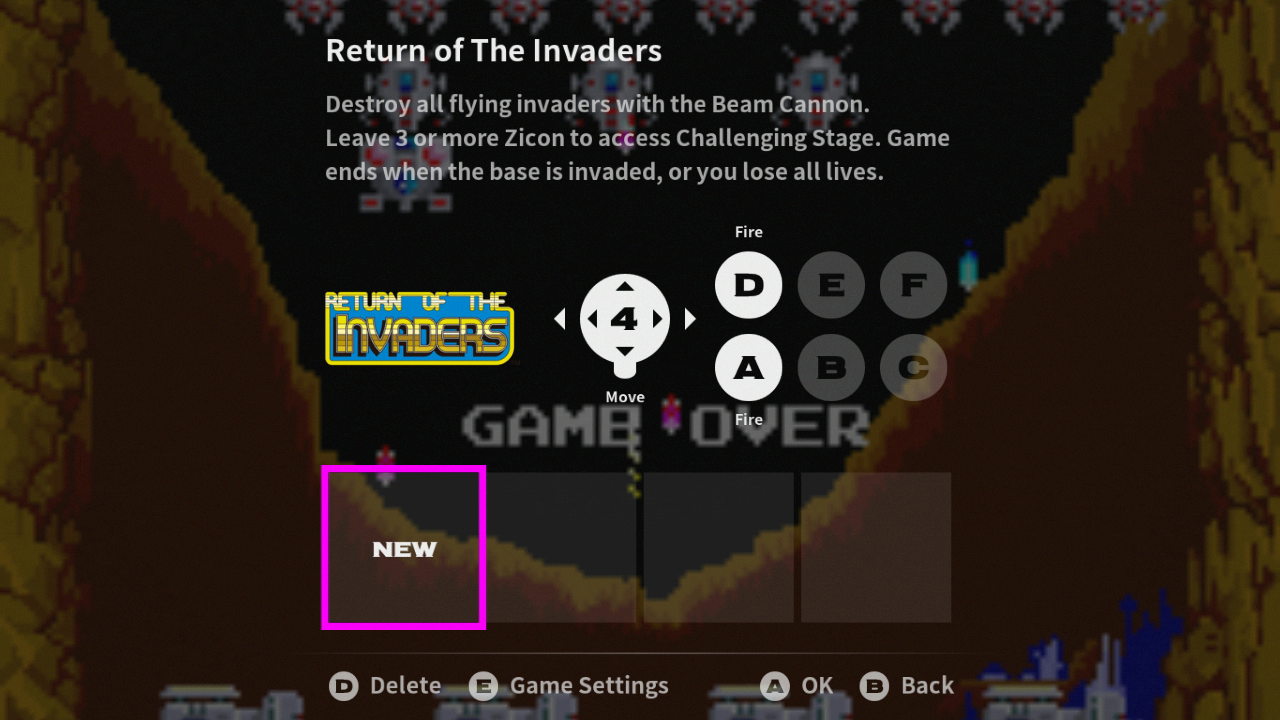
Another thing I quite like about this one is it continues the tradition of having weird little secrets and actually goes in a little harder on them. The 'rainbow' secret from the original returns (where leaving an invader on the bottom row as the last one you shoot down- this time not possible on certain stages due to the formation changes- causes a special effect) but here it's even more dramatic, with the invader zooming in on you before disappearing and there's now things like some invaders getting launched and falling to the ground when you shoot them (attack them again as close to your ship as possible for the maximum bonus) and certain invaders we'll talk about later having 'pilots' that escape that you can shoot for more points (including the soldier from Front Line!). The biggest secret, and the one that affects how you play the game the most, is the Challenging Stage. There's specific invaders on each stage called Zicons (either the beige one-eyed ones or the small grey ones with pincers) that you actually don't want to shoot- leave at least three of these types alive and they'll combine after every other invader's taken down to form a mothership! From there they'll hover menacingly at the top of the screen and spit out a stream of invaders at you, only stopping either once you destroy the mothership or after a pretty long time's passed. These bonus stages are really fun and challenging, with a big element of risk-reward to them- if you shoot down the mothership too early, you'll sacrifice all the points you can get from the smaller invaders, but the longer you let the challenging stage go on, the more the screen gets flooded with invaders and there's the chance the mothership will get away without you cashing in on it. You can get a lot of bonus points from the Challenging Stage- play the first one well enough and you can get an Extend nice and early- so it's definitely worth mastering them, even if it's a bit difficult to tell exactly which of the three motherships you'll get (they're worth different point amounts). The other secrets aren't quite so meaningful so they don't add a whole lot, but the Challenging Stage's implementation is a point in the game's favour.
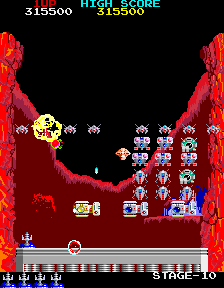
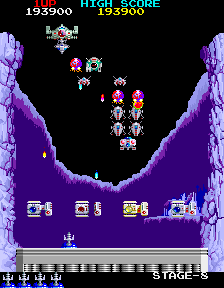
On a related note, and moving on to aspects I don't like, the game also includes power-ups for the first time in the series which is also a secret in and of itself (the number of shots you've fired so far determines what item you get, but good luck keeping track) but you actually don't want two of the three powers on offer! The blue one, Gazel, allowing for four shots on-screen instead of two, is great and always useful, but the other two will get in the way of triggering the Challenging Stage which is the last thing you want if you want to earn extra lives through extends, as the yellow one, Goral, makes your shots too big to squeeze past invaders which is needed for some stages and the red one, Gowl, gives you penetrating shots that'll shoot down the Zicons whether you like it or not. One of the other changes is to the barricades that protect your cannon and this I'm not so keen on. I mean, at least it actually gives you barricades unlike Space Invaders 90 but they work very differently from most other barriers in the series, and not in a good way. Rather than blocks that slowly get chipped away at like in the original or solid blocks that slowly move up the screen as you shoot them like Majestic Twelve, these ones (referred to as Xero-Guard in the attract mode) are solid blocks split in two with a weak connecting rod between them that you can destroy and shoot through, but other than that the barricades just have a health meter in the form of a light that changes colour as it takes damage and won't slowly disappear as they're shot, exploding violently when they're out of energy. The little gap you can create to shoot from is a nice touch, but later stages make the barricades all shunt to the side before moving back to their default positions at specific intervals. Cute idea but it will block your shots just as you're lined up to nail a UFO, and I generally prefer it when the barricades in these kinds of games are a bit more interactive, with Majestic Twelve and Space Invaders '95: The Attack of Lunar Loonies doing particularly interesting things with them.
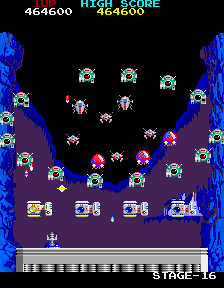
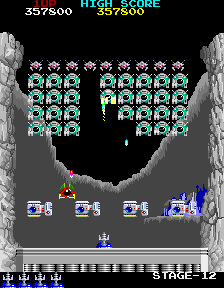
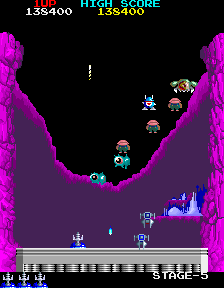
Return also introduces a brand new kind of invader, Legard, referred to in the attract mode as the 'Deflector Invader'. A simple design of a green orb with a sinister red light in a canopy in the middle with two metal arms on either side, this is the aliens' ace in the hole and they're a right pain to deal with. As the names implies, they can reflect your shots, and they're very good at it- hitting their metal arms will send your shots back at you at about the same speed you fire them, which is to say very very fast. Instead, you have to hit them right in the middle, in the canopy with the red light, after which a random pilot will jump out (including, weirdly, the soldier from Front Line) that you can shoot for extra points before they disappear. Considering how small the sprites are, this is actually a pretty tough shot to consistently make, but in theory it shouldn't be a huge problem early on as they're only on stages where you can take them out early to prevent them from speeding up. In practice though, they're frustrating to deal with no matter what because even when slow-moving, you'll often miss the small target you need to hit and then get hit by the reflected shot unexpectedly. You can try and mitigate it by constantly moving while firing at them but then you're more likely to miss the target anyway, and that's not factoring in being pinned down by other enemy fire. It's a shame because there's good ideas here but I feel the execution is just a bit too punishing, if the reflected shots were slower than yours and the target was just a little bit bigger, I think this could've worked as a fun challenging enemy, but even then, the game commits to using them a bit too frequently later in the loop with Stage 12 having an entire formation of them which is just miserable to deal with. Whoof.
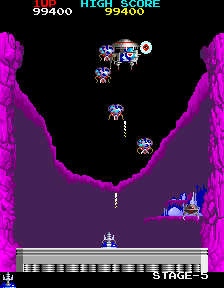
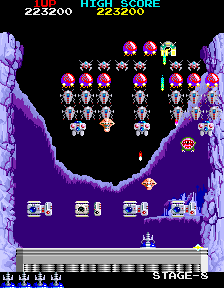
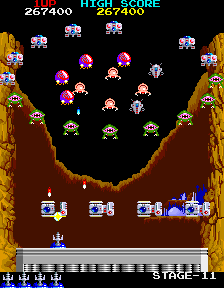
In conclusion, I'm a little torn on this game. It makes an interesting comparison with Space Invaders 90 on the Mega Drive, which I described as a missing link between Return and Majestic Twelve. That definitely still rings true after spending way too much time with Return, and you can see elements that would show up in later games in the series such as power-ups and boss fights, but it's more like a smattering of new ideas that could potentially be really interesting, but the execution isn't quite there yet. Honestly, the Challenging Stage mechanic is easily the highlight here, as you have to play a little differently to reach it and it has a really fun risk / reward element to it as you need to balance your own greed against surviving the onslaught of invaders. However, many other parts of the game- the power-ups being actively detrimental to reaching the Challenging Stage, the Legards being such a huge pain to deal with and not a fun or engaging enemy to fight, the barricades being more of a hassle than a help and a slight lack in variety with the formations- just don't do it for me and it seems outclassed by other games in the genre. In particular, Galaga and Gaplus from Namco, released in 1981 and 1984 respectively, are significantly more fun and interesting than this one, so you have to wonder why Comix and Taito didn't take more cues from those more dynamic games. Still, Return is more like a stepping-stone with ideas that get iterated upon in the future in a much more interesting way, and the presentation is pretty nice with a lot of different weird invader designs and a soundtrack that has a nice space feel to it rather than the original's heartbeat soundscape, so it makes it an interesting Invaders follow-up to at least study. The best arcade Space Invaders were yet to come, and Return walked so those games could run, but we'll have to wait for them...
For not quite bringing the Space Invaders into the modern world of the 1980s, Return of the Invaders is awarded...

In a sentence, Return of the Invaders is...
Potentially good.
And now, it's that time, folks!
EXTENDED PLAY!
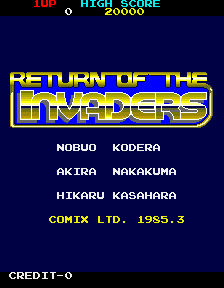
Let's start with that cheat code we mentioned earlier, via The Cutting Room Floor.
Press Left, Start and Fire on both player control sides, then hold 2P Start at any point except the gameplay demo in the attract mode to see three names and a copyright string.
Inside the code, the programming is attributed to Akira Nakamura, but the roles of Nobuo Kodera and Hikaru Kasahara in the game's development is unknown.
This is also the only video game credited to Comix.
Next, home ports and rereleases, and there's not that many to speak of.
This one didn't receive any contemporary ports at the time, so you'd have to wait until the late mid 2000s for this one!
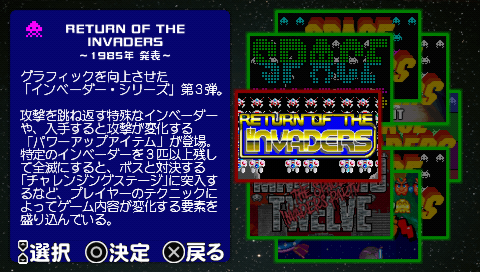
Let's start with its first rerelease, Space Invaders Pocket on the PSP from 2005.
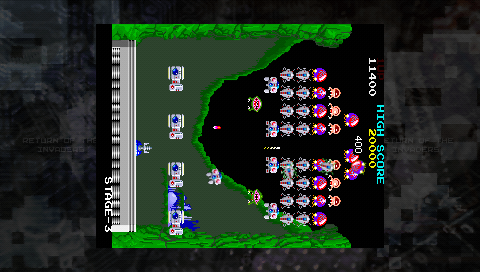
This is a Japan-only collection of Space Invaders games, unsurprisingly, specifically the Taito-distributed arcade games (sorry, Midway's cocktail cabinet Space Invaders II, again) going all the way to Akkanvader (the Japanese version of Space Invaders '95: The Attack of Lunar Loonies) so that includes Return of the Invaders for the first time at home. It seems like a perfectly fine version of the game with maybe some slightly shrill sound in spots, but a feature you might not spot immediately is you can play it in tate mode- press both shoulder buttons at the same time to flip the display as well as your controls. See, Oddly, these versions alter the games to add a prompt for an options menu on the title screen, a bit like some of the Namco rereleases around the same time. This is a pretty decent set, albeit fairly barebones when it comes to extra options, so it's worth a look if you're curious about the other Space Invaders games. You can't enter the credits cheat in this version, though!
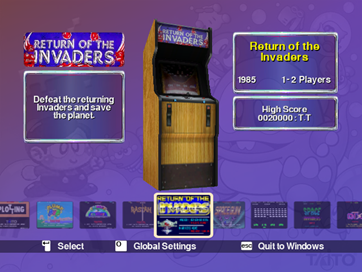
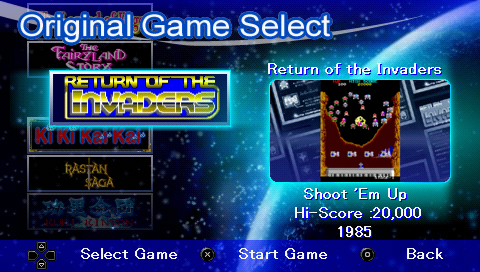
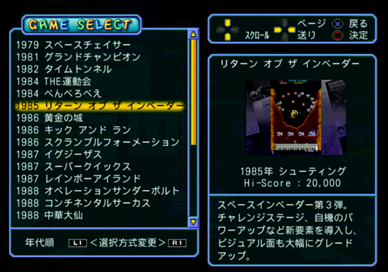
Let's put the Taito compilation releases together, just to make things easier for me.
Those would be Taito Legends (2005, PS2 / Xbox / PC, not Japan), Taito Legends: Power-Up (2006, PSP, not Japan) and Taito Memories II Joukan (2007, PS2, Japan only).
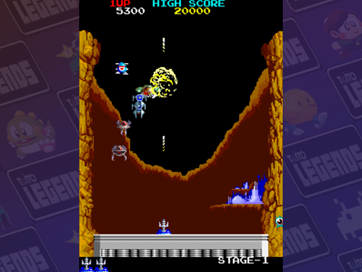
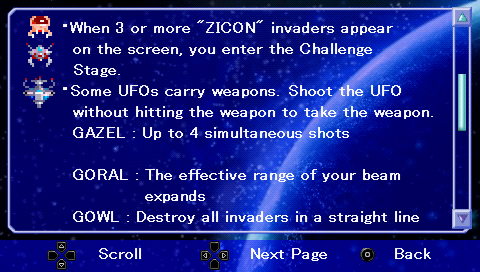
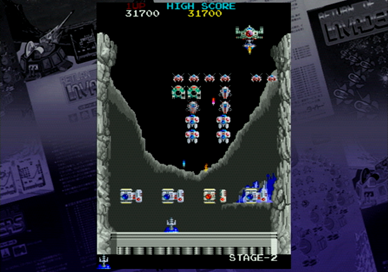
What's that? Taito Legends: Power-Up got a Japanese release as Taito Memories Pocket? Oh, you silly goose, Return of the Invaders isn't on Taito Memories Pocket at all! It was one of a handful of games added to the Western release (alongside Space Invaders, Space Invaders Part II, Space Chaser, Phoenix, Space Dungeon at the cost of removing Rainbow Islands Extra). That aside, these are all pretty comparable with only a few dip-switch options for lives and extends available and no real extras to speak of, although each has its own exclusive features- Power-Up and Memories II Joukan allow you to rotate the screen (they even use the same menu interface) while Legends has a scan of the original flyer available instead, plus you can't enter the credits cheat on Power-Up.
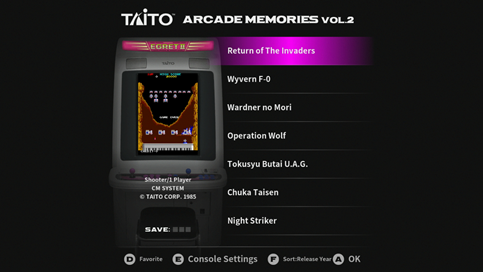
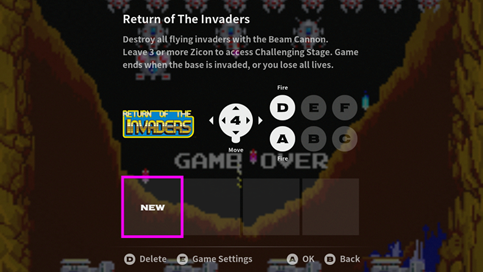
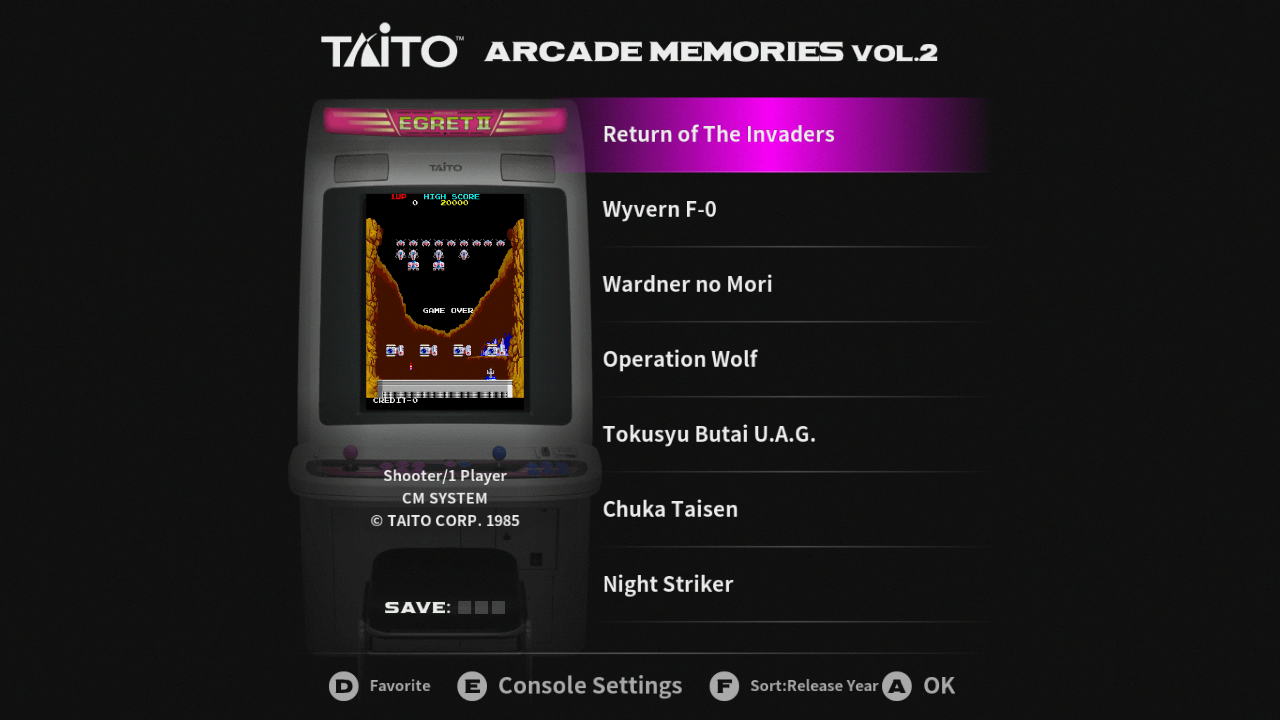
Finally, the best version so far is the one included on the Taito Egret II Mini expansion card Arcade Memories Vol. 2 from 2024.
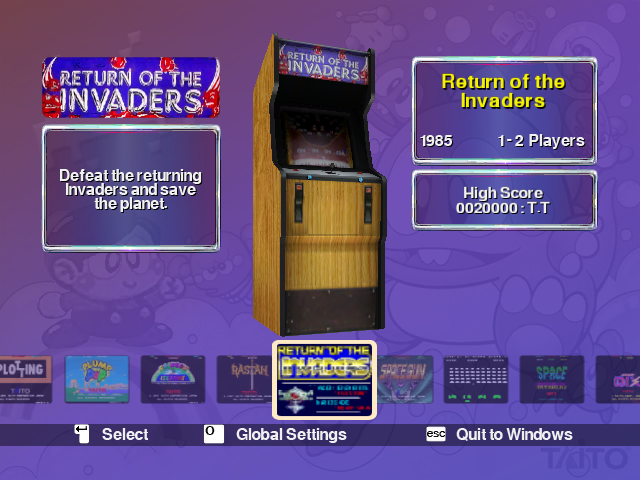
Alongside games like Crime City, Yūyu no Quiz de Go! Go! and Operation Wolf, Return of the Invaders is on this expansion card (just insert it into the side of your little Egret II to load it up) and it comes complete with the full set of dip-switches to mess with (which means you can change whether the year's displayed in the attract mode and even enable 'NO-HIT' mode for invincibility). If you're playing on the unit itself and not a TV, you also get to rotate the monitor for the full tate experience which is just lovely. It clicks and clacks into place, it's like a big toy. Ahem. Anyway, if you have an Egret II Mini, and you can grab this expansion pack, it's definitely worth it, mostly for the other games on it but having Return of the Invaders is nice too.
Oh, and you might be wondering, what about Space Invaders Invincible Collection from 2010?
Nope! Return of the Invaders isn't on there! No, I don't know why. Yes, I'm still a bit miffed about it.
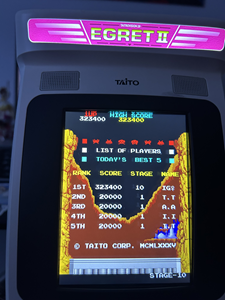
I though it'd be nice to end on a photo of the Taito Egret II Mini I conducted most of this review on. It's my precious.
PLEASE PUT MAJESTIC TWELVE ON THE TAITO EGRET II MINI I BEG OF YOU