
EDITOR'S NOTE:
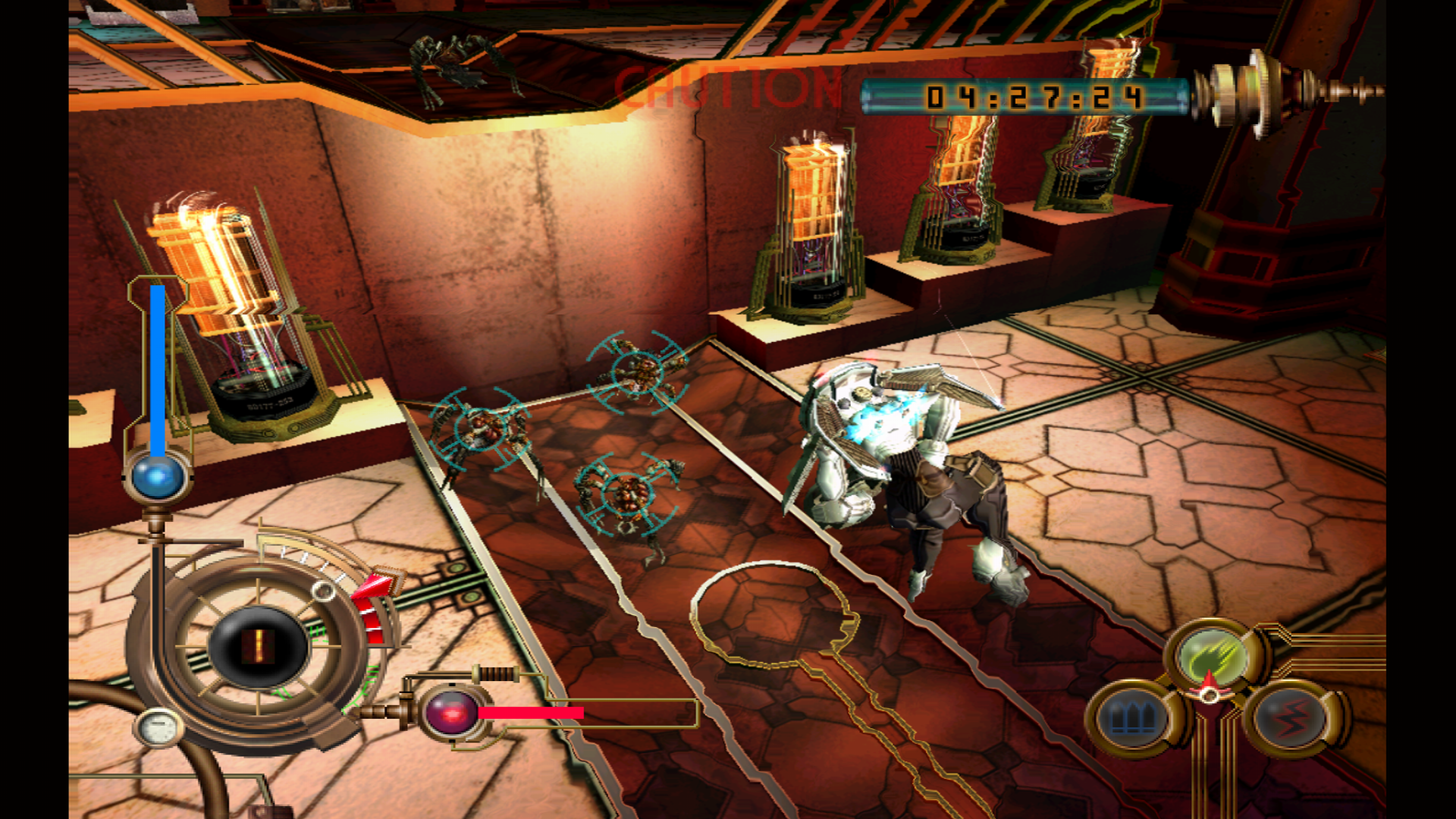
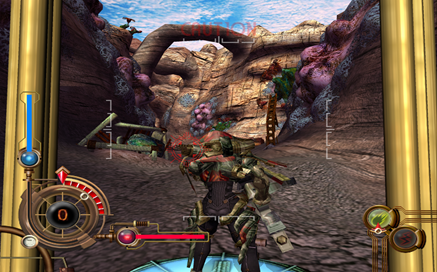
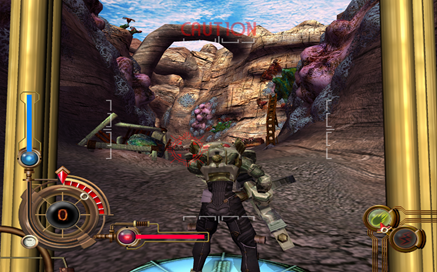
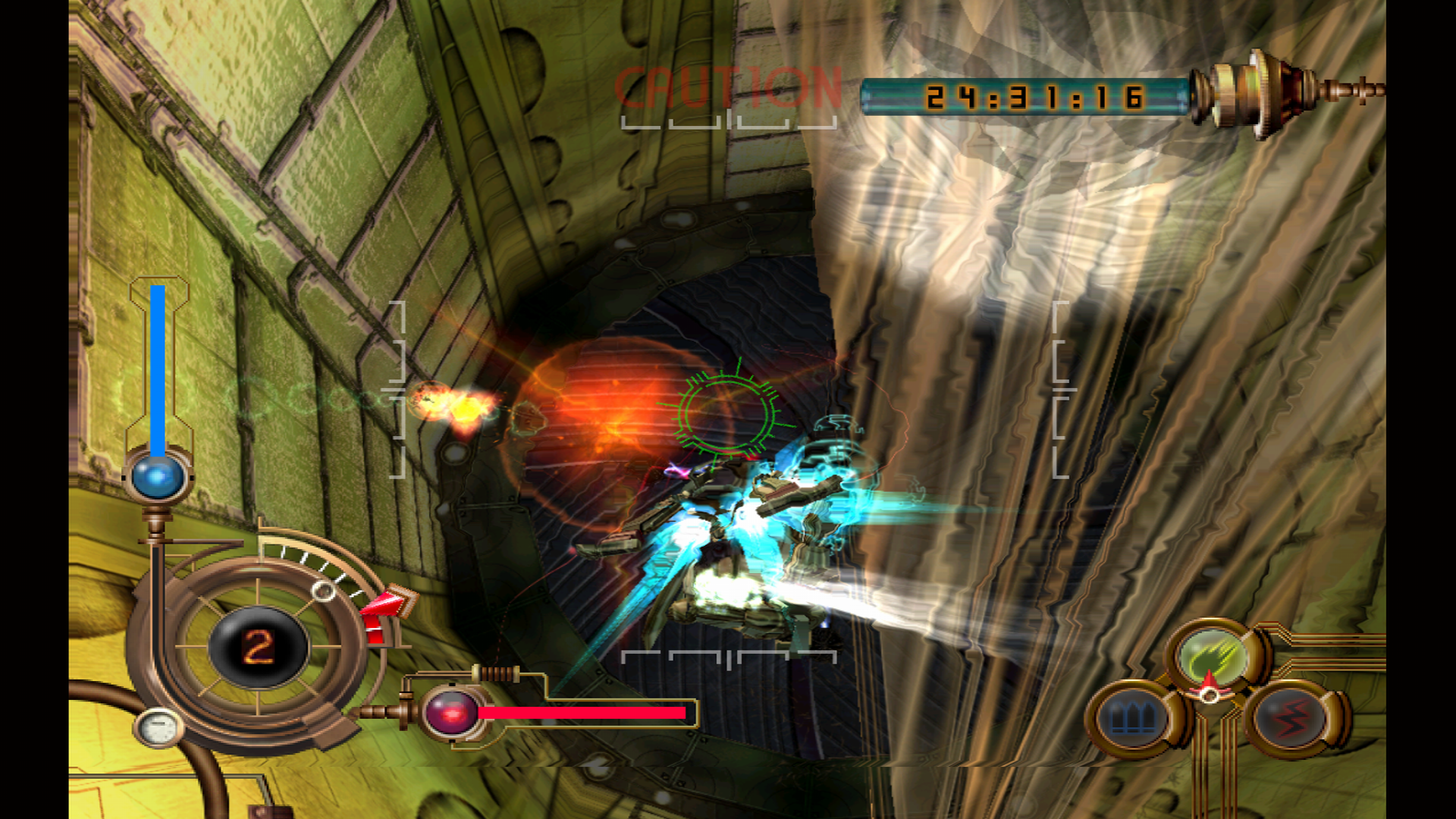
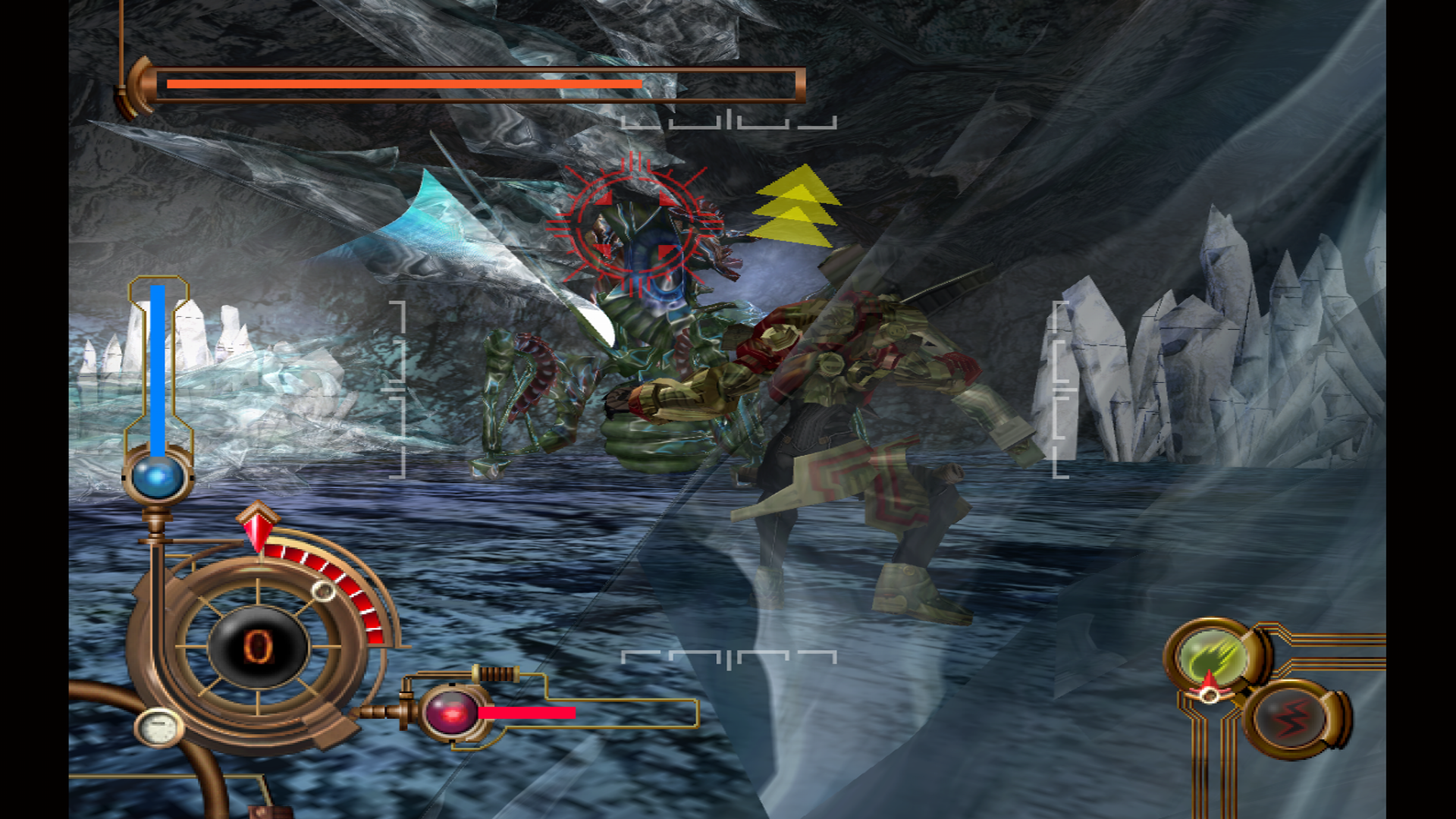
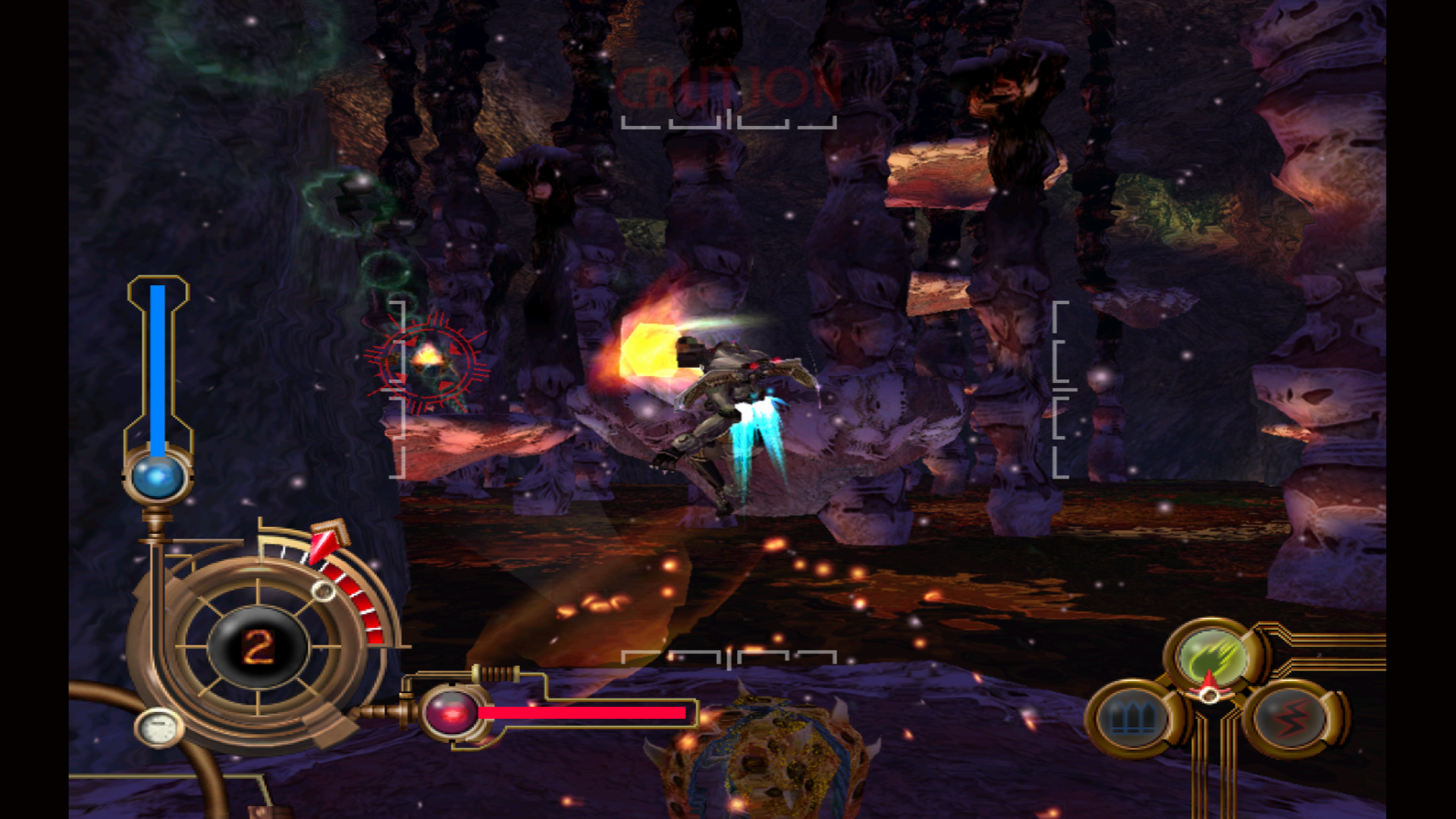
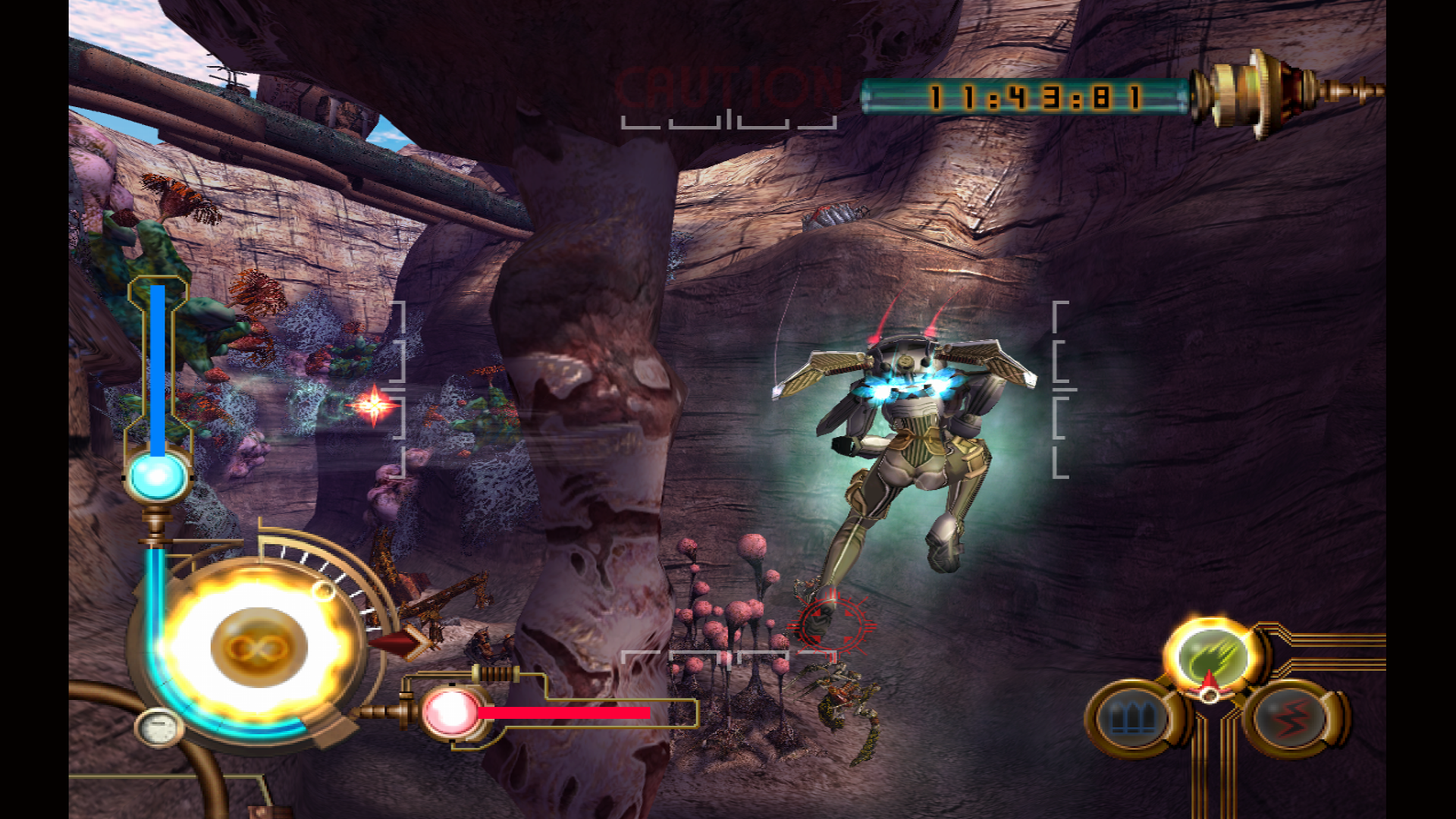
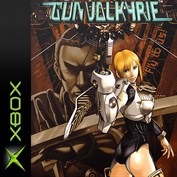
Did you know Gunvalkyrie is still available on Xbox One? Like, you can pay money for it and just play it on modern Xbox consoles? Yes, it survived the Great Sega Delisting of December '25. Not only can you exchange money for the goods and service of this 2002 Xbox title, but if you have an original disc- say, one you bought many years ago for about three British pounds, which may or may not be the circumstances under which Gaming Hell obtained the game- you can just slip it into your Xbox One's mouth and play it. So that's what we did, playing in widescreen mode and using the Share button to take screenshots easily, click them to rebigulate them if you so desire. We also played it a bit on the original Xbox for the culture, the only major difference being it's in 4:3 on our beloved, ageing CRT, it has the Black and White buttons instead of a second pair of shoulder buttons which makes no real difference with this game and there's slightly more slowdown on the original hardware, usually only apparent in close-quarters during the boss fights. One final point that the writer is insistent on making is that they're not a super-expert on what you'd call 3D character action games. The arcade is where they live, after all. However, every effort was made to master this game and really dig into it, so hopefully what we've slapped together is a good enough overview of the game from a layperson's perspective. Or you can just ignore everything we say, I think ignoring about half of what my idiot writer says is a healthy amount, just like Nico Yazawa.

Sega's output on the original Xbox was strange, wasn't it?

Strange as a positive, mind you. I dunno, maybe it's just me that feels this way, but from the launch of the system Sega released a surprising amount of exclusive titles for Microsoft's onyx slab, some of which are still exclusive to it to this very day (written in 2026, prove me wrong Sega!). Especially in the first few years, there was follow-ups to Dreamcast games (Crazy Taxi 3: High Roller, Jet Set Radio Future), dormant series getting a new lease on life (Panzer Dragoon Orta, Spikeout: Battle Street), an arcade port or two from Chihiro hardware which was based on the Xbox specs (Outrun 2, The House of the Dead III) even one new IP (Otogi, developed by From Software), alogside all the multi-platform games like Phantasy Star Universe, Sega Soccer Slam, Sonic Heroes and as many 2K sports games as Visual Concepts could crank out before they got sold to Take Two Interactive... There were also a few straight ports from the Dreamcast (Shenmue II, Phantasy Star Episode I & II and Rent-a-Hero No. 1) but at least two in this category were games that were planned for the Dreamcast, but would only come out on Xbox. One of those is ToeJam & Earl III which was found on a Katana devkit and publicly released in 2013 but that's not what I'm talking about today- instead, we're looking at Gunvalkyrie, planned for the Dreamcast in 2001 but ultimately released on the Xbox in 2002 instead.


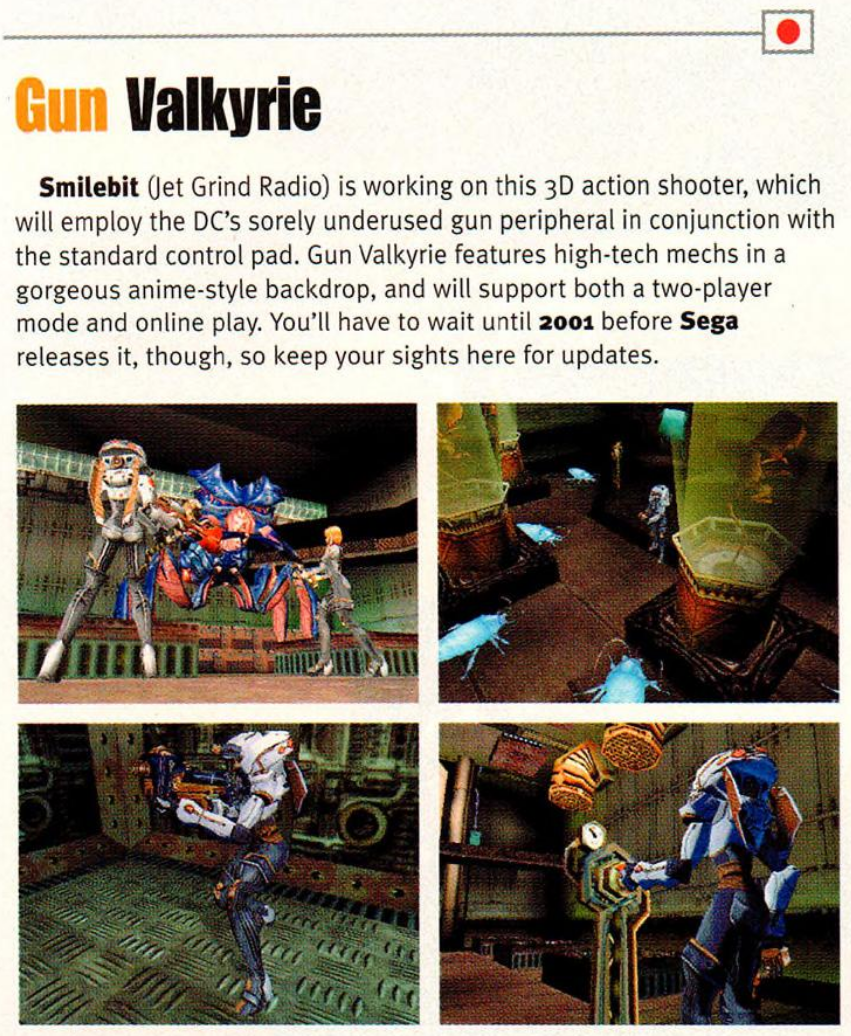
Before we get to the game that did release, it's a good idea to look at what's out there regarding the original Dreamcast game, as while the scraps that remain (no ISO has ever surfaced but there's a few previews and video trailers out there) have a lot of similarities with the final game, there's also some big differences and things that would later be dropped such as co-op and online play. The most outrageous tidbit is seen above, from EGM #137 from December 2000 (also on Internet Archive) which says the game would use an unorthodox control scheme where you'd use both a control pad and a light gun, with the control pad in the left hand for character movement and the light gun in the right hand for shooting. Due to running a website about video games that frequently requires me to look stuff up in old magazines, I've developed trust issues of pretty much anything said by games mags ever (see also: anything said by Sega of America executives) but fortunately this outlandish fact is backed up by this sega.jp Creators Note interview with Chief Planner Tadashi Ihoroi (whose previous works include the two Sonic & Tails games on Game Gear and Hundred Swords) linked on Sega Retro'sGunvalkyrie page (and also available on Sega Retro itself). He explains that this bizarre control scheme was indeed the original plan, intending to make attack direction and movement direction separate, with a PC version also considered before settling on the Xbox. He also comments on development length, saying that if you count from the start of development on the Dreamcast version, it took two years, but really it was six months and while I'm unfortunately relying on machine translation here (if anyone wants to take a proper look, we'll pay you!), he says something like "What's on this disc was about two months' work" suggesting the Xbox version was fairly quickly moved over to the console, which not only makes a lot of sense, but may explain some of the elements of the finished product, especially the story. We also have some video clips of the original Dreamcast version- one here, one here- which seem to match up with the ones seen in EGM and showcase a few things not in the final game, including cutscenes, bosses and Kelly without her Gearskin (frequently seen in the manual and loading screens, but not in the game otherwise). In any case, the project moved over to the Xbox, and so here we are.


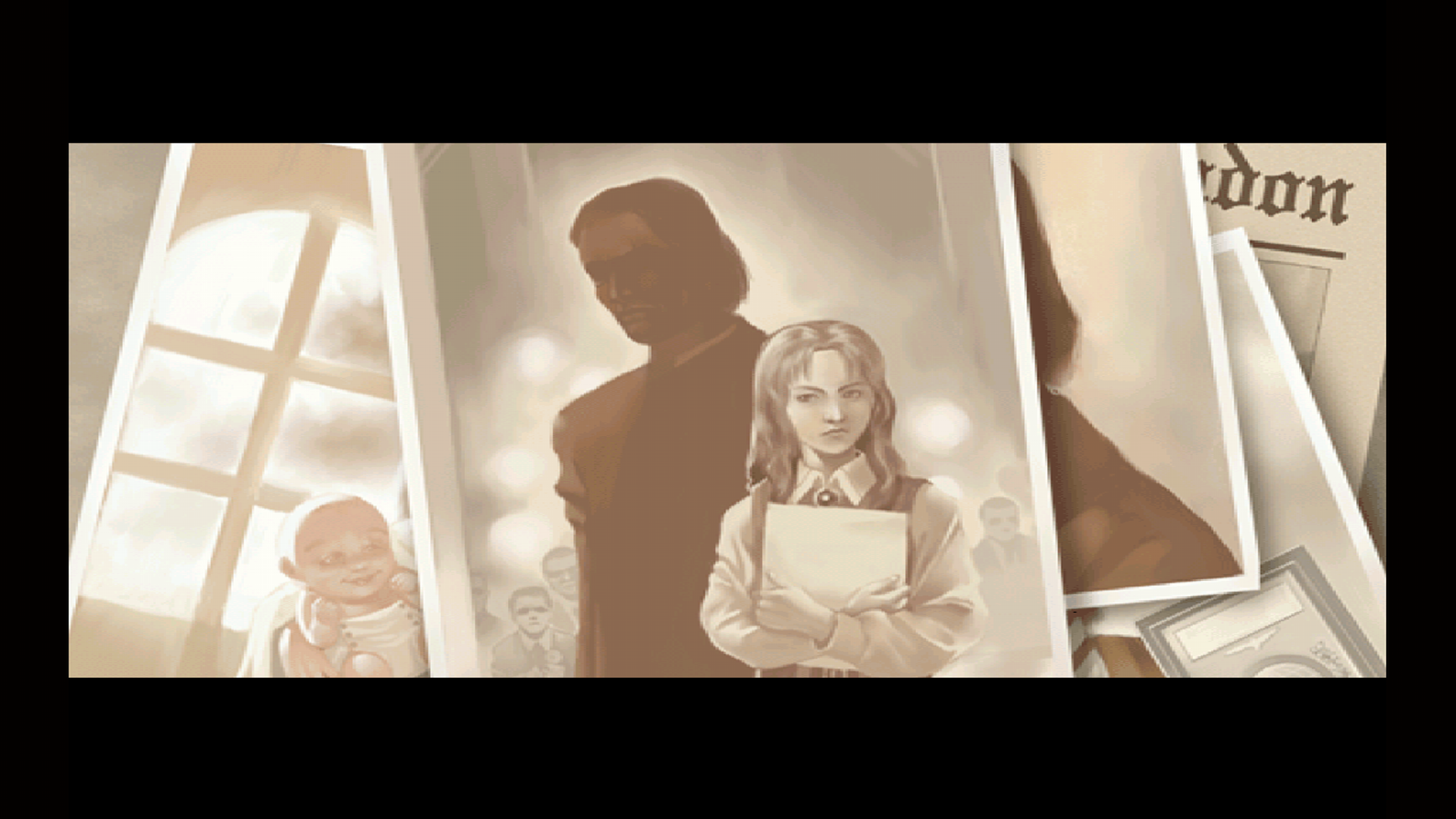
Released in 2002, within the first six months of the Xbox's life in every region (although it was closer to the Japanese launch than other releases, joining the likes of Dead or Alive 3 and another Smilebit game, Jet Set Radio Future), Gunvalkyrie's story is a little vague and underdeveloped for reasons we'll get to later, but roughly it's an alternate history set in 1906, with scientific progress taking a very different, 'elec-punk' direction (this is how it's described in the first official issue of Famitsu Xbox from January 2002, Page 69- some sources say this is specifically what Smilebit said, but I haven't found a specific source for that) as a result of Halley's Comet. In 1835, the comet passed by the planet as it does every 75 years, but this time it left a strange material on the planet, Halley Core, which contains vast amounts of energy and can even alter the DNA of any living thing it comes into contact with. Affected by Halley Core while in his mother's womb, Dr. Hebble Gate became known as the first of Halley's Chosen- humans affected by Halley Core- and with his superior intellect and abilities, he soon became the founder of Hebble Technology, utilising the power of Halley Core findings to make scientific advancements that propelled humanity into a new age, including colonising new planets and also founding the Gunvalkyrie project that pioneered the use of Gearskin, electromagnetic armour that offers great protection and flight abilities to Halley's Chosen...

And then, in 1902, he disappeared. Four years later, disturbing reports come in from the planet Tir na Nog (a bit of Celtic folklore there, although the game also takes names from Norse mythology too like Nidhogg and Yggdrasil, the world tree) that not only was Gate looking into genetic modification of humans there, but the colonists have all disappeared and now horrible, violent insect life forms have moved in. Seeking answers, Lieutenant Meridian Poe (Gate's daughter, now a disembodied head kept alive via a life-support system and her burning hatred of her father) sends Gunvalkyrie's Dolphin Team- Kelly O'Lenmey from Ballymun, Ireland who found a Halley Core as a young child and had previously fought for Irish independence, and Saburouta Mishima from Southern Kyushu, Japan who was exiled to a remote island and wiped out an entire army with his Halley's Chosen abilities and hired by GV to spare him the death sentence- to find out what's happened on Tir na Nog, see if there's anything left of the colonists, and ultimately try and find out what happened to Dr. Hebble Gate. Don't worry if most of that went over your head, the story is pretty much confined to the manual, text-only reports from Poe and an intro and outro cutscene, so it's not really there at all.


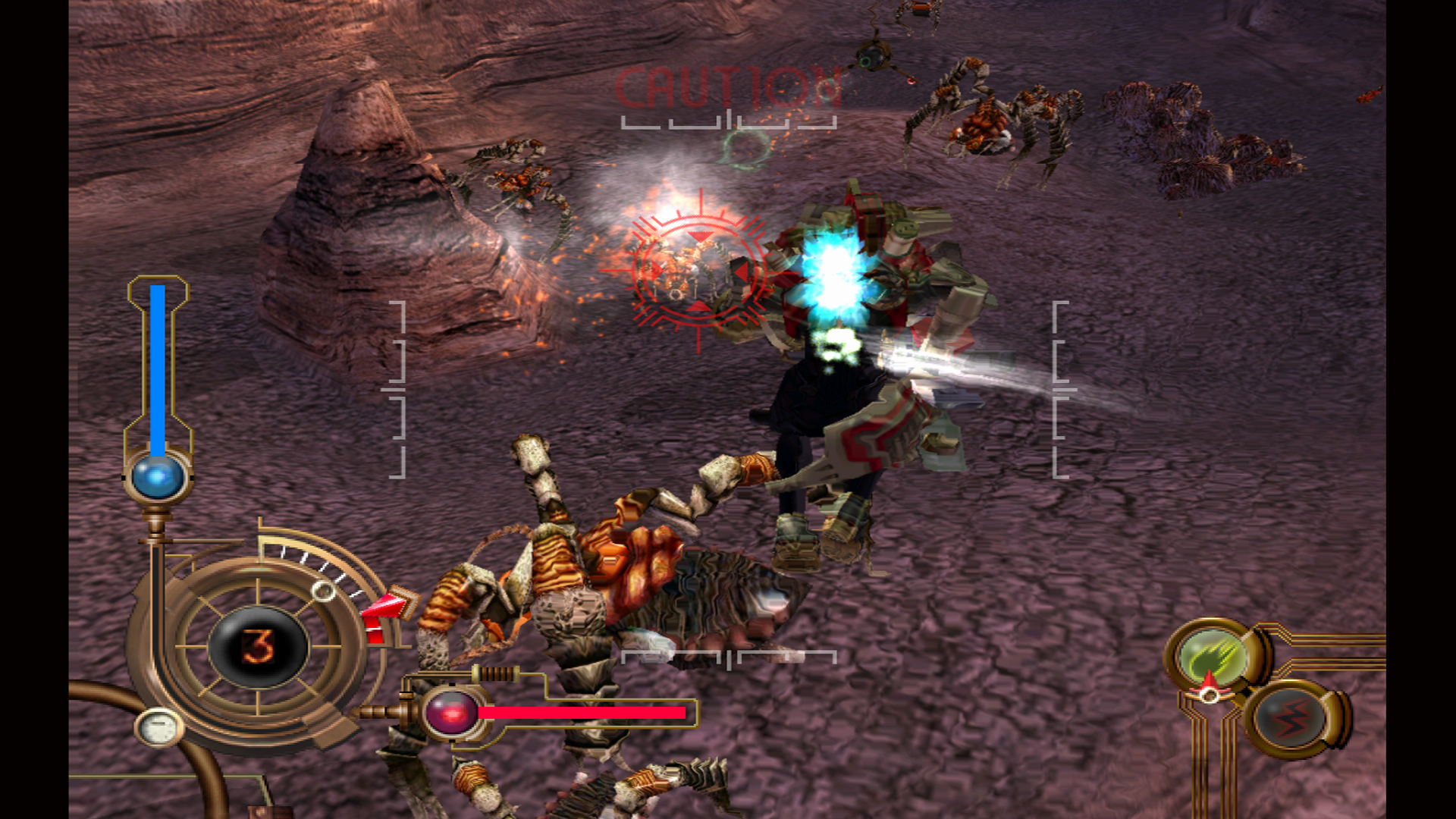
To go over the basics, Gunvalkyrie is a 3D action game with a big focus on freedom of mobility and aerial combat, or at least combat where you're in the air, not necessarily the enemy. The Gearskins Kelly and Saburouta use come equipped with jetpacks with limited air-time by holding the left shoulder trigger, with a hover if you pull the analogue stick back, but aiming with the left stick and clicking it in (we'll use the modern nomenclature, L3, to make this clearer) sends you cartwheeling in that direction for a sort-of dodge, referred to as a boost. This includes dodging to the side, shunting yourself backwards and boosting forward (you can continue to hold to move fast and consume your mobility gauge or just tap for a quick burst, with the latter being extremely useful for reaching long distances- if you've got the right height, the distance is less of an issue as tapping drains way less meter) and all this can be performed on the ground too, but it's in the air when you thrive, being able to have near-complete control using these boosts. Clicking in R3 also lets you quick-turn in any direction to swing the camera around (you don't have much control of it otherwise, the right analogue stick can only 'twist' your character in forward-facing directions- this, I suspect, may be a remnant of the light gun controls they had in mind from the Dreamcast version, seeing as you'd only really be able to move your aim in the direction your facing). It takes a lot of getting used to, and can definitely make your hands sore after a long session, but the amount of freedom you get once you understand it is really nice- you can stay in the air for a lot longer than you'd think the boost gauge would allow, and utilising certain quirks like tapping the forward boost instead of holding it to get much further than you should and using side-boosts to strafe and stay in the air feels so satisfying! The one thing I don't like is that actual precision platforming can feel quite difficult, and while it never really asks you to do too much, some areas have large platforms you'll need to use, and landing on the damn things can be tricky (and it's easy to boost yourself off them as you try to land).

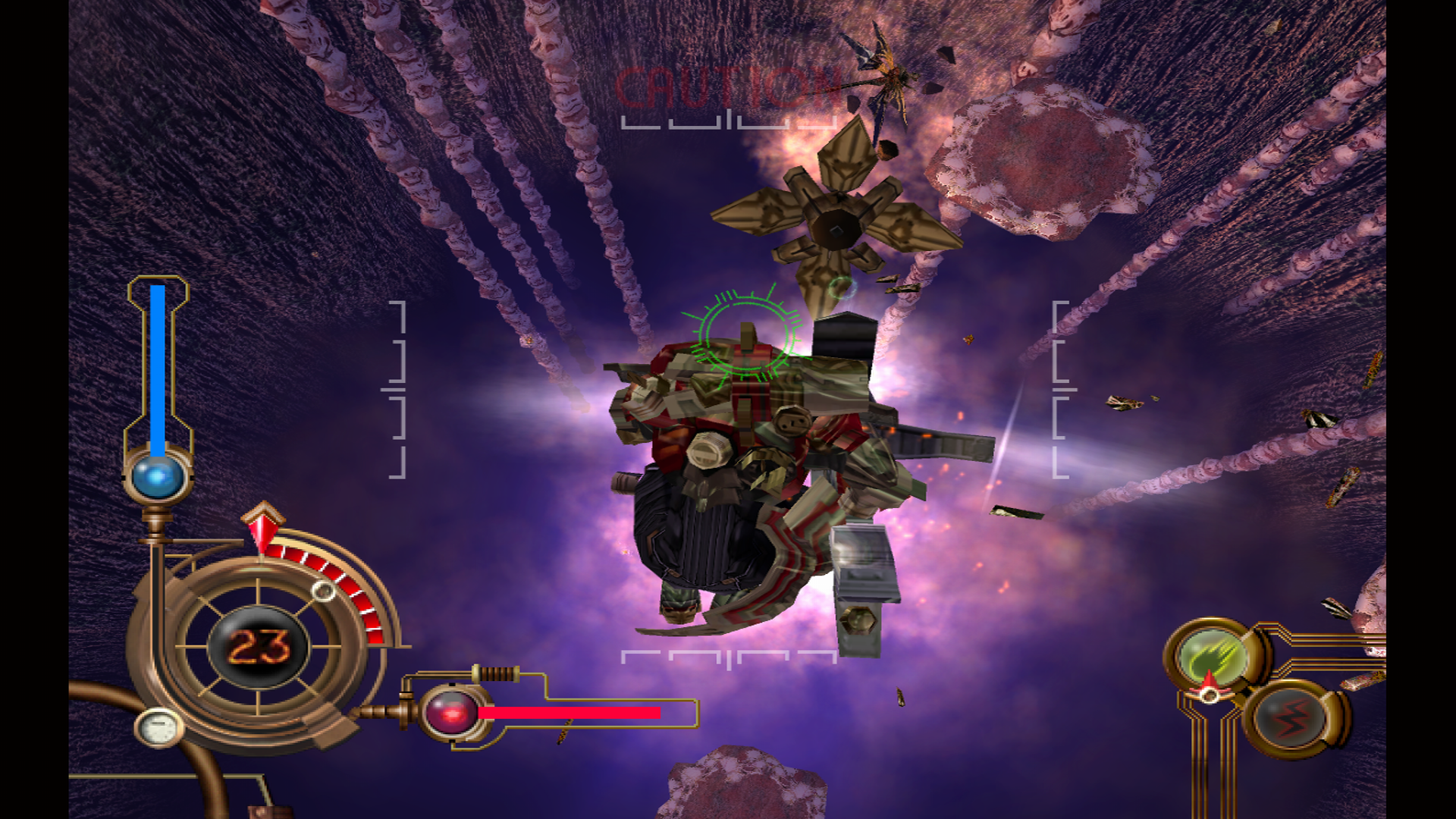
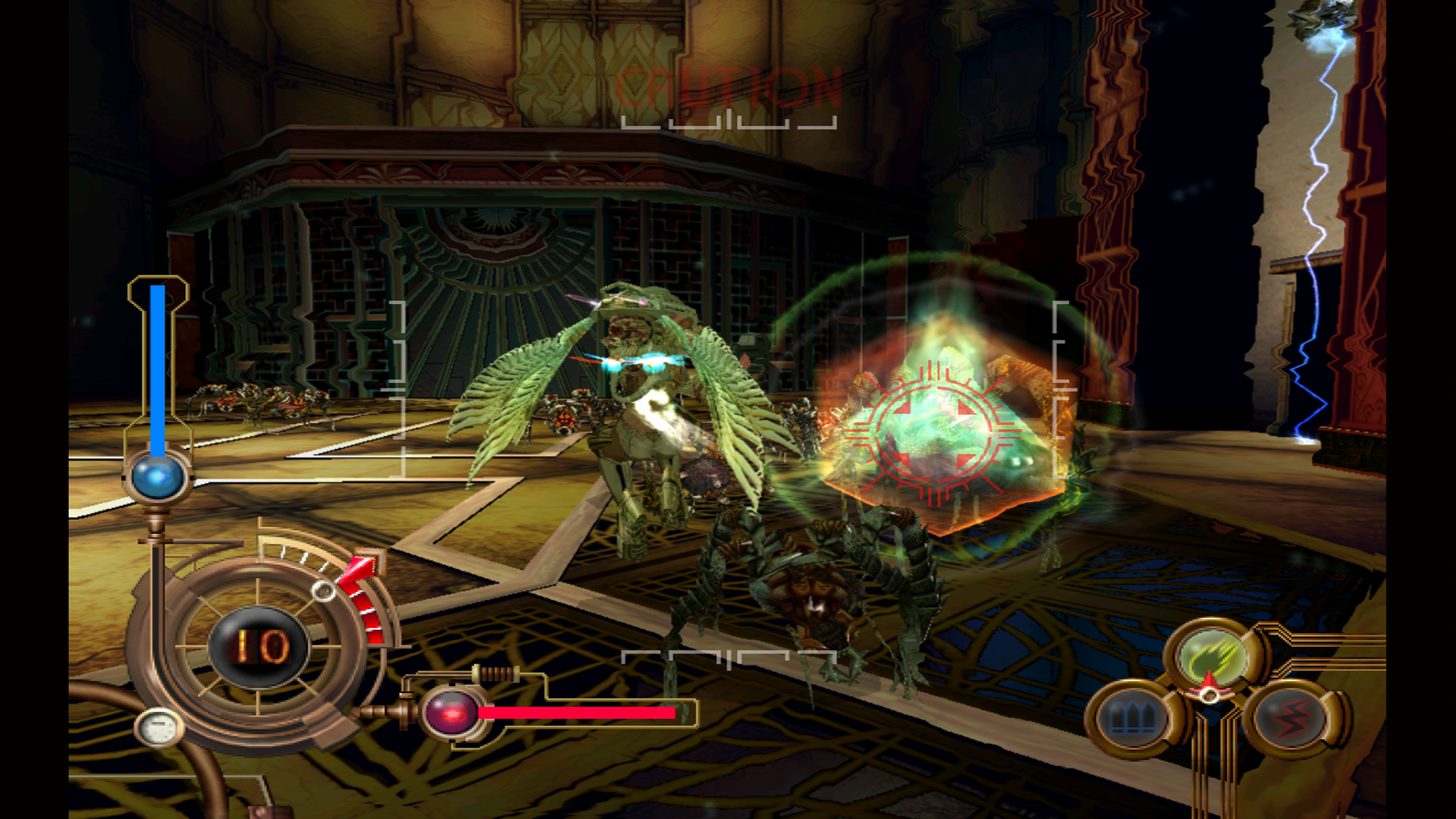
All that's just talking about the basic movement though, in combat it gets a bit more complicated. Your weapons are fairly basic- the Heat Blaster for Kelly / Matchlock Cannon for Saburouta is the basic gun that can lock on to enemies, the Plasma Hook for both characters is a mobility tool for latching onto special orbs that the manual swears you can use against certain enemies but I never found it that helpful (but hooking onto an orb mid-combat is very satisfying too) and the Drive Gun, exclusive to Kelly, is a rapid fire weapon that roots her in place (even in the air, so be careful) but racks up damage quickly. Both characters have an ace in the hole in the form of GV Napalm- performed by clicking in both L3 and R3, when used on the ground it's a 'get off me' explosion around you but in the air it's the Meteor Drive, a long-distance dash that ploughs through enemies and lets you get even more air time as you can aim your direction with the right stick. This costs fuel though, shown by a blue meter on your HUD, and while some enemies drop pick-ups to refill it, the easiest way to get more is boosting. When enemies are around (you'll see a big CAUTION sign on your HUD), boosting adds a point to your combo meter (as long as you keep changing direction, and hovering resets it to zero) and you get little GV Napalm refills at certain numbers, but make it to 25 and you enter Mobius State where for a short time you're invincible and your weapons become significantly more powerful, especially useful in boss encounters. After Mobius State ends, you can start racking up combo points again and keep going! There was definitely some thought put into this system as you can't just boost willy-nilly- it has to be near enemies to count for a combo and you have to vary your boosting direction, so you can't farm for it in a safe corner, you need to be knee-deep in the enemies to get any benefit from it. Those enemies have a few variations among them, although not a huge amount- most just try and attack you, but others use cloaking to hide and teleport around you, others explode upon defeat and damage you, so slightly different approaches are required, but I mostly felt they were fodder for building your chains up, if that makes sense.


Again, this takes a lot of practice to get your head around, and it is possible to just ignore this system entirely and play through the game completely fine... But once it starts to click, it feels supremely satisfying to maintain verticality while blasting bugs to smithereens, dodging and weaving gracefully as you get more fuel for Meteor Crashes to get even higher in the air, hitting Mobius State and destroying everything in sight. It takes a long time to figure it out, and some of the level designs really aren't suited to it- the open air but linear nature of the Valley stages are just right for it and long vertical areas of both the Yggdrasil and the later Civilian Base stages work pretty well once you figure out where and when the enemies appear (even if they repeat the tubes a bit too much for my liking) but the cramped corridors of the first Civilian Base and the spread-out groups of enemies in Naglfar's Pit don't quite suit it, at least not for me. However, with a lot of practice and a bit of getting used to the controls, you'll eventually get into a 'flow state' with this system, your feet never touching the ground until every last insect's blown to bits while reaping the benefits of more GV Napalm and the power-boost of the Mobius State. This also ties into your ranking at the end of a stage, as the more combos you get, the better bonus you're awarded in addition to bonuses for time, number of times hit (which'll be lower if you're playing well) and whether you found the hidden Halley Core on a stage, with each getting an individual rank from D to S and the top three scores being saved. In a way, it reminds me of another Sega game, NiGHTS into Dreams, in that if you really wanted to, you could ignore the score attack element and just plough through the game but that's also missing the point and isn't nearly as fun or engaging, and when you get into this game, it does have a good flow to it! Personally though, I didn't feel that Gunvalkyrie quite managed what NiGHTS achieved in making a moreish, just-one-more-go score attack game- the levels are just a bit too long and there's less direct feedback on how well you're doing outside of the boost combo which is only one of the four ranking categories, so while I did try for a few high scores, it didn't quite give me that score-chasing feeling of other score-attack games.

There are definitely a few other things that hold the game back from being really great for me- little things that gnaw away at you and, you would hope, would've been cleaned up for a sequel that never came to be. First and foremost, there's no radar for where the enemies are. I can get that a little- it'd have to account for verticality as well as general direction, so it'd be tricky- but since several of the missions are of the seek-and-destroy type (and some of these are also on a time limit that's sort-of generous but some enemies are literally hiding which is frustrating at first), you really do need to know where the hostiles are. The closest you have is a map you pull up manually which pauses the game and can sometimes be quite unhelpful, with your position marked by a hard-to-see red arrow and enemy blobs being marked imprecisely, especially the few flying enemies, so it can frustrating when you've only got one more flying enemy to take out (who will, inevitably, bonk you on the head with their projectiles while you can't see them) and you can't quite find them because the map's insufficient for the task at hand. The levels themselves, as mentioned, can also get in the way of letting you really use the mechanics to their full potential, with some being far more suited to it than others. The reuse of level chunks and environments in particular is a bit hit-and-miss, as sometimes it's pretty clever, but not consistently. The two Naglfar's Pit stages use the same map for the most part but one has you travelling up and into a giant orb to fight a boss, while the other starts you at the top of the same map, sans orb, to seek and destroy the remaining enemies, and the two Yggdrasil stages do a similar thing, although on your second trip you're chased by an all-consuming void that forces you into a boss battle if you're caught by it. However, you'll definitely get sick of seeing the same areas in the two later Valley stages with little change aside from maybe some slightly different enemies as well as the vertical tubes in the Civilian Base. I found the boss fights similarly middling- I quite enjoyed Daihellm, the first boss, where you need to be underneath it in the first phase to hit the weak spot, then above it in the second phase to avoid its spinning, try and hit Mobius State and blast him to bits, but Nidhogg's arena is too cramped to do much in the air, Mimir is a fight against multiple giant bugs that can't be hurt about 3/4 of the time meaning hitting Mobius State can be completely wasted, and the final two bosses are alright (Svart is definitely easier if you've mastered the mechanics) but I felt they could incorporate the game's core systems just a little bit more.


The game's structure is the type you'll have seen in a few action games of this generation, with you going from stage to stage with a shop menu inbetween to buy upgrades with earned points (and free story dumps every few stages, more on that later), but there's a little leeway here with some very light non-linearity. Starting a new game you've only got one mission to pick (Valley 1, a tutorial that teaches you the very basics, although you'd be best to consult the manual) but then you get to pick your next stage from two followed by a boss fight, then the game lets you pick from three stages leading to a boss fight two more times, until the final stage (that one has two boss fights afterwards). It's not a whole lot of freedom but if you're struggling on one stage, there's usually at least one other option to try and see if you fare any better. After you're done with the story, you can return to any stage you like in the Challenge Mode but otherwise you can start another run and see if you can score better. The upgrades between stages are the sort of thing you'd expect, with shield and GV Napalm meter upgrades and a (very expensive!) item that increases shield power during boosting, as well as character-specific weapon upgrades (Kelly gets more of them compared to Saburouta, increasing her maximum number of lock-ons) as well as a one-time-use revive item that's thankfully inexpensive. These upgrades are mostly unobtrusive and don't get in the way of the core mechanics too much, but even if you're playing for the first time and still mastering the controls, important things like the shield upgrades are quite affordable, with Saburouta's Matchlock Cannon being an expensive reward for players who've mastered the game and can rake in lots of points from each stage. Seasoned players can also unlock Kelly's Level 3 Gearskin to make the final stage and bosses significantly easier (although those going for more points will likely unlock it anyway, seeing as getting the Halley Core in each stage gives a big points payout).

One area where this structure falters for me is the character selection. When you're starting out, the game encourages you to play as Kelly first, outright telling you she gets to upgrade her equipment more and has better mobility, plus at the end of the first stage she gets the Drive Gun that Sabu never gets to play with. What they don't tell you is that at the start, Kelly can't use the Meteor Drive, and instead you have to earn it by defeating the second boss, Nidhogg, who shows up over halfway through the game. I can sort-of see the logic here- Gunvalkyrie is a lot to begin with, so maybe Smilebit didn't want to overwhelm players and decided to introduce this mechanic much later for the character they encouraged people to start with. I won't lie though, this kinda soured things for me, and I wish I'd started as Saburouta instead! The Meteor Drive is a pretty important part of your toolkit, allowing you to trade in some GV Napalm to keep your boost combo going and more easily and safely adjust your position in the air, and you can really get into a flow state when you start using it, but Kelly gets it too late into the game and they don't really make this clear. Saburouta does have his own quirks, mind- he has to stand still to lock on to enemies whereas Kelly can move at the same time, plus he can't participate in the boss fights or the final stage so you will have to play as her a bit- but on about my fourth playthrough of the game for this article, I played solely as Saburouta and got a bit more into racking up high scores and played a lot better than earlier. Still not quite the score-attack I was hoping for, but it was better! You could also attribute this to being one of those games that doesn't really 'start' until you beat it for the first time, but I think it's a little unfortunate that, in a way, they start the player off at a disadvantage by nudging them towards the 'easier' player character.


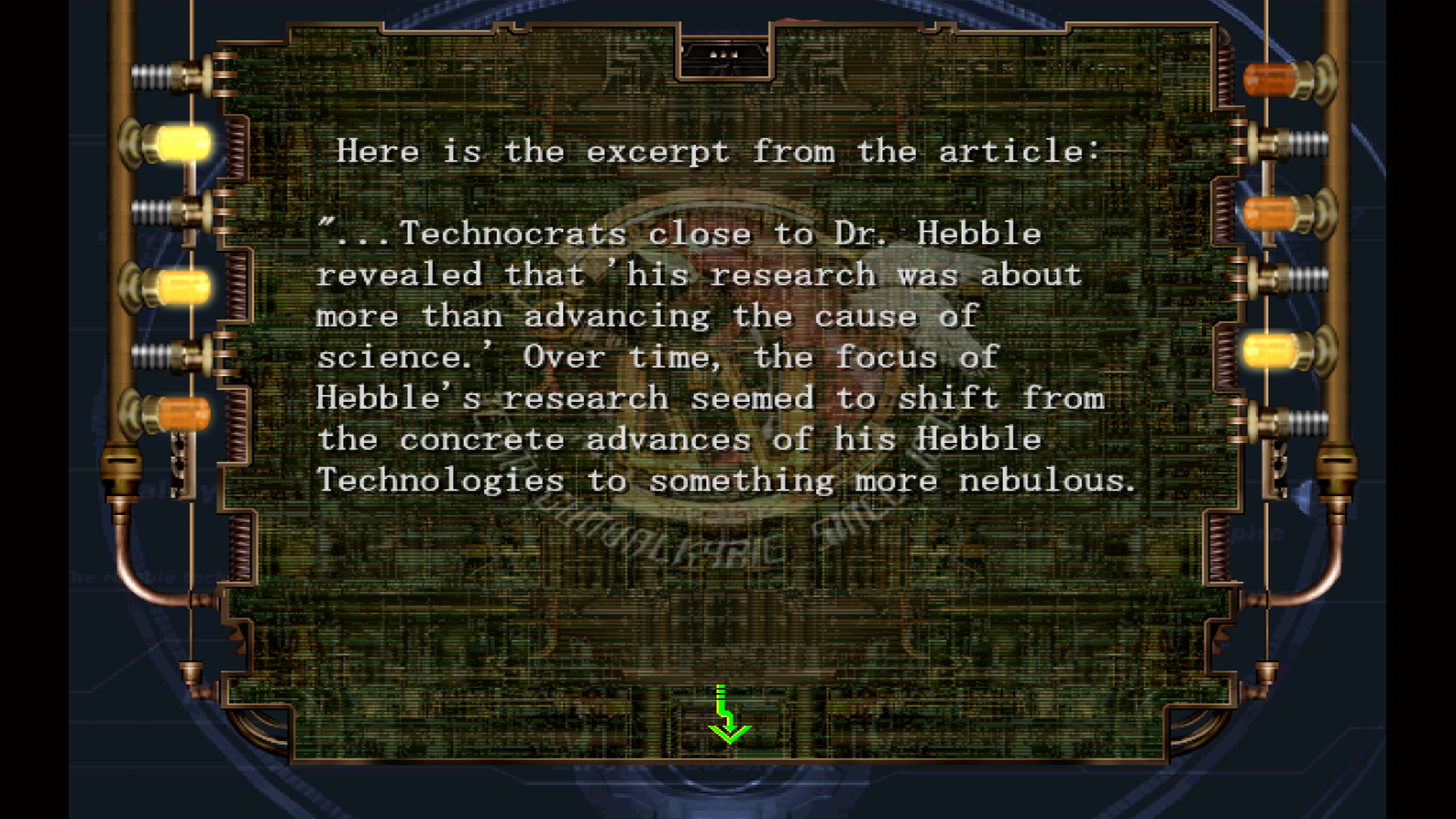
The presentation is generally pretty good, as while it doesn't look great in still screenshots (much as I did my best here!) but in motion it runs pretty smooth (with minimal slowdown on original Xbox models, completely eliminated on One and Series S / X) and the environments are suitably alien and strange, especially Naglfar's Pit and Yggdrasil. I also really like that the UI fits in with the 'elec-punk' aesthetic with every part of the HUD fitting in with it (like the weapon indicators rotating themselves even when you're not doing anything) and the pre-mission menus committing to it with everything having to be powered by electricity. The music, composed by Tatsuyuki Maeda and Teruhiko Nakagawa, is an eclectic mix of styles, from Maeda's gentle menu song Valkyrie's Launch to the adventurous, gallant stride of Nakagawa's Cosmic Blast Rising for both Valley 1 and the end credits and the drum-and-bass madness of Nakagawa's In the Flat Field, it tries for a bit of everything and it's pretty good and fitting for the most part! However, another part of presentation is the story and theming, and, well, I get the feeling the game may have been kicked out the door slightly unfinished because of how the game's narrative is told. Obviously this is a launch-adjacent game for a relatively new console, but knowing it was shifted from one console to another mid-development (and the short development time on the Xbox end) couldn't have been easy on the staff. The story in the final game is delivered almost entirely in text dumps provided by Poe's Reports between levels (completely optional, by the way) and three (3) cutscenes, one of which has no text or dialogue at all and you have to interpret it through vibes alone. Poor Saburouta only gets a single line of dialogue in the entire game! You find out a few things regarding Dr. Hebble's fate and the events on Tir na Nog, but not much, much more goes unexplained (Naglfar's Pit 1 has you stop a voice recording of Dr. Hebble repeating over and over, but this is never elaborated upon) and the key plot threads are left unresolved by the end of the game. The Gunvalkyrie Perfect Guide Book and manual have a lot more world-building and backstory but it ends up going nowhere in-game. I'm not the type that demands every single plot point and mystery be solved- there is joy in not knowing everything, being free to speculate and figure it out yourself- but so little of the story gets resolved here that you really get the feeling they had to rush it a little which feels a bit unsatisfying in the end.

After all that, Gunvalkyrie was something of a failure for Sega, it would appear. Xbox Nation Issue 3 (also on Sega Retro and Internet Archive) describes the game as selling 'dismally' in Japan (ouch!) alongside similar poor sales for Jet Set Radio Future. I couldn't find any sales figures for the Western release, but I think it says a lot that whenever I post about the game on places like Bluesky or played the game for my Twitch stream (Caution! Bad gameplay inbound! I got a lot better at the game before writing about it, I promise!), there's at least a few people who have never heard of the game and are completely fascinated by it, asking for more info about it. It's a shame, really, as while the game's technically available on a modern console, it's still stuck within the Xbox family of systems and there was barely any fanfare for it when it did get made compatible with Xbox One and Xbox Series S / X, so it's often forgotten. I can't say the game's a standout success at what it sets out to do, and maybe my lack of mastery in the 3D character action genre is a disadvantage, but I did my best to learn the mechanics of the game and get to grips with the unusual control scheme which, once you get used to, offers you a lot more freedom than you'd expect. The freedom and satisfaction in combat is definitely there in parts, but it's a little scattershot with some of the level designs not really suiting the style of gameplay the game does best, little frustrations like the lack of a radar (especially noticeable in a game focused on 360° combat) and the boss fights not doing a great job capitalising on the core mechanics left me feeling this was a score-attack game that didn't quite have that moreish quality to it to make me really go for those high scores. I feel, though, this is the kind of game where some people will just 'get' it, and the things I've been describing have those kinds of players salivating and slowly nodding along. In the end, I think it's a pretty decent game, not quite an essential one, and it's worth playing to see if you click with it, and if not, just to see the sights of Tir na Nog and feel the rush of blasting alien bugs mid-air then turning around and picking the ones off behind you. That's the power of video games!

For being a rough but fascinating attempt at 360° annihilation, Gunvalkyrie is awarded...

In a sentence, Gunvalkyrie is...
An imperfect but interesting aerial shoot-out.


And now, it's that time, folks!
EXTENDED PLAY!


A couple of official site links for you before we talk about rereleases and secrets and that.

Smilebit's Gunvalkyrie page is neat, with character and story info, a gallery of CG images, wallpapers, the usual sort of thing. Earlier versions of the page have 'Coming Soon' pages for Enemy, Q & A and Column sections but these never seem to have been updated, and were eventually removed entirely. There's also the sega.com page but that's a little less interesting- it has a link to an official website but that appears to be unarchived as it's some kind of Java / HTML page.


If you want to play Gunvalkyrie today, you're unfortunately stuck with the Xbox lineage, but there is a convenient option, sort-of!


Gunvalkyrie was not lucky enough to make it to the Xbox 360 compatibility list so you can't but, in 2021, it was added to the Xbox One and Xbox Series compatibility list and, even better, was made available digitally (and here's the link for our American readers) and for pretty cheap too. If you have a physical disc, you can also pop it into your Xbox One or Series and it'll automatically download it for you, although you'll still need the disc in the machine to play it. No other versions is a shame, but at least this makes it slightly easier to play nowadays. Just a tiny bit. Sorry, that's all I've got for you here. This is a short section. It probably looks a bit silly.


Not a whole lot to go over here, but the game has some unlockables- two guaranteed, one you have to work for.


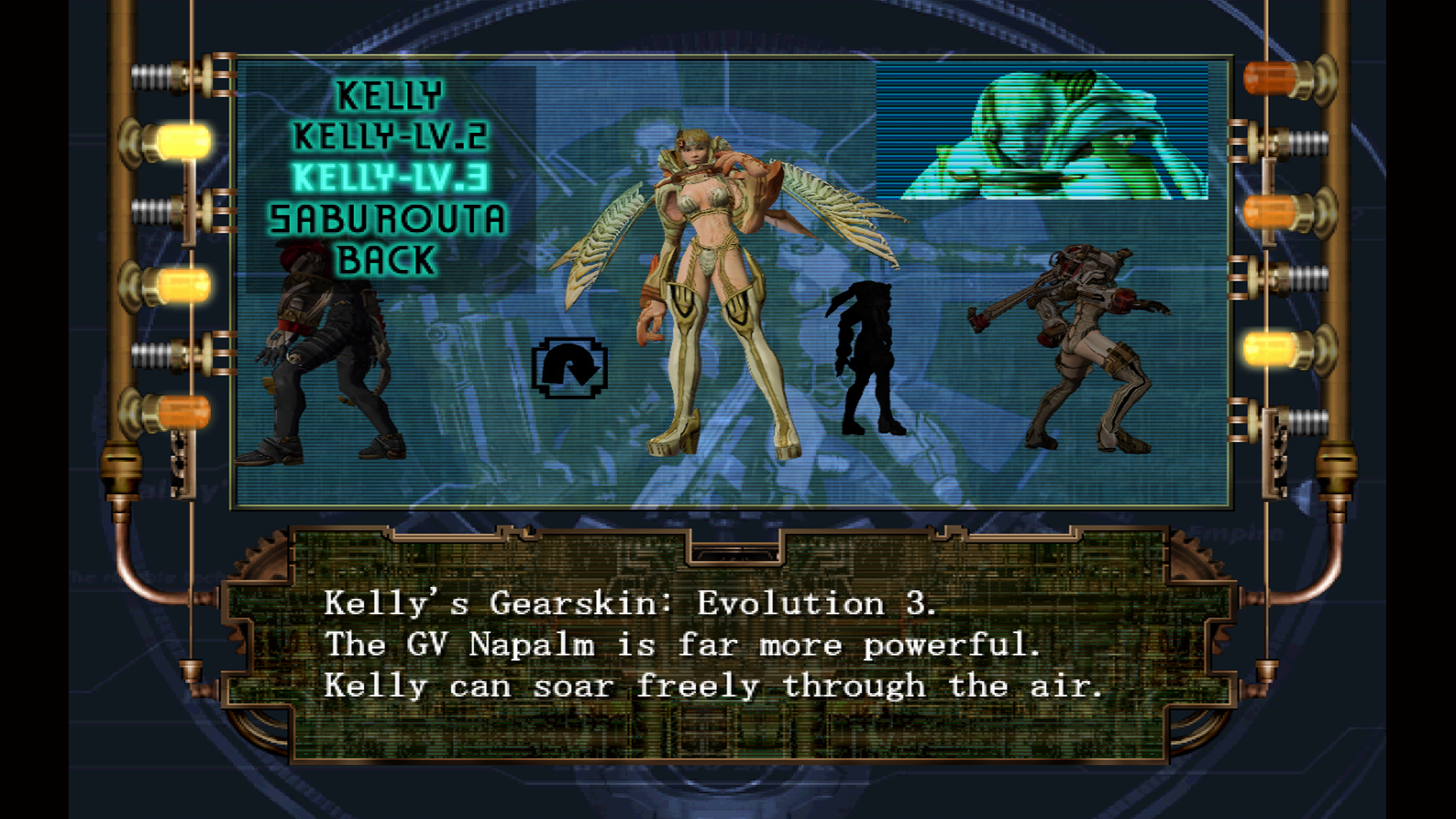
Let's start with the one you've gotta work for. As you play through the game, you'll defeat Niddhogg and unleash the potential of Kelly's Gearskin, upgrading her to Level 2 and allowing her to use the Meteor Crash. However, that's not her true potential, as there is a Level 3 Gearskin available. To get it, collect all 10 hidden Halley Cores in one run of the main game without missing any. There's one hidden in each non-boss stage (each boss fight gives you one once you defeat the boss) and if you've collected all the previous ones, finding the one in Yggdrasil 2 triggers a cutscene where Kelly's Gearskin evolves again to Level 3, taking on an angelic appearance and bestowing great power upon her. Once you start a Meteor Crash in this suit, you'll have the damaging properties of the dash permanently on until you run of out GV Napalm Fuel, land or tap Jump while in the air. It's a little broken, a nice reward for going out of your way to find those Cores.

The other two are things you unlock just by playing the game. First, to unlock Challenge Mode, beat the game, simple as that. It'll be below Options on the main menu, and as the name suggests, you can rechallenge any stage in the game, including boss fights, and this has a few exclusive features. It seems you're granted all extra upgrades for characters meaning stronger weapons and one extra 'life' per stage, plus you can select freely from Kelly (both Level 1 and 2, as well as 3 if you've unlocked it in any save file) and Saburouta, even on the stages he isn't normally allowed to visit. This is the mode you'll want to master all the stages and get those ranks up, and it shares the high score tables from the main game, so aim for the top!


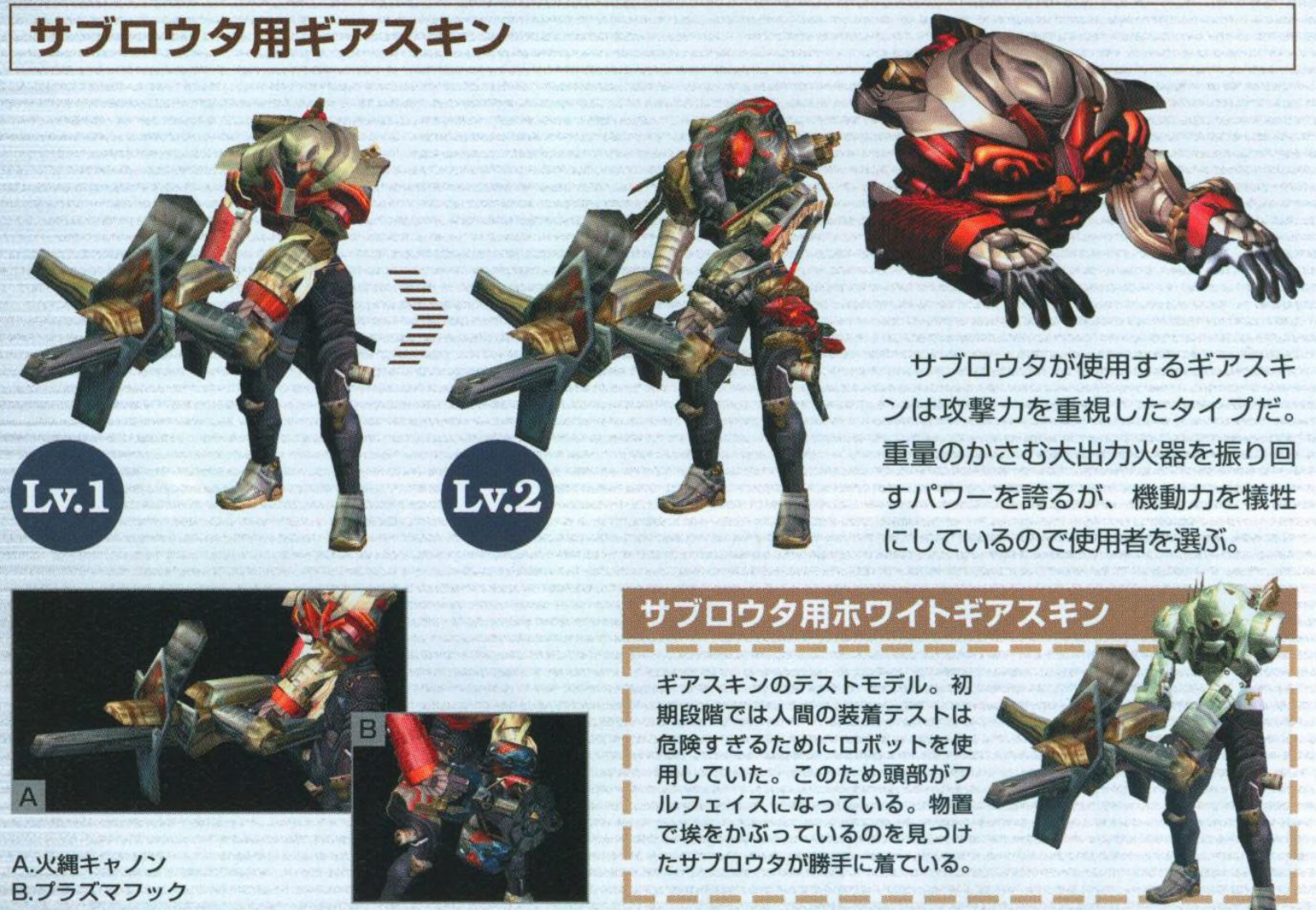
This is also where another secret lies, one that's been undocumented on the internet but I found in the Japanese Gunvalkyrie Perfect Guide Book and, after messing it up a lot, figured out so here you are (and I put it up on GameFAQs under an old account, so you're welcome, internet). That guide explains that while Saburouta never gets the mid-story upgrades to his Gearskin like Kelly does, he does have two extra Gearskin- a Level 2 suit and a 'prototype' Gearskin that he found in a warehouse and put on without permission (that's really the explanation in there, and might be a little joke as it looks a lot like the Gearskin seen in trailers for the Dreamcast version)- that require button codes to use. Unlike the different versions of Kelly's Gearskin, these don't change anything about how Saburouta plays, they're just a visual extra. We've got pictures below, hover your mouse over them to compare with the original Gearskin.

Select Saburouta in Challenge Mode and on the 'Send to insertion point?' prompt, hold in both the L and R shoulder buttons and press Up, X, Right, X, Down, X, Left, A
to use his Level 2 Gearskin.


LEVEL 2 GEARSKIN
View


Select Saburouta in Challenge Mode and on the 'Send to insertion point?' prompt, hold in both the L and R shoulder buttons and press Up, Y, Right, Y, Down, Y, Left, A
to use the Prototype Gearskin.


PROTOTYPE GEARSKIN
View


Before we wrap up here, there's one thing we couldn't quite solve ourselves. Maybe you can help?


A cheat listed on GameFAQs appears to be mostly bunk, but maybe there's something I'm not getting. Contributed by holyvision who also wrote the S-Rank Guide for the game, it says that if you destroy all the light fixtures in Citizen Base 1, you can then use a Meteor Crash to bust through a particular door in the stage and find a room with developer pictures in it. I tried this a few times with a few different characters and couldn't get anywhere with it, trying to Meteor Crash through multiple doors after making sure no lights were left standing with no luck. There's even this video by Easter Egg Archive trying to find the room with no results. Is this a wild goose chase? Does the developer room really exist? If you know, please tell us!


This is probably a good choice for Gaming Hell's first Xbox game, right?

Only took us, what, 18 years? We'll get to the Wii U in like 2049. If you're lucky.